

Last Updated: July 2026
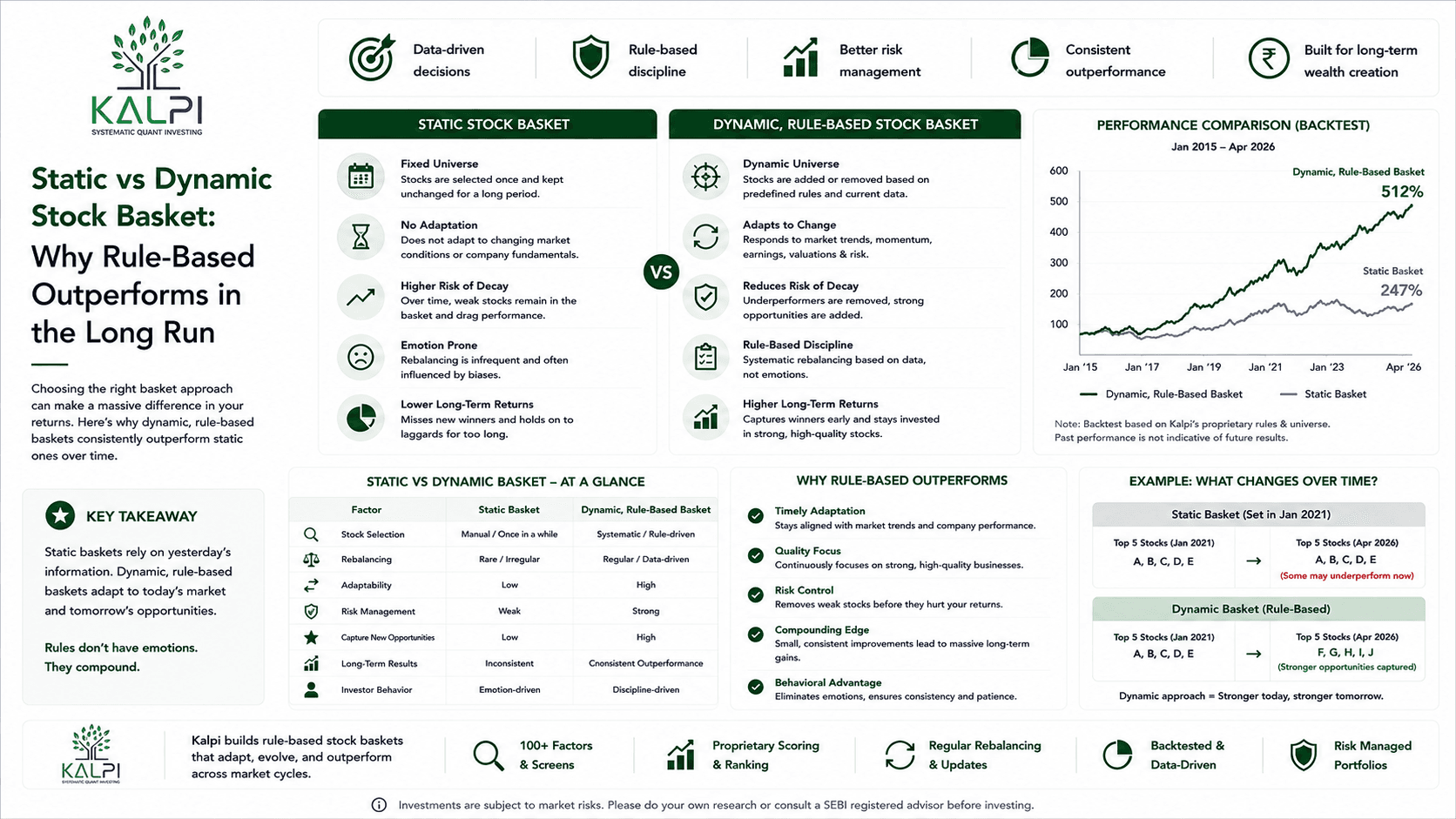
A dynamic stock basket follows predefined rules to update its holdings as market conditions change, while a static basket usually stays the same after it is built. Over time, a rule-based portfolio can adapt to shifting business performance and market trends, helping investors avoid holding companies that no longer deserve a place in the portfolio. The static vs dynamic basket choice depends on your investing style, but many investors lean towards a rules-based approach because it brings consistency and keeps emotion out of the process.
Why Do Some Portfolios Keep Growing While Others Slow Down?
Picture two people planting a small garden. The first plants flowers, waters them once, and then forgets about the whole thing. A few months in, weeds have taken over, some plants have dried up, and others just are not growing the way they used to.
The second person checks in every few weeks. They pull out weeds, trim the unhealthy branches and swap out weak plants for stronger ones whenever it is needed. The garden keeps changing, but it also stays healthy.
Investing often plays out the same way. Plenty of people spend weeks researching companies before putting money in, and once the portfolio is built, they rarely look at it again because they assume the hard part is done.
Markets do not stop moving just because you have stopped watching. Businesses expand, industries evolve, customer preferences shift and new competitors show up. A portfolio that looked solid two years ago might not look nearly as strong today.
This is exactly where the static vs dynamic basket question starts to matter. One approach sticks to the same path for years. The other checks itself against predefined rules whenever market conditions shift. Neither guarantees higher returns, but understanding how each one works can help you make smarter long-term calls.
What Is a Static Stock Basket?
A static stock basket does exactly what it sounds like. An investor picks a group of companies and keeps holding them without making regular changes.
Some investors only look at their portfolio once every few years. Others step in only when something feels seriously wrong. This approach is simple and needs very little upkeep. For investors who strongly believe in the businesses they own, a static basket often feels comfortable, since there are fewer decisions to make along the way.
But businesses keep changing even when the portfolio does not. A company that was growing fast a few years back may now be dealing with slower sales, tougher competition or shifting customer demand. If the portfolio never adjusts, some of these companies can end up dragging down overall performance instead of adding to it.
None of this makes a static basket a bad choice on its own. It just means the investor is leaning more on patience than on regular reviews.
What Is a Dynamic Stock Basket?
A dynamic stock basket takes a different route. Instead of assuming today’s strongest companies will keep leading forever, it works on the assumption that market leadership changes over time.
The key part is that changes are never made randomly. Adjustments only happen when predefined investment rules flag that a review is needed. Those rules typically look at factors such as:
- Business performance
- Earnings growth
- Relative strength
- Momentum
- Valuation
- Risk management
Because every decision follows the same process, emotion has far less room to creep in. Instead of reacting to rumours or whatever is trending on social media, investors lean on a structured framework.
Think about your phone. You install software updates whenever they show up. The phone still does the same basic things, but those updates improve performance and iron out problems behind the scenes. A dynamic basket works on a similar idea. Its purpose stays the same, but the holdings can change whenever the rules point to a stronger combination of companies being available.
That is one reason many investors prefer building a rule-based portfolio instead of relying purely on their own judgement.
There is a football angle here too. A coach does not swap out players after every single match, but no player keeps their spot in the starting eleven forever just because they did well once. If someone else keeps delivering better performances, the coach makes the change. It is a decision built on performance, not personal preference. A dynamic stock basket works on that same principle, reviewing companies against predefined rules instead of gut feeling.

Tracking cumulative performance against a benchmark shows how a portfolio actually behaves over time, which is the kind of data a rule-based review relies on.
Why Markets Keep Changing
One of the biggest assumptions new investors make is believing today’s market leaders will keep leading for years to come. Look back at past market cycles and a different pattern shows up instead.
Industries move through different phases of growth. Some sectors do well when the economy is expanding, others hold up better during uncertain stretches. Technology changes. Consumer preferences change. Government policy changes. Interest rates change.
As all of this shifts, businesses respond differently. Some companies adapt fast, others struggle to keep up. This constant movement is exactly why many investors believe portfolios deserve a periodic look instead of staying frozen for years.
Reviewing a portfolio does not mean trading every month. It simply means accepting that markets keep moving even when your holdings stay the same.
Static vs Dynamic Basket: A Quick Comparison
Both approaches aim to build wealth over time. The real difference shows up in what happens after the portfolio is created.
A static basket assumes the original selection will keep serving the investor well for years. A dynamic basket accepts that markets evolve and uses predefined rules to review holdings whenever it is warranted. Both have their place, and the better fit depends on how actively you want to manage your money and how much time you are willing to put into reviewing your portfolio.
Table 1: Static Basket vs Dynamic Basket
| Feature | Static Basket | Dynamic Basket |
|---|---|---|
| Portfolio changes | Rare | Based on predefined rules |
| Decision making | Mostly based on investor judgement | Based on a structured process |
| Portfolio review | Less frequent | Regularly reviewed according to rules |
| Flexibility | Limited | Adapts as market conditions change |
| Emotional influence | Higher | Lower because decisions follow predefined rules |
Why Rule-Based Investing Can Make a Difference
The biggest challenge in investing is rarely finding good companies. It is staying disciplined once markets turn unpredictable.
Plenty of investors know they should avoid emotional decisions, yet they still buy stocks after hearing exciting news or hold on to weak companies simply hoping prices will bounce back. A rule-based portfolio works differently. Instead of decisions driven by fear or excitement, it follows a predefined process.
A portfolio might only include companies that meet certain quality, momentum or risk criteria. If a company stops meeting those conditions, it gets reviewed and, if needed, replaced with a business that fits the strategy better. Following the same process over time helps investors sidestep a lot of emotional decisions, and that consistency is exactly why many long-term investors prefer rule-based investing over constantly reacting to headlines.
Smallcase vs Dynamic Basket
Many investors bring up Smallcase vs Dynamic Basket as though they are the same thing, but they are not quite that.
Smallcase is a platform offering investment baskets built around different themes and strategies. Some of these baskets stay almost unchanged for long stretches, while others get reviewed and updated regularly depending on their methodology.
A dynamic stock basket is not tied to any single platform. It is simply an approach where holdings change according to predefined rules instead of personal opinions. In other words, a dynamic basket can exist across different investment platforms, or even inside a portfolio you manage yourself. What matters is not where the basket lives, but whether the process behind it stays disciplined and consistent.

Rolling volatility comparisons like this help a rule-based portfolio judge whether risk is staying within acceptable limits over time.
Common Mistakes Investors Make
Even a well-designed strategy can disappoint if a few basic investing principles get ignored along the way.
Changing the strategy too often
Some investors keep hopping from one strategy to another. One year it is momentum, the next it is value investing, and a few months later they switch direction again after reading some market prediction. Jumping around like this makes it almost impossible to tell whether any single approach is actually working.
Ignoring portfolio reviews
A static portfolio does not mean forgetting about it forever. Markets and businesses keep evolving, and an occasional review helps confirm whether your original decisions still hold up.
Following popular opinion
Buying a stock just because everyone is talking about it rarely counts as a solid investment strategy. Popularity and business quality are not the same thing. Strong investment decisions usually come from research, not from market buzz.
Forgetting diversification
Whether you go static or dynamic, diversification still matters a great deal. Leaning too heavily on one company or one sector raises portfolio risk. Spreading investments across multiple businesses generally creates better balance when conditions shift.
There is another benefit to following predefined rules, and it shows up most when markets get shaky. When prices fall sharply, plenty of investors panic and make quick, regrettable decisions. A rule-based approach keeps investors anchored to their framework instead of reacting on impulse. No strategy removes risk completely, but having a clear process usually leads to steadier, more disciplined investing.
Table 2: Good Investing Habits for Long-Term Success
| Good Practice | Why It Helps |
|---|---|
| Follow a consistent investment process | Reduces emotional decision making |
| Review the portfolio regularly | Keeps investments aligned with changing markets |
| Diversify across sectors and companies | Reduces concentration risk |
| Focus on business quality | Supports long-term wealth creation |
| Stay patient | Helps avoid unnecessary buying and selling |
Final Thoughts
The static vs dynamic basket debate is not about crowning one approach as the winner for every investor. It comes down to understanding how each strategy fits different investing styles.
A static basket offers simplicity and asks for fewer decisions along the way. A dynamic stock basket offers more flexibility, responding to changing market conditions through a structured process instead of guesswork.
Many investors lean towards a rule-based portfolio because it swaps emotional decision making for consistency. Instead of reacting to headlines or short-term noise, every call follows the same framework. That said, no investment strategy wipes out risk completely. Building long-term wealth still comes down to understanding businesses, staying diversified and following a disciplined process across many years.
Whether you pick a static basket or a dynamic stock basket, consistency and patience usually matter far more than trying to predict every market move. Good investing rarely comes down to one perfect decision. It is about following a sensible process, checking in on your investments now and then, and staying the course through different market conditions.
Frequently Asked Questions
1. What is the difference between a static and dynamic stock basket?
A static basket usually stays unchanged after it is created, while a dynamic stock basket updates its holdings according to predefined investment rules.
2. What is a rule-based portfolio?
A rule-based portfolio follows a fixed investment methodology instead of relying on emotions, market rumours or short-term predictions.
3. Why do investors prefer dynamic stock baskets?
Many prefer them because they can adapt to changing market conditions while still following a disciplined investment process.
4. Is a dynamic basket always better than a static basket?
Not necessarily. The right choice depends on your investment goals, risk tolerance and how actively you want to manage your portfolio.
5. Is diversification important in both strategies?
Yes. Whether you choose a static or dynamic basket, diversification helps reduce risk and builds a more balanced portfolio overall.