

Last Updated: July 2026
A sector rotation strategy India is an approach where investors gradually shift their focus towards sectors showing improving business and market strength instead of spreading money equally across every industry. Rather than assuming the same sectors will always perform well, investors build a sector rotation basket by tracking changing market conditions, company performance and sector momentum. The goal is to stay aligned with where the market is showing sustained strength instead of relying on guesswork.
Why Do Some Sectors Suddenly Become the Market’s Favourite?
Watch the stock market for a while and one thing quickly stands out. The industries leading today’s rally are often different from the ones investors were discussing a few months ago.
At one point, banking companies dominate market conversations. Later, technology businesses start attracting attention. Then healthcare, defence or capital goods gradually move into focus. The names change, but the movement of money usually follows a pattern.
Investors rarely move their money into every part of the market at once. As business conditions improve in one area of the economy, attention naturally starts shifting towards sectors that look stronger. This changing leadership is one of the reasons many investors follow a sector rotation strategy India.
Instead of asking which stock might become the next multibagger, they ask a different question. Which sectors are already showing strength, and what is supporting that strength? Looking at the market this way helps investors understand why some industries keep attracting fresh money while others quietly move into the background.
What Is Sector Rotation?
Sector rotation is an investment strategy where investors gradually increase exposure to sectors showing improving strength while reducing exposure to sectors that look weaker.
The strategy rests on one practical observation. Market leadership keeps changing. No sector stays at the top forever. Banking, information technology, pharmaceuticals, automobiles, consumer businesses and manufacturing all respond differently as the economy shifts. As conditions change, leadership in the stock market changes with it.
Instead of expecting one sector to outperform every single year, investors following this approach regularly check where business performance is improving and where growth is starting to slow. That is the foundation of building a sector rotation basket.
Think of your favourite restaurant through the year. In winter, customers naturally order hot soups, tea and warm desserts more often. Once summer arrives, cold drinks, fresh juices and lighter meals become far more popular. The restaurant is still serving food. The chef has not forgotten how to cook winter dishes. Customer demand has simply moved with the season.
Markets behave in a surprisingly similar way. Different sectors attract investor attention during different phases of the economy, and money keeps flowing towards wherever growth and business performance look stronger at that moment.
Why Do Sectors Move in Cycles?
Many people believe sectors rise and fall without any clear reason. In reality, several factors are usually working together behind every major shift. Some of the most common ones include:
- Changes in interest rates
- Corporate earnings
- Government policies
- Economic growth
- Commodity prices
- Global developments
- Investor confidence
Higher infrastructure spending, for instance, can improve the outlook for capital goods companies. Growing demand for digital services can strengthen technology businesses. Lower borrowing costs often support banking and real estate. These factors rarely work in isolation. When business conditions improve, investors naturally start paying more attention to those sectors, and as more participation comes in, market leadership gradually begins to shift. This usually plays out over weeks or months, not overnight.
Understanding a Sector Rotation Basket
A sector rotation basket is a portfolio built around sectors that are currently showing stronger business performance and healthier market participation.
Instead of giving every industry equal weight, investors focus on areas where multiple companies are reporting better earnings, improving growth and stronger investor confidence. A basket right now might include companies from banking, information technology, capital goods, defence and pharmaceuticals. Six months later, the same portfolio could look quite different. If manufacturing starts slowing while consumer businesses report stronger numbers, the basket may gradually shift in that direction.
A sector that delivered the highest return recently is not automatically the best investment. What matters is whether that strength is backed by improving business performance or just short-term excitement. Before building a portfolio around sector rotation, it helps to understand how investors actually separate genuine strength from temporary momentum.

Tracking cumulative performance against a benchmark over time helps confirm whether a sector’s strength is holding up or fading.
How Do Investors Identify Strong Sectors?
Many people think sector rotation is just about buying whichever sector delivered the highest return recently. Experienced investors usually follow a far more structured approach.
A sector can move higher on a single announcement or a short burst of optimism. That alone does not mean it has entered a long stretch of strength. Before increasing exposure, investors generally look for signs that the improvement is backed by real business performance rather than temporary excitement. Some of the factors they commonly study include:
- Consistent earnings growth across companies in the sector
- Improving revenue trends
- Healthy price performance over a reasonable period
- Strong trading volume
- Institutional participation
- A positive business outlook
No single indicator tells the whole story. A sector may catch attention after a big government announcement, but if company earnings stay weak over the following quarters, that early enthusiasm fades fast.
A stronger signal shows up when improving earnings, healthier business conditions and rising investor participation all move in the same direction together. That combination usually gives investors far more confidence that the trend has real legs. This is why experienced investors spend more time understanding why a sector is doing well instead of just noticing that prices have gone up.
What Is a Sector Momentum Basket?
A sector momentum basket is a carefully chosen group of companies from sectors showing sustained strength over a period of time.
The goal here is not to cram in the largest number of stocks possible. The focus stays on picking quality businesses from industries where earnings, business performance and investor participation are all improving together. If banking, capital goods and information technology are all showing healthy momentum, the basket may include selected companies from each of these sectors instead of piling everything into one industry.
This gives investors exposure across different parts of the market while still sticking to the basic idea behind sector rotation. Markets keep changing, so the basket should not stay frozen forever. As some sectors gradually lose strength and others start improving, investors review the portfolio and decide whether any changes are genuinely needed, based on shifting market conditions rather than short-term noise.
A point many beginners overlook is how often changes should actually be made. Sector rotation does not mean rebuilding a portfolio every week. Markets move daily, but meaningful business changes usually take much longer to develop. Reviewing a portfolio every few days often just creates extra activity without improving the decisions behind it. Giving trends enough room to play out usually leads to a more balanced, disciplined process.
Sector rotation and traditional investing are not opposing approaches. They simply look at the market from different angles.
Table 1: Traditional Investing vs Sector Rotation
| Feature | Traditional Investing | Sector Rotation Investing |
|---|---|---|
| Primary focus | Individual company selection | Sector strength along with company quality |
| Portfolio review | Less frequent | Based on changing market conditions |
| Investment approach | Long-term allocation | Periodic adjustment when sector leadership changes |
| Decision making | Company fundamentals | Fundamentals supported by sector trends |
| Main objective | Long-term wealth creation | Participate in changing market leadership while maintaining diversification |
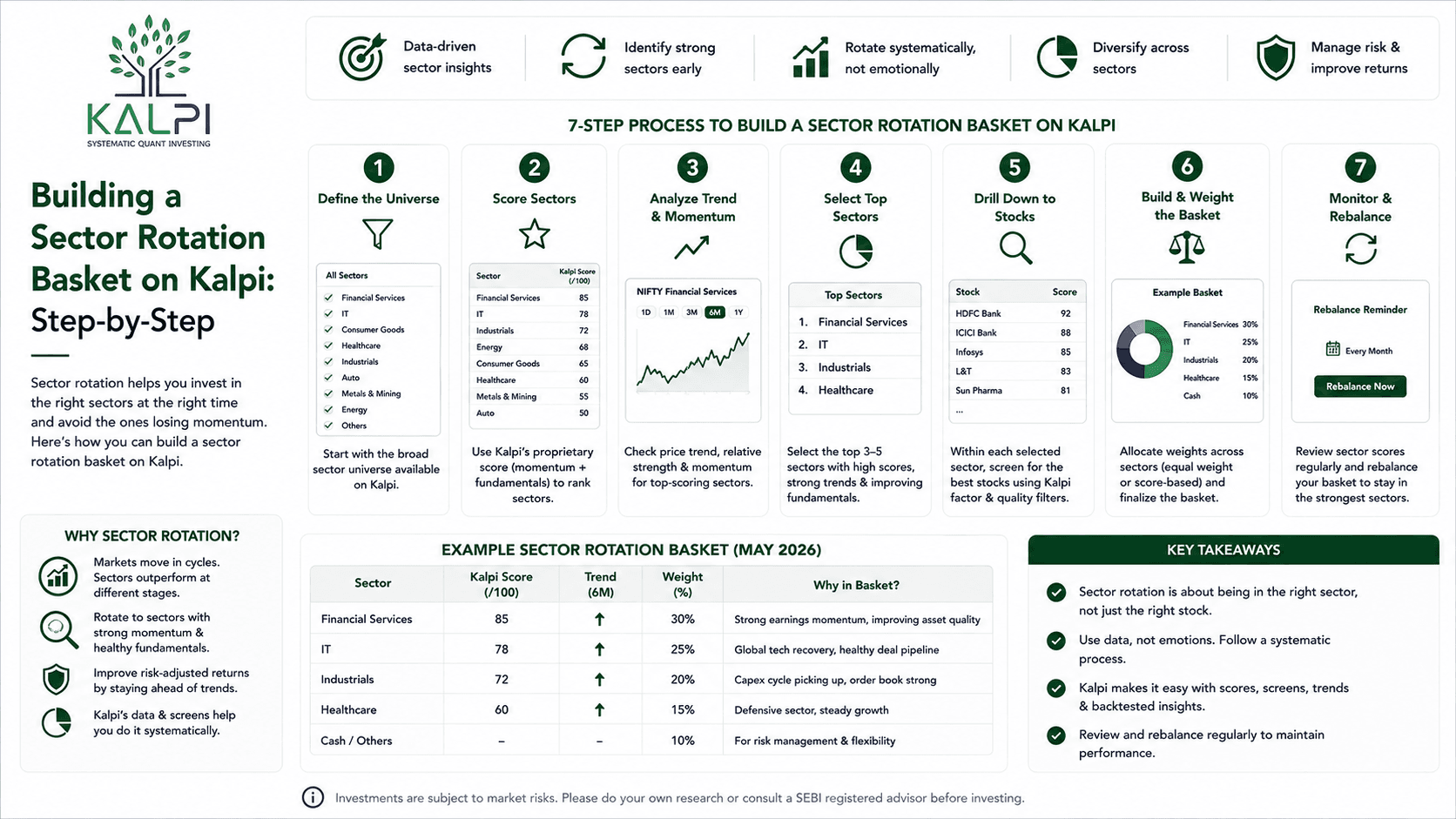
Building a Sector Rotation Basket on Kalpi
Understanding sector rotation is only the first step. The real value shows up once you apply it through a clear, repeatable process. Many beginners think they need complicated charts or advanced indicators to build a sector rotation basket. In reality, the process can be much simpler. Consistency matters far more than complexity.
Step 1: Look at the broader market first
Before picking individual stocks, spend time understanding how different sectors have performed over the last few months. Instead of asking which stock gave the highest return this week, try asking which sectors are reporting stronger earnings, where revenue growth is improving, which industries are benefiting from current economic conditions, and where institutional investors are increasing their participation. Looking at the market this way helps you spot where business strength is actually building instead of reacting to short-term price swings.
Step 2: Shortlist sectors showing steady strength
After studying the market, put together a shortlist of sectors that keep showing positive business trends.
This is where a lot of investors slip up. They assume the sector with the biggest recent gain must also be the strongest opportunity. That is not always true. A sudden price jump can happen because of one positive announcement or a burst of market excitement. Genuinely strong sectors usually show something more meaningful, where company earnings improve, business activity stays healthy and investor confidence keeps building over time. Learning how to rotate sectors is not about chasing whatever is making headlines. It is about recognising where strength is turning consistent rather than staying temporary.
Step 3: Choose quality companies
A strong sector still has both strong and weak businesses sitting inside it. That is why picking individual companies still matters a great deal.
Before adding a stock to your portfolio, spend a little time reviewing its financials. Is the company reporting consistent earnings? Is revenue growing steadily? Does it manage debt sensibly? Is the business financially sound overall? Choosing companies with solid fundamentals gives your portfolio a much stronger base than relying on sector performance alone.
Step 4: Build a balanced sector momentum basket
A common mistake is putting most of your money into a single sector just because it is performing well right now. A balanced sector momentum basket usually works better.
If banking, capital goods, information technology and healthcare are all showing healthy strength, spreading your investments across these sectors can cut down unnecessary concentration risk. Nobody knows for certain which sector will lead six months from now, and diversification is what prepares your portfolio for that uncertainty.
Step 5: Review instead of reacting
Markets change every single day. That does not mean your portfolio needs to change every day too. Business performance usually shifts gradually, not overnight.
Instead of making frequent adjustments after every market move, review your portfolio at regular intervals. Many investors find that a structured review process leads to better decisions than reacting to every headline or short-term price swing. Sometimes, after reviewing the portfolio, the best decision is to change nothing at all. A disciplined investment process is often quieter than people expect, built on observation, patience and consistency rather than constant buying and selling.

Setting a fixed review frequency, rather than reacting to every market move, keeps a sector rotation basket disciplined instead of reactive.
Mistakes That Can Weaken Your Portfolio
Building a good portfolio takes time, but a few common mistakes can quietly reduce how effective it is. Most of these happen when decisions are driven by emotion instead of a clear process.
Buying a sector after it has already become popular
When a sector dominates news headlines and social media, many investors feel they are missing out. By that point, a large part of the move may already be behind them. Instead of following the crowd, spend time checking whether the sector is still backed by improving earnings, business growth and healthy market participation.
Ignoring company quality
A strong sector does not automatically make every company in it a good investment. Two companies in the same industry can deliver very different financial results. Looking at earnings, debt, cash flow and management quality matters just as much as studying the sector itself.
Making changes too frequently
One of the biggest misunderstandings about how to rotate sectors is thinking portfolios need constant updates. In reality, business conditions usually shift gradually. Reviewing the portfolio at regular intervals tends to lead to better decisions than reacting to every short-term market move.
Investing too heavily in one sector
Even when one industry looks attractive, putting most of your money into that single area raises your risk. A portfolio spread across multiple strong sectors is generally better prepared for changing market conditions.
Table 2: Habits That Support Better Sector Rotation
| Good Practice | What to Avoid |
|---|---|
| Study business fundamentals along with sector trends | Buying only because a sector is popular |
| Diversify across strong sectors | Investing most of your money in one industry |
| Review the portfolio periodically | Making changes after every market move |
| Focus on long-term business strength | Depending only on short-term price movements |
| Follow a consistent investment process | Making emotional decisions |
Final Thoughts
A sector rotation strategy India rests on a simple idea. Different sectors perform well at different stages of the market, and investors should be willing to recognise those changes instead of assuming the same industries will always lead.
That does not mean changing your portfolio every few weeks or chasing whichever sector delivered the highest recent return. A better approach is to study business performance, understand market trends and review your investments with patience. A well-built sector rotation basket is designed to adapt as market leadership changes while staying diversified throughout.
If you are creating a sector momentum basket, remember that no strategy guarantees success in every market. A structured process, followed consistently, tends to improve the quality of your decisions far more than reacting to short-term noise. Over time, consistency usually matters more than making frequent changes.
Frequently Asked Questions
1. What is a sector rotation strategy?
A sector rotation strategy is an investment approach where investors gradually shift their portfolio towards sectors showing stronger business and market performance while reducing exposure to sectors that appear weaker.
2. How do I build a sector rotation basket?
Start by studying sector performance, company earnings, business trends and investor participation. Then select quality companies from sectors showing consistent strength while maintaining diversification.
3. How often should a sector rotation basket be reviewed?
There is no fixed schedule. Many investors review their portfolio periodically and make changes only when business conditions or sector leadership shift meaningfully.
4. Is sector rotation suitable for beginners?
Yes. Beginners can follow this approach, but they should combine sector analysis with company fundamentals and avoid making frequent portfolio changes based on short-term market movements.
5. What is the difference between a sector rotation basket and a sector mutual fund?
A sector rotation basket lets investors build and review their own selection of companies across sectors, while a sector mutual fund is managed by a professional fund manager and follows its own investment mandate.