

Last Updated: July 2026
The P/E ratio, short for Price-to-Earnings ratio, is one of the first numbers investors run into while sizing up a stock. It compares a company’s share price with its earnings per share (EPS) to show how much investors are paying for every rupee of profit. Use it well and it can help you compare companies fairly. Lean on it alone, though, and you can end up making a poor call.
Most people stumble onto the P/E ratio within their first week in the market. It’s easy to calculate, easy to compare, and just as easy to get wrong.
Think about two restaurants on the same street. One always has a queue snaking out the door, the other has empty tables most evenings. Most people would guess the crowded one serves better food, but that’s not always the case. The busy restaurant might just be more popular, while the quiet one could be dishing out better food at a lower price.
Stocks behave the same way. Some companies trade at a high Price-to-Earnings ratio, others at a much lower one, and the number alone rarely tells you why. Figuring out why the market has priced a company that way matters a lot more than the number itself.
What Is the P/E Ratio?
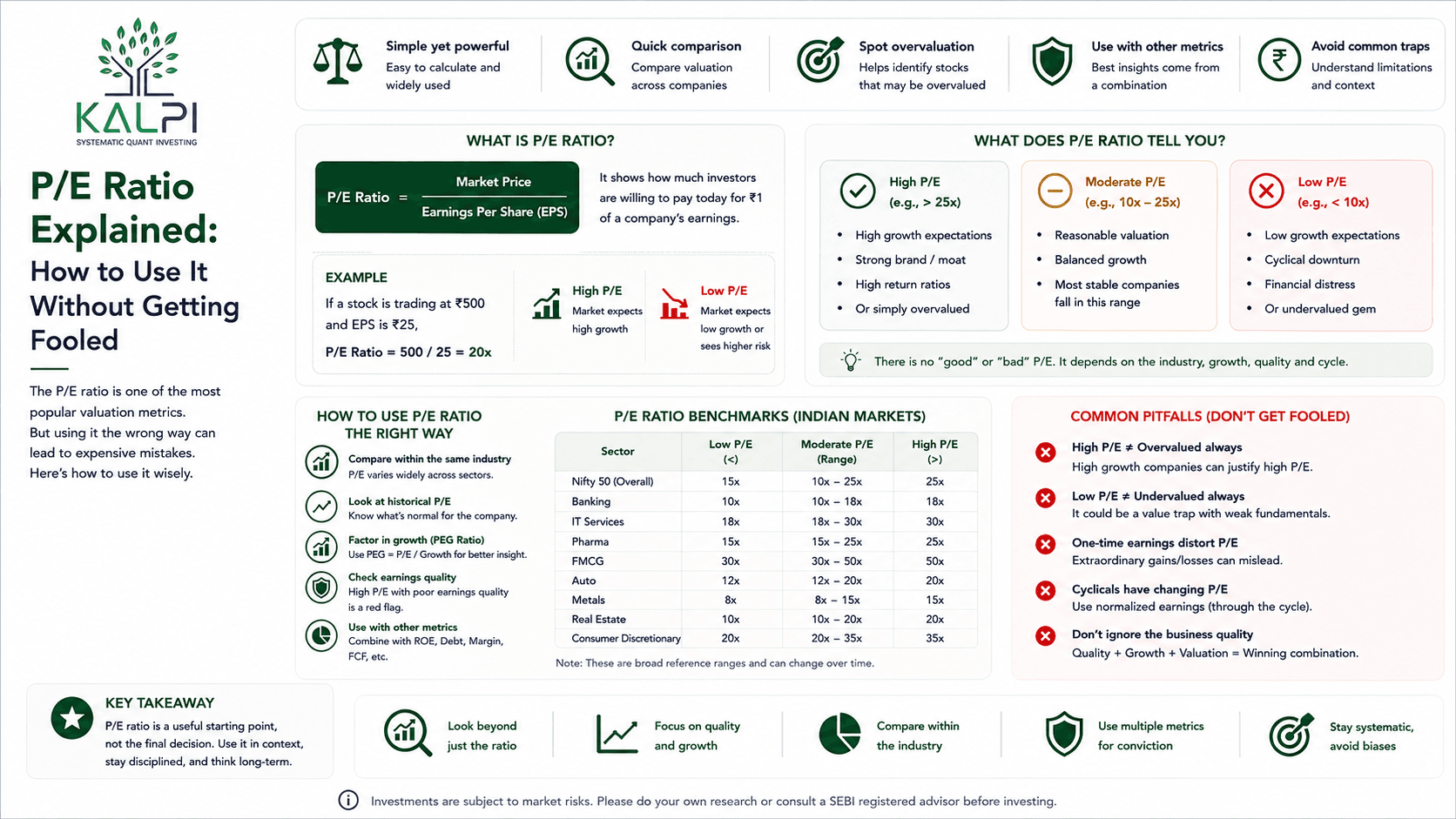
The P/E ratio, or Price-to-Earnings ratio, compares a company’s current share price with its earnings per share (EPS). The formula is short and simple.
P/E Ratio = Share Price ÷ Earnings Per Share (EPS)
Say a company’s share price sits at ₹400 and its earnings per share come to ₹20. Its P/E ratio would work out to:
400 ÷ 20 = 20
That means investors are currently paying ₹20 for every ₹1 the company earns in a year.
The ratio can’t tell you where a stock is headed next. It just shows how the market is valuing the company’s earnings right now, nothing more.
Why Do Investors Use the P/E Ratio?
The biggest thing the P/E ratio has going for it is that it makes comparing companies a lot easier.
Looking at price alone can trip you up. A ₹3,000 share isn’t automatically expensive, and a ₹300 share isn’t automatically a bargain.
Say Company A trades at ₹3,000 but earns ₹200 per share every year. Company B trades at ₹300 but earns just ₹5 per share. Company A has the higher sticker price, sure, but it could actually be offering better value once you look at earnings.
This is why seasoned investors rarely judge a company on price alone. They also check how much profit they’re actually getting for what they pay.
Does a Low P/E Ratio Mean a Stock Is Cheap?
Not necessarily.
Plenty of beginners go hunting for low PE stocks India, assuming they’ve stumbled onto a bargain. Sometimes they have. More often, they haven’t.
A stock can trade at a low P/E ratio for reasons like these:
- Earnings are expected to decline
- The business is dealing with operational trouble
- Investor confidence has taken a hit
- Growth has slowed down considerably
In other words, the market may already be pricing in problems that aren’t obvious at first glance.
A low P/E ratio can be a genuine opportunity, but it can just as easily be a warning sign in disguise.

Digging into rolling alpha and idiosyncratic risk shows why a single valuation number like P/E rarely tells the whole story on its own.
Does a High P/E Ratio Mean a Stock Is Expensive?
Again, not always.
Companies with strong growth prospects often trade at higher P/E ratios simply because investors expect their profits to keep climbing over the next few years.
Technology companies, consumer brands and other fast-growing businesses regularly command richer valuations than mature, slow-moving industries.
Paying a higher multiple can still make sense if the company keeps growing its earnings steadily year after year.
Instead of asking whether the P/E ratio looks high or low, a better question to ask is this. Does the company’s future growth actually justify what you’re paying for it today?
| Situation | Possible Meaning |
|---|---|
| Low P/E Ratio | Undervalued or facing business challenges |
| Average P/E Ratio | Fairly valued |
| High P/E Ratio | Strong growth expectations or expensive valuation |
Why Comparing P/E Ratios Can Be Misleading
One of the biggest mistakes investors make is comparing companies from completely different industries.
Picture an airline sitting next to a software company. Their business models, cost structures, profit margins and growth rates have almost nothing in common. Naturally, their P/E ratios won’t line up either.
The same trap shows up while analysing Nifty 50 companies. Comparing a bank against an IT company or an FMCG business rarely leads anywhere useful.
A far better approach is sticking to companies within the same industry that follow similar business models. That makes the comparison mean something.

Breaking down what actually drives a portfolio’s risk each year shows why earnings quality and business context matter more than a single ratio.
Don’t Stop at the P/E Ratio
The P/E ratio is a useful starting point, but it never tells the whole story on its own.
Before putting your money in, it’s worth checking a few other things too:
- Revenue growth
- Profit growth
- Debt levels
- Return on Equity (ROE)
- Cash flow
- Industry outlook
- Management quality
Think about buying a house. You would never sign off on a deal based only on the price tag. You’d also check the location, the construction quality, the neighbourhood, and what’s coming up in the area down the line.
Stocks deserve that same level of scrutiny.
Common Mistakes Investors Make
The P/E ratio is simple, and that simplicity is exactly why it gets misused so often.
Some of the most common slip-ups include:
- Buying every low P/E stock without figuring out why it’s cheap
- Assuming every high P/E stock must be overvalued
- Comparing companies from unrelated industries
- Ignoring future earnings growth
- Leaning on just one financial metric while investing
Treat the P/E ratio as the start of your homework, not the final verdict.
Final Thoughts
The P/E ratio remains one of the simplest ways to gauge whether a stock looks expensive or cheap relative to its earnings. But it has real limits too. A low P/E ratio isn’t always a bargain, and a high P/E ratio isn’t always a red flag.
The sharpest investors never use the P/E ratio in isolation. They compare it against similar companies, dig into the business, weigh future growth prospects, and only then decide whether the valuation actually makes sense.
Used this way, the Price-to-Earnings ratio turns into a genuinely helpful guide instead of a shortcut that leads you astray.
Frequently Asked Questions
1. What is the P/E ratio?
The P/E ratio compares a company’s share price with its earnings per share and shows how much investors are paying for every rupee of earnings.
2. What is a good P/E ratio?
There’s no fixed ideal number. A good P/E ratio depends on the company’s industry, growth rate and future earnings expectations.
3. Are low PE stocks India always good investments?
No. Some low P/E stocks may genuinely be undervalued, while others may be carrying weak fundamentals or slowing business growth.
4. Can the P/E ratio be used for Nifty 50 companies?
Yes. It works well for comparing companies within the same sector of the Nifty 50, rather than comparing unrelated industries against each other.
5. Should investors rely only on the Price-to-Earnings ratio?
No. The P/E ratio should always be used alongside other financial metrics such as revenue growth, debt, cash flow and return on equity before making investment decisions.