

LAST UPDATED:JULY2026
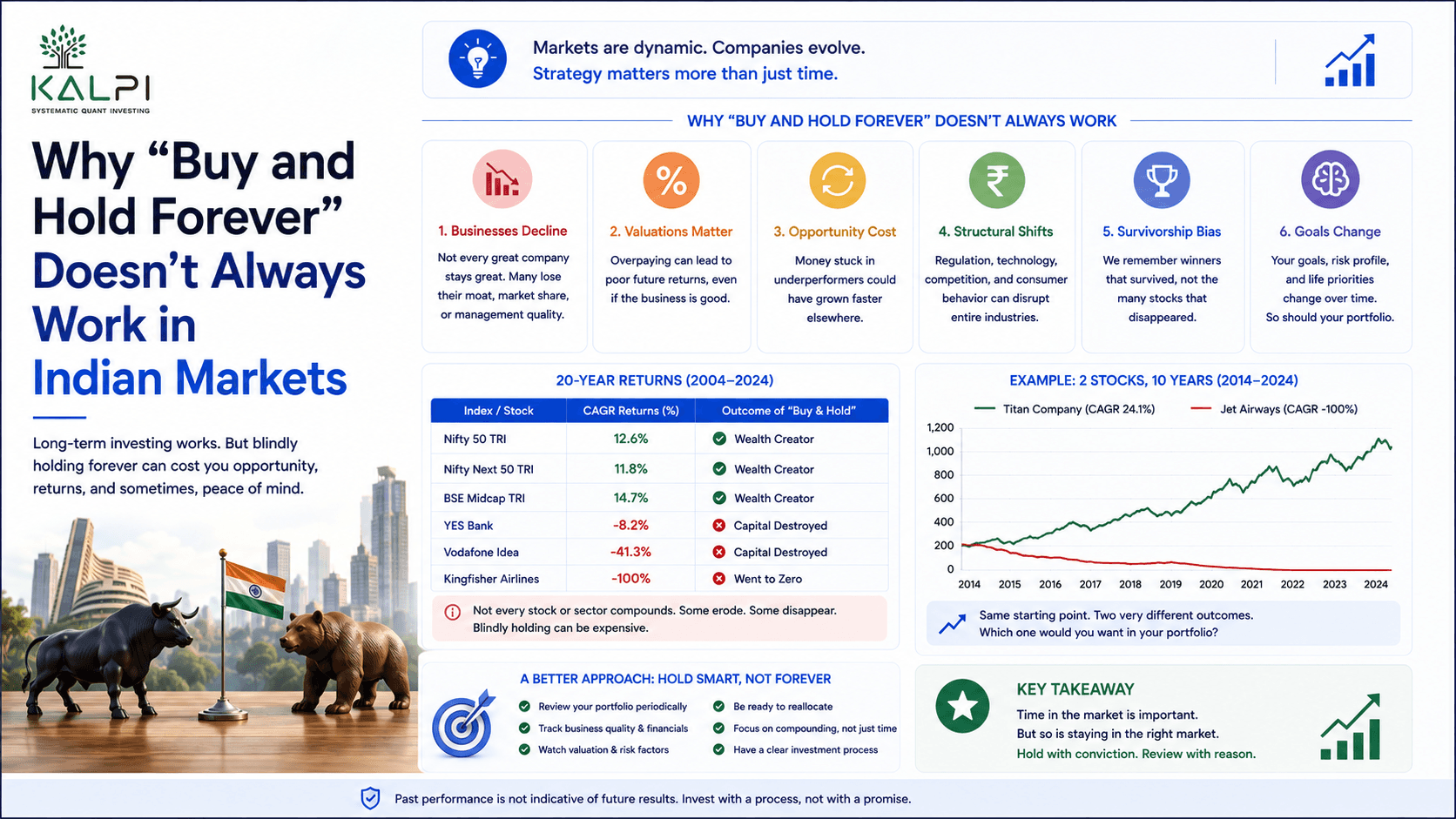
Many investors believe buying a good stock and holding it forever is the safest way to build wealth. This approach has worked well in plenty of cases, but it does not suit every company or every market cycle. Successful long-term investing in India is not about ignoring your portfolio. It is about reviewing it at the right time while staying focused on your long-term goals.
The Advice Everyone Hears First
If you’ve spent even a few weeks learning about investing, you’ve probably come across this line: buy great companies and never sell.
It sounds simple, and that’s exactly why so many investors follow it without question.
The idea behind the buy and hold strategy is that strong businesses keep growing over time. Instead of reacting to every market correction, investors stay patient and let compounding do the work.
There’s real truth in this. Plenty of successful investors have built wealth by staying invested for years instead of chasing short-term price swings.
But one word in that advice tends to get ignored. Forever.
Businesses are not permanent. Some companies keep improving every year, while others slowly lose their edge. Industries evolve, customer preferences shift, technology moves fast, and new competitors show up. A company that looked unbeatable a decade ago may not hold the same position today.
This is usually where investors start to feel that buy and hold doesn’t work.
The reality is a bit different. Buying and holding a quality business isn’t the problem. The trouble starts when you hold every business forever without ever checking whether it still deserves a spot in your portfolio.
Think about owning a car. Buying a reliable one doesn’t mean you skip servicing it. Even the best vehicles need regular checks to make sure everything’s working the way it should. Most of the time, the mechanic just confirms the car is fine. Every now and then, a small issue gets caught before it turns into an expensive repair.
Investing works the same way. Reviewing your portfolio doesn’t mean you’re planning to sell everything. It just means checking whether your investments are still heading in the right direction.
What Buy and Hold Actually Means
The traditional buy and hold strategy encourages investors to buy good businesses and stay invested through short-term market volatility.
This helps investors sidestep emotional decisions driven by fear or excitement. Instead of obsessing over daily price moves, they stay focused on how the underlying business is growing.
But patience should never be mistaken for neglect.
Long-term investing doesn’t mean forgetting about your portfolio the moment you buy something. It means giving quality businesses enough time to grow, while checking every so often whether your original reasons for investing still hold up.
A disciplined investor reviews facts. An emotional investor reacts to prices. Those are two very different approaches, even though they can look similar from the outside.
Why “Forever” Can Become Risky
The Indian market today looks very different from what it was ten or fifteen years ago. New industries have shown up. Consumer behaviour has changed. Digital businesses have reshaped entire sectors.
Because of this, long-term investing India requires investors to stay reasonably informed about the businesses they hold. Reviewing a company once or twice a year doesn’t make you a trader. It makes you a responsible investor.
Before you decide to keep holding a stock, ask yourself a few simple questions.
- Is the business still growing steadily?
- Has management continued making sensible decisions?
- Has debt increased significantly?
- Would I still buy this company today if I didn’t already own it?
These questions help separate emotional attachment from rational investing, and that separation matters more than most beginners realise.
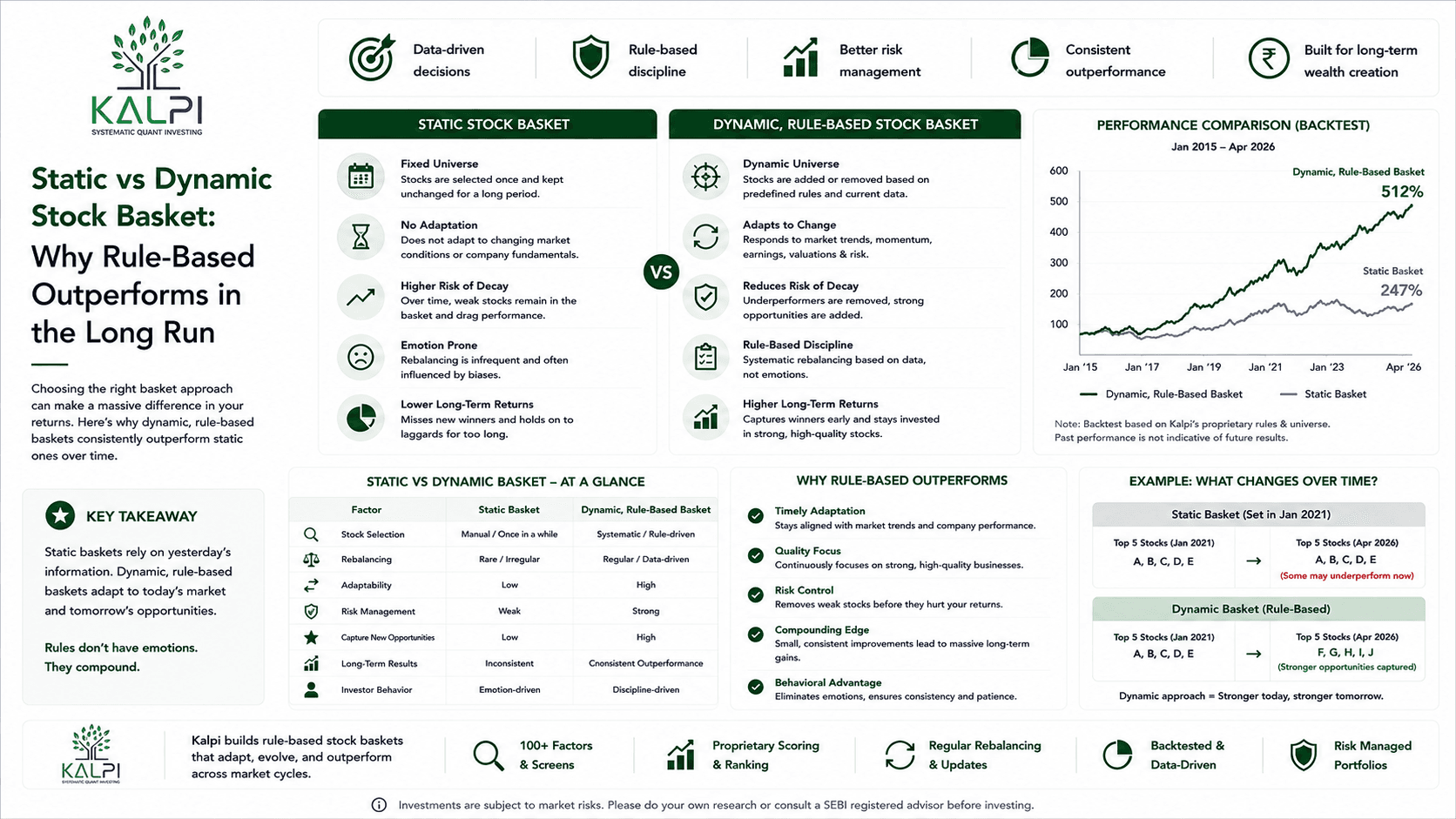
Traditional Buy and Hold vs Rule-Based Investing
| Traditional Buy and Hold | Rule-Based Investing |
| Buy and rarely review the business | Buy and review the business periodically |
| Focuses mainly on patience | Combines patience with discipline |
| May overlook changing fundamentals | Decisions are based on updated business performance |
| Higher risk of holding weak businesses too long | Encourages timely portfolio reviews |
| Relies on hope that every company stays strong | Accepts that businesses and industries evolve |
The goal here isn’t to sell frequently. The goal is to keep holding businesses that deserve your confidence, while noticing when circumstances have genuinely changed.
Understanding that difference is the first real step towards becoming a better investor.
Why Rule-Based Investing Is Becoming More Popular
If buying and holding forever isn’t always the answer, does that mean investors should just keep buying and selling? Not really.
Investing isn’t a choice between holding forever and trading every week. The real goal is finding a disciplined middle ground where decisions come from facts instead of emotions.
Frequent trading brings its own problems. Costs pile up, emotions take over, and investors often end up reacting to short-term noise instead of focusing on business quality.
This is where the discussion around rule-based versus buy and hold becomes genuinely useful.
A rule-based investor doesn’t sell just because a stock falls 10% or jumps 20%. Every decision follows a predefined process instead.
That process might include things like:
- A significant decline in business fundamentals
- A sharp increase in debt levels
- Weak earnings growth over multiple quarters
- Major changes in industry outlook
- Portfolio allocation drifting far beyond its target
The decision comes from evidence, not emotion.
Why Emotions Often Hurt Investment Returns
Finding good companies is only half the job. Managing your own emotions is just as important.
When markets rise sharply, investors tend to get overconfident and start believing every decision will work out. During corrections, fear takes over and people end up selling quality businesses simply because prices have dropped.
Both situations quietly damage long-term returns.
Picture driving on a long highway. You don’t yank the steering wheel every time the road bends slightly. But you also don’t lock it in place and refuse to adjust for the whole trip. You make small corrections only when they’re actually needed.
Investing works much the same way. Ignoring every market wobble is sensible. Ignoring every real change in the business is not.
A disciplined review process helps investors stay focused without getting swept up emotionally.
Long-Term Investing Still Works
None of this means long-term investing is a flawed idea. Long-term investing India has helped countless investors build real wealth over the years.
The important part is understanding what long term actually means.
Long-term investing means giving a strong business enough time to grow. It doesn’t mean refusing to notice when the business itself has changed.
Patient investing and passive investing aren’t always the same thing. A patient investor keeps reviewing the business while letting compounding do its work. A passive investor might keep holding purely out of an old belief, even after the original reasons for investing have disappeared.
That difference sounds small on paper, but it can matter a lot over the long run.

Comparing portfolio performance against the benchmark over a decade or more, rather than a few weeks, is what genuinely long-term investing looks like in practice.
When Should Investors Review Their Holdings
Reviewing your portfolio doesn’t need to be a monthly ritual. For most retail investors, checking in once or twice a year is usually enough, unless something significant has changed.
It’s also worth reviewing your holdings after specific events, such as:
- Annual financial results
- Major management changes
- Significant industry disruptions
- Large mergers or acquisitions
- Changes in your own financial goals
The goal isn’t to predict market movements. The goal is simply to confirm that your original investment thesis still holds true.
The Goal Is Better Decisions, Not More Decisions
A lot of investors assume successful investing means constant action. In reality, experienced investors usually do the opposite.
They stay patient most of the time. When they do act, it’s because the facts have changed, not because the market got noisy.
This is why many investors today blend the strengths of the traditional buy and hold strategy with a disciplined review process. Instead of blindly holding every investment forever, they periodically ask themselves one simple question:
If I didn’t already own this company today, would I still buy it?
That single question shifts the focus back to business quality instead of your past purchase decision. It removes the emotional attachment and brings you back to facts instead of memories.
When Should You Continue Holding a Stock
After all this, you might wonder whether every stock now needs constant reviewing and selling the moment something changes. The answer is no.
In plenty of situations, continuing to hold a quality business is still the right call. A temporary market correction, one weak quarterly result, or a bit of negative news doesn’t automatically make a company a poor investment.
Markets often react emotionally in the short term. Strong businesses focus on creating value over many years, not over a few weeks of headlines.
That’s why it helps to first understand what’s actually changed before deciding what to do next.
For example, if a company keeps growing its earnings, maintains healthy cash flows, manages debt sensibly, and operates in an industry with real long-term potential, there’s often no reason to sell just because the share price dipped.
A falling stock price doesn’t always mean a weak business, just as a rising one doesn’t always mean a strong one. Looking past daily price movements is one of the most useful habits a long-term investor can build.
When Does Selling Become Reasonable
Selling should follow a disciplined process too. A decision to exit should be backed by facts, not emotions.
A few situations where selling might genuinely deserve consideration:
- The original reason for investing no longer exists
- Business fundamentals keep weakening over multiple quarters
- Management decisions consistently reduce shareholder value
- Debt levels become difficult to sustain
- A significantly better opportunity shows up that still fits your overall strategy
Selling because everyone else is selling rarely leads anywhere good. Selling because the original investment thesis has genuinely changed is a much stronger reason.
When to Continue Holding vs When to Review
| Situation | Better Approach |
| Temporary market correction | Keep holding and review the business instead of reacting to price |
| One weak quarterly result | Wait for future results before deciding anything |
| Business fundamentals remain strong | Continue holding for the long term |
| Continuous decline in business quality | Review whether the original thesis still holds |
| Major change in personal financial goals | Reassess the portfolio and rebalance if needed |
A disciplined investor understands that reviewing a stock doesn’t automatically mean selling it. Sometimes the review just confirms the business is doing exactly what you expected.

A structured review, looking at strengths, weaknesses, opportunities and risks together, is a far better habit than reacting to a single red day on the screen.
Build a Simple Investment Framework
Every investor has a different style, but having a clear review process makes decision-making a lot easier.
Instead of asking yourself, should I sell this stock today, try asking:
- Has the business become stronger or weaker?
- Would I buy this company today if I didn’t already own it?
- Does this investment still match my financial goals?
- Has my portfolio become too concentrated in one sector or stock?
- Am I making this decision based on facts or emotions?
These questions take a few minutes to answer, but they push you toward disciplined investing instead of emotional investing.
Over time, improving your decision-making usually matters far more than trying to predict every market move.
Final Thoughts
The discussion around rule-based versus buy and hold often gets framed as though investors have to pick one and reject the other. In reality, successful investing rarely works that way.
The most disciplined investors combine the strengths of both approaches. They stay patient with quality businesses. They ignore short-term market noise. At the same time, they keep checking whether those businesses still deserve a place in their portfolio.
That’s really the core lesson here. The goal isn’t to buy and sell more often. It isn’t to hold every stock forever either. The goal is to make better decisions as new information shows up.
Holding quality businesses for the long term remains one of the most reliable ways to build wealth. The key is making sure those businesses continue to deserve your trust.
If you’ve ever wondered why buy and hold doesn’t work for some investors while others keep creating wealth through long-term investing in India, the answer usually comes down to discipline, not duration.
Successful investing isn’t about choosing between patience and action. It’s about knowing when patience is still justified and when change becomes necessary.
Frequently Asked Questions
1. Does the buy and hold strategy still work in India?
Yes. The buy and hold strategy can work well when investors choose quality businesses and review them periodically. Holding a stock forever without ever checking on business performance is a different approach altogether.
2. Why do some investors believe buy and hold doesn’t work?
Many investors keep holding companies even after the fundamentals have clearly deteriorated. In these cases, it’s usually poor business performance, not the strategy itself, that leads to disappointing long-term returns.
3. What is the difference between rule-based investing and buy and hold?
Rule-based investing follows predefined conditions for reviewing investments, while traditional buy and hold focuses mainly on staying invested for the long term. Many experienced investors end up combining both approaches.
4. How often should I review my portfolio?
For most long-term investors, reviewing the portfolio once or twice a year, or after a significant business development, is usually enough.
5. Is frequent trading better than long-term investing?
Not really. Frequent trading tends to increase costs and emotional decision-making. A disciplined long-term approach, supported by periodic reviews, generally works better for retail investors.