

Last Updated: July 2026
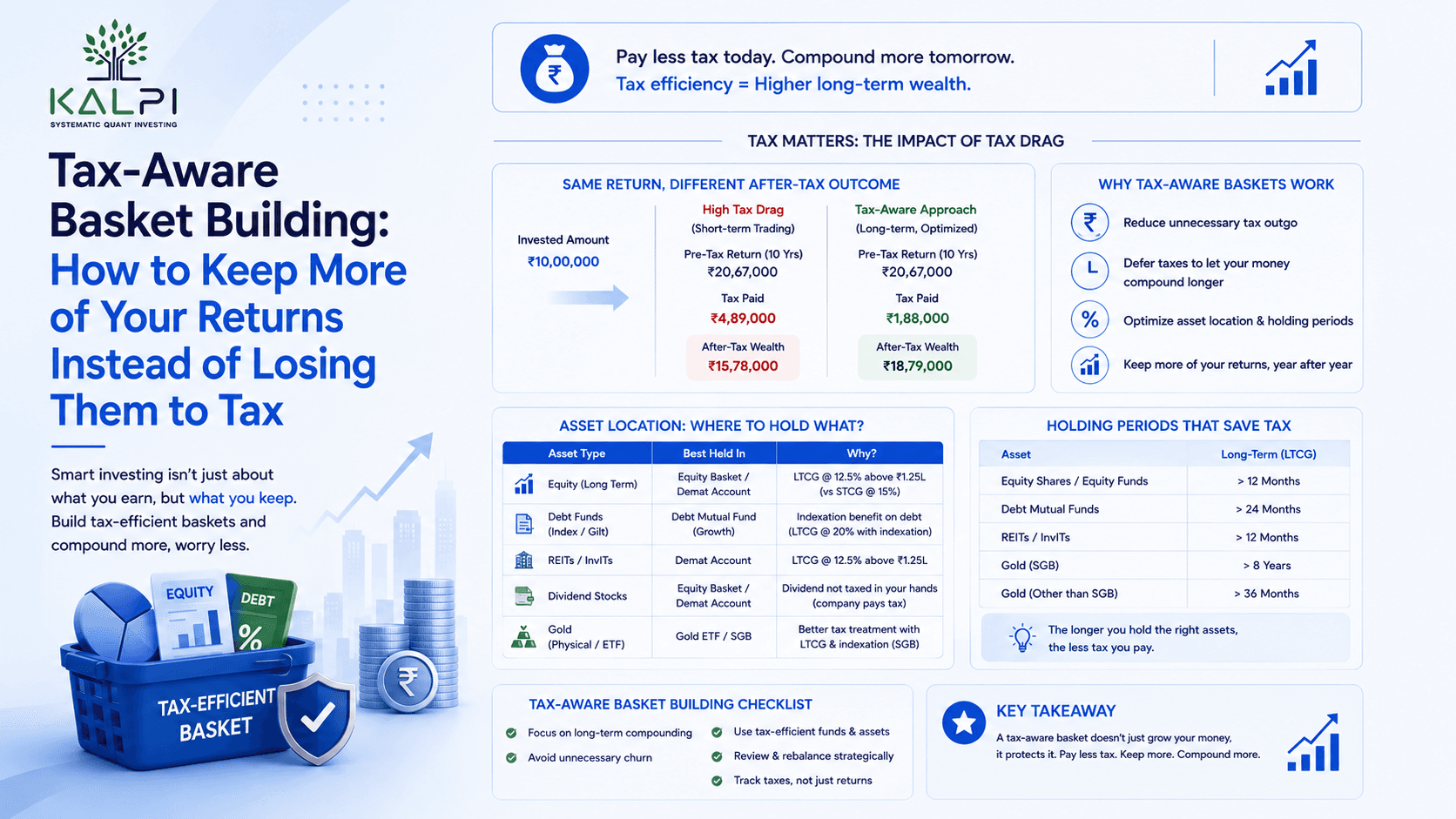
Tax-saving stock investing is not just about earning higher returns. It is also about keeping more of the returns you already earn. By understanding concepts like LTCG optimization, tax loss harvesting India and smart rebalancing tax, investors can legally reduce unnecessary tax outflows and improve long-term wealth creation.
When people think about investing, they usually ask one question.
“Which stock can give me the highest return?”
It is an important question, but there is another one that deserves equal attention.
“How much of that return will I actually keep after paying taxes?”
Many investors spend hours researching companies, reading financial statements and following market trends. Yet, when it comes to selling their investments, taxes are often an afterthought.
That small oversight can quietly reduce long-term returns without most investors even noticing it.
Think about shopping during a festive sale.
Suppose you want to buy a pair of shoes priced at ₹5,000. One store sells the shoes at full price, while another offers the same pair with a discount and cashback. The shoes are exactly the same, but the second option leaves more money in your pocket.
Investing works in a similar way.
Your returns are important, but the amount you keep after paying taxes matters just as much.
That is where tax-saving stock investing becomes useful.
The goal is not to avoid paying taxes. It is to organise your investments in a smarter way so that you do not end up paying more tax than required under the law.
Even small tax savings can make a meaningful difference over time because the money that stays invested continues to grow through compounding.

A rule-based strategy screen: filters, ranking and weighting logic built to run consistently, the same discipline that keeps tax decisions systematic instead of emotional.
What Is Tax Drag?
Many investors are familiar with market risk and inflation, but very few pay attention to tax drag.
Tax drag simply refers to the reduction in your overall investment returns because of taxes.
Imagine two investors who earn the same return from their portfolios over a year.
The first investor plans purchases and sales carefully, while the second frequently buys and sells stocks without considering the tax impact.
Although both investors earned similar returns before tax, the first investor ends up keeping more money because their investment decisions were more tax-efficient.
That difference is called tax drag.
Reducing tax drag does not mean searching for shortcuts or trying to avoid taxes.
It simply means making investment decisions after understanding their tax implications.
Why Tax Planning Should Be Part of Investing
Many people treat investing and tax planning as two completely separate activities.
In reality, both work together.
A portfolio that earns slightly lower returns before tax can sometimes create more wealth because it is managed more efficiently from a tax perspective.
That is why experienced investors often look at two numbers instead of only one.
- Return before tax
- Return after tax
The second number is what ultimately matters because that is the money you actually get to keep.
Ignoring taxes while investing is similar to planning your monthly household budget without considering electricity bills or grocery expenses. The budget may look perfect on paper, but it does not show how much money actually remains at the end of the month.
Investing works the same way.
Traditional Investing vs Tax-Aware Investing
| Traditional Investing | Tax-Aware Investing |
|---|---|
| Focuses mainly on earning returns | Focuses on earning and keeping more returns |
| Tax impact is considered only while selling | Tax impact is considered throughout the investment journey |
| Frequent selling may increase tax liability | Selling decisions also consider tax efficiency |
| Portfolio reviews focus only on portfolio performance | Portfolio reviews include both performance and tax planning |
| Long-term wealth depends only on returns | Long-term wealth depends on returns and after-tax efficiency |
Understanding LTCG Optimization
Before discussing LTCG optimization, it helps to understand the basic idea behind long-term capital gains.
Whenever you sell an investment for more than its purchase price, the profit is known as a capital gain.
The tax you pay depends on factors such as the type of investment, applicable tax rules and how long you have held that investment.
For listed equity shares in India, investments held for the required long-term holding period are generally taxed differently from short-term holdings.
This is why the timing of a sale can sometimes affect your overall tax liability.
Tax laws may change over time, so investors should always refer to the latest government guidelines or consult a qualified tax professional before making financial decisions.
The important point is that LTCG optimization is not about delaying every sale forever.
Instead, it is about understanding whether selling an investment at a particular time makes sense from both an investment and a tax perspective.
What Is Tax-Aware Basket Building?
Building a stock portfolio is a bit like packing for a long trip.
If you throw things into your bag without a plan, you may carry unnecessary items while forgetting the essentials.
A well-packed bag is organised, balanced and prepared for different situations.
Your investment portfolio should be built with the same mindset.
Instead of buying random stocks based on market noise or recommendations, investors build a basket of companies that matches their financial goals, investment horizon and risk tolerance.
A tax-aware basket takes this approach one step further.
Along with selecting quality businesses, investors also think about how future buying, selling and portfolio rebalancing decisions may affect taxes.
Business quality, diversification and long-term growth remain the priority.
Tax efficiency does not replace good investing. It simply becomes another factor that helps investors keep more of the wealth they create over time.
How Can Investors Build a More Tax-Efficient Portfolio?
Building wealth is not only about choosing good stocks. It is also about making smart decisions after buying them.
Many investors spend months selecting companies but make quick decisions when it comes to selling. A stock rises by 15 or 20 percent, and they immediately book profits without considering whether the timing makes sense from a tax perspective.
Over the years, these small decisions can quietly reduce overall returns.
A tax-aware portfolio does not try to avoid taxes. Instead, it helps investors make better decisions so that more of their returns remain invested.
Hold Investments With a Purpose
Imagine planting a fruit tree in your garden.
If you dig it up every few months to check whether it is growing, it will never become strong enough to bear fruit.
Investments work in much the same way.
Quality businesses need time to grow. Selling them too quickly simply because the share price has increased may not always be the best decision.
Before selling any investment, ask yourself a few questions.
- Has the company’s business changed?
- Has my financial goal changed?
- Am I selling because of facts or because of market emotions?
If the original reason for investing is still valid, holding the investment a little longer may sometimes make more sense than reacting to short-term price movements.
This approach also supports LTCG optimization, where investment decisions are made after considering both business fundamentals and tax efficiency.
Understand Tax Loss Harvesting
The term tax loss harvesting India sounds technical, but the idea is actually quite straightforward.
Suppose your portfolio has two stocks.
One investment is making a profit, while another is currently showing a loss.
Instead of looking at both investments separately, experienced investors often review the complete portfolio before making any decision.
In some situations, realising a loss may help offset taxable gains, depending on the applicable tax rules.
The objective is not to create losses intentionally.
The objective is to manage an existing portfolio more efficiently.
Since tax regulations can change over time, investors should always check the latest government guidelines or consult a qualified tax professional before using this strategy.
Rebalance Without Ignoring Taxes
Think about your wardrobe.
Over time, some clothes are worn regularly while others remain untouched. Every few months, you organise everything again so that your wardrobe stays balanced and useful.
A portfolio also needs occasional rebalancing.
Sometimes one stock performs so well that it becomes much larger than the rest of the portfolio.
Reducing that position may improve diversification, but selling without considering taxes may increase your overall tax liability.
This is where smart rebalancing tax strategies become useful.
The goal is not to avoid rebalancing.
The goal is to rebalance at the right time while keeping both portfolio risk and tax efficiency in mind.
Avoid Common Tax Mistakes
Many investors lose money not because they chose poor businesses, but because they ignored simple planning.
Some common mistakes include:
- Selling investments simply because prices have gone up.
- Buying and selling too frequently without a clear investment strategy.
- Ignoring the tax impact before booking profits.
- Making tax the only reason to buy or sell a stock.
Tax planning should support your investment decisions, not control them.
A strong business should always remain the first priority.
A Disciplined Process Makes a Difference
Successful investing is rarely about making one brilliant decision.
It is usually the result of making many sensible decisions over a long period.
Instead of focusing only on returns, experienced investors also pay attention to business quality, diversification, valuation and tax efficiency.
None of these steps will eliminate taxes completely, and that should never be the goal.
The idea is simply to make thoughtful decisions so that more of your investment returns remain invested and continue compounding over time.
A disciplined approach may not look exciting in the short term, but over several years it can make a meaningful difference to the wealth you eventually create.
Small Tax Decisions Can Create Big Long-Term Results
Many investors spend years searching for the next multibagger.
Ironically, they often overlook something that is completely under their control.
The way they manage taxes.
No tax strategy can turn a poor investment into a great one.
At the same time, even a strong portfolio can lose part of its potential if taxes are ignored year after year.
Think about a leaking tap at home.
A few drops of water do not seem important. Most people ignore them because the loss feels too small to matter.
But if that leak continues for months, a surprising amount of water is wasted.
Taxes can have a similar effect on an investment portfolio.
One decision may not make a huge difference. However, repeating the same mistakes over several years can quietly reduce the wealth an investor builds.
That is why experienced investors pay attention to both returns and tax efficiency.
Neither should be ignored.
Building Good Habits Matters More Than Finding Shortcuts
Many people look for quick ways to reduce taxes.
In reality, tax-efficient investing is usually built on simple habits rather than complicated strategies.
For example:
- Reviewing your portfolio regularly instead of making emotional decisions.
- Avoiding unnecessary buying and selling.
- Understanding the tax impact before booking profits.
- Keeping your investment goals in mind while rebalancing.
None of these habits are difficult on their own.
The challenge is following them consistently.
Over time, consistency often produces better results than trying to predict every market movement.
Don’t Let Taxes Become the Only Focus
While taxes are important, they should never become the main reason for making investment decisions.
Imagine refusing to repair your house simply because you want to save money today.
You may avoid spending in the short term, but the repair cost could become much higher later.
Investing works in a similar way.
Holding a weak company only to postpone taxes may not always be the right decision.
Likewise, selling a strong business only because of short-term market noise may also hurt long-term returns.
A good investment decision balances several factors together.
Business quality, valuation, diversification, financial goals and taxes all deserve attention.
Looking at only one of them rarely leads to the best outcome.
A Simple Checklist Before Selling Any Investment
Before selling a stock, ask yourself a few simple questions.
- Has the company’s business changed?
- Does this investment still match my financial goals?
- Am I selling because of emotions or because the facts have changed?
- Have I considered the tax impact of this decision?
- Would waiting make more sense for both my investment plan and tax efficiency?
You may not answer “yes” to every question every time.
However, asking these questions encourages thoughtful decisions instead of emotional ones.
Tax-Efficient Portfolio Review Checklist
| Question | Check |
|---|---|
| Has the business fundamentally changed? | ☐ |
| Does this investment still match my financial goals? | ☐ |
| Have I considered the tax impact before selling? | ☐ |
| Will this improve portfolio diversification? | ☐ |
| Am I making this decision based on facts instead of emotions? | ☐ |

A disciplined portfolio review in action: tracking actual weight against ideal weight is the same habit that supports smart, tax-aware rebalancing.
Final Thoughts
Successful investing is not only about earning higher returns.
It is also about keeping more of the returns you earn.
That is why tax-saving stock investing deserves attention from every long-term investor.
A well-built portfolio is supported by quality businesses, sensible diversification, disciplined decision-making and an understanding of how taxes affect long-term wealth.
Strategies such as LTCG optimization, tax loss harvesting India and smart rebalancing tax are not designed to eliminate taxes.
Their purpose is much simpler.
They help investors make informed decisions so that unnecessary tax outflows do not quietly reduce years of hard-earned returns.
No investment strategy guarantees success.
However, building good habits, staying patient and thinking beyond short-term market movements can put investors in a much stronger position over time.
The goal is not to beat the market every month.
The goal is to make sensible decisions consistently, allowing both your investments and your wealth to grow steadily over the years.
Frequently Asked Questions
1. What is tax-saving stock investing?
Tax-saving stock investing means managing your portfolio in a way that reduces unnecessary tax liability while staying aligned with your long-term investment goals.
2. What is LTCG optimization?
LTCG optimization is the practice of considering long-term capital gains rules before selling investments so that decisions support both investment objectives and tax efficiency.
3. What is tax loss harvesting in India?
Tax loss harvesting involves reviewing loss-making investments to understand whether realised losses can help offset taxable gains, subject to applicable tax regulations.
4. Why is smart portfolio rebalancing important?
Portfolio rebalancing helps maintain diversification and manage risk. Considering the tax impact while rebalancing can improve after-tax returns over time.
5. Should tax saving be the only reason to buy or sell a stock?
No. Tax planning is only one part of investing. Business quality, valuation, financial goals and risk should always remain the primary factors when making investment decisions.