

Last Updated: July 2026
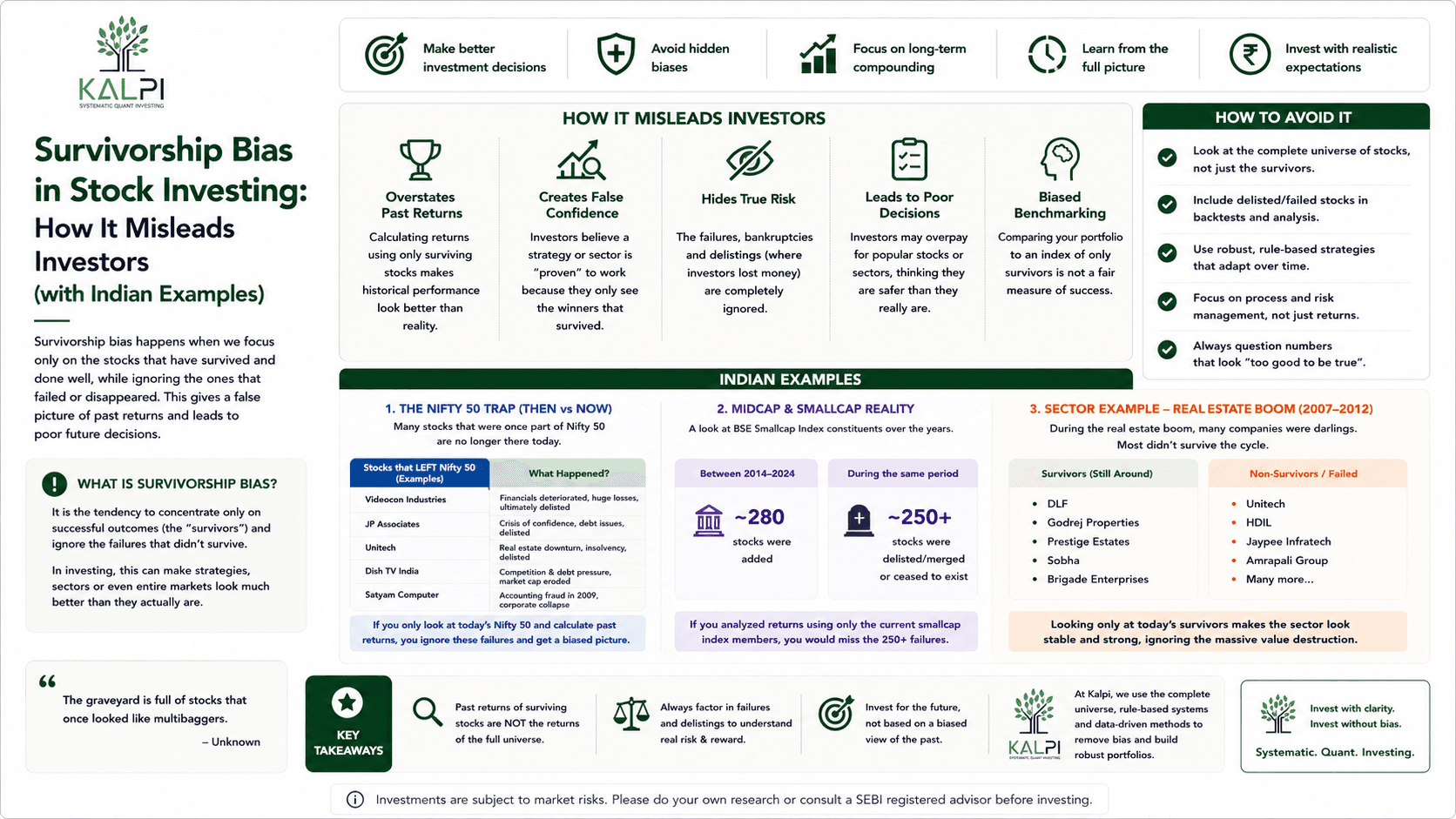
Survivorship bias in investing is the mistake of focusing only on successful companies, funds or strategies while ignoring the ones that failed. It quietly builds an unrealistic picture of returns and makes investors underestimate the risk they are actually taking.
Have you heard someone say, “If you had invested in Infosys, TCS or HDFC Bank twenty years ago, you would have created huge wealth”?
That statement is not wrong. But it leaves out most of the story.
Behind every company that created long-term wealth, there are many others that looked just as promising at the time and never delivered. Some lost their market position, some ran into financial trouble, some got acquired, and some simply disappeared.
When investors look only at the companies that survived and ignore the ones that failed, they fall into a common trap called survivorship bias.
What Is Survivorship Bias?
Survivorship bias is the tendency to study only the investments that remained successful, while ignoring the ones that failed or vanished along the way.
Think of a school that only puts up photos of students who scored above 95%. Everyone starts talking about their study habits and routines. But if you never look at the students who struggled, you are only seeing one side of the picture.
Investing works the same way. We remember the companies that became industry leaders because they are still around and still doing well. Their stories are easy to find. The businesses that failed usually disappear from conversation altogether, even though they matter just as much for understanding how markets actually work.
That missing piece of information can completely change how an investor reads an opportunity.
A Simple Example
Say ten companies entered the electric vehicle business in India ten years ago.
Today, three of them are doing well. The other seven either shut down or never created any real value for investors.
If someone studies only the three winners, they might conclude that investing in EV companies was an easy, obvious call.
But that conclusion ignores seven out of ten companies. Looking only at the winners makes success look far more common than it really was.
A fair analysis has to include both the companies that made it and the ones that didn’t.
Survivorship Bias Examples in India
Indian investors run into this bias often while reading long-term wealth creation stories.
Names like Asian Paints, Titan, Infosys, TCS and Bajaj Finance come up again and again because they rewarded shareholders handsomely over many years.
What rarely comes up is the list of companies that had similarly strong growth expectations at one point, but struggled later due to competition, weak decisions, industry shifts or financial stress.
Looking only at today’s winners can create the false impression that spotting future market leaders was simple. It wasn’t.
When these companies were still small, investors had dozens of similar-looking options in front of them. Nobody knew for certain which ones would become the market leaders of today. Many companies with comparable potential at the time failed to create any lasting value.
That is why studying only the survivors gives an incomplete, and sometimes misleading, picture of investing.
Survivorship Bias in Mutual Funds
This bias is not limited to individual stocks. It shows up in mutual fund analysis too.
Say a fund house launches twenty equity funds over fifteen years. Some do well and keep attracting investors. Others underperform and eventually get merged into other schemes or shut down entirely.
Years later, if someone compares only the funds that are still around, the results look better than what investors actually experienced as a group. The weak performers have quietly dropped out of the comparison.
This is why checking for survivorship bias in mutual fund data matters. A fair comparison should also account for funds that were closed or merged, not just the ones still active today. Leaving out the failures makes an entire category look stronger than it really was.
Survivorship Bias in Backtesting
Backtesting is meant to show how a strategy would have performed using historical data. But a backtest built on incomplete data can be seriously misleading.
Say someone tests a stock strategy using today’s Nifty 500 companies and checks how that basket performed over the last fifteen years.
The problem is that many companies from fifteen years ago are no longer part of that index today. Some were removed for poor performance, some got acquired, and some stopped trading altogether.
If those companies are missing from the dataset, the backtest automatically looks stronger than it should. The strategy can appear highly profitable simply because the failures were never part of the data in the first place.
Before trusting an impressive backtest, it is worth asking what data went into it. A backtest is only as good as the information behind it.
However, the impact of survivorship bias is not limited to historical analysis. It can also influence the decisions investors make today.

Example of how complete historical data can help investors understand performance without survivorship bias.
Why Survivorship Bias Can Hurt Your Decisions Today
This bias doesn’t just distort how we see the past. It shapes the decisions investors make right now.
Many investors believe that successful investing simply means picking a few great companies and holding them for years. Some investors have genuinely built wealth this way. But this view skips over an important reality: plenty of people followed the exact same approach and ended up holding companies that never performed.
The difference is that failed bets rarely turn into popular stories.
On social media and in everyday financial chatter, people talk about the stock that doubled or tripled. Very few talk about the one that lost 50% or 70% of its value.
Seeing only the winners makes investing look easier than it is. It can push investors toward excessive risk, make them ignore uncertainty, and set unrealistic expectations for returns.
Good investing decisions come from understanding both sides, the winners and the losers. Studying failures often teaches risk lessons that success stories never show.
How to Avoid Survivorship Bias
It is hard to remove this bias completely. People naturally remember success more than failure. But investors can reduce its effect by asking a few sharper questions before making a decision.
- Am I looking only at businesses that succeeded?
- What happened to companies that failed in the same industry?
- Does this historical data include companies that disappeared?
- Am I judging this strategy on complete information, or a filtered version of it?
It also helps to actively study market failures and business collapses. A company that failed can sometimes teach an investor more about risk than one that became a market leader.
Common Mistakes Investors Make
Many investors carry this bias without ever noticing it. Some of the most common patterns:
- Looking only at today’s successful companies while ignoring the ones that disappeared
- Assuming every long-term winner was easy to spot from day one
- Trusting backtests without checking if delisted or failed companies were included
- Comparing only active mutual funds while ignoring merged or closed schemes
- Following well-known investors without looking at their unsuccessful bets too
| Mistake | Better Approach |
| Studying only successful stocks | Analyse both winners and failures |
| Trusting every backtest | Check whether the data has survivorship bias |
| Comparing only active mutual funds | Consider merged and closed funds where possible |
| Following success stories blindly | Understand the risks behind every investment |
Why Rule-Based Investing Helps
One practical way to reduce the effect of survivorship bias is to follow a disciplined, rule-based process instead of chasing popular stories.
Rule-based investing works off predefined factors such as earnings growth, valuation, quality, momentum and risk. Instead of picking a company because it has already become famous, the process follows consistent criteria applied to every stock in the universe, including the ones that never make headlines.
This does not remove risk. No approach can do that.
However, rule-based investing also requires proper testing, risk management, and understanding of the underlying methodology.
But a systematic process reduces emotional decision-making and cuts down the tendency to buy into a company only after it has already become a success story.

Example of how a rule-based approach can evaluate a broader stock universe using predefined factors.
Final Thoughts
Survivorship bias is one of the easiest mistakes to overlook, simply because successful companies get all the attention. Their stories are visible everywhere. The businesses that failed quietly drop out of the conversation.
Looking only at the survivors makes investing seem safer and more predictable than it actually is.
Whether you are studying stocks, mutual funds or historical strategies, it is worth asking what information might be missing from the picture. Companies that failed are not just bad luck stories. They usually carry real lessons about risk, valuation and business quality.
The best investors don’t study winners alone. They study the failures too, understand what went wrong, and use that to sharpen their own process.
The next time someone points to a handful of multibagger stocks as proof that investing is simple, remember: that is only one side of the story.
Frequently Asked Questions
1. What is survivorship bias in investing?
It is the tendency to focus only on successful investments while ignoring the ones that failed, which creates unrealistic expectations about both returns and risk.
2. What is a survivorship bias backtest?
It is a backtest that leaves out companies which were delisted, merged or failed, which makes a strategy’s historical performance look better than it actually was.
3. How does survivorship bias affect mutual fund analysis?
When investors compare only the mutual funds that are still active, the funds that were closed or merged due to poor performance get left out, making the category look stronger than it really was.
4. What are some survivorship bias examples in India?
Focusing only on winners like Infosys, TCS or Titan while ignoring the businesses that failed or disappeared along the way is a common example of this bias playing out in Indian markets. The point is not that successful companies like Infosys, TCS or Titan were poor investments. The issue is that looking only at winners can make identifying future winners appear easier than it actually was.
5. How can investors avoid survivorship bias?
By studying both successful and unsuccessful companies, checking what data went into any historical analysis, and avoiding decisions based only on popular success stories.