

Last Updated: July 2026
Introduction
You have ₹50,000 saved and want to start investing. The first challenge isn’t finding an investment option, it’s deciding which one actually fits your needs.
Should you directly buy a group of selected stocks through a stock basket? Should you invest in an ETF that tracks an index? Or should you choose a mutual fund where a professional manages the portfolio?
This is a common question for both new investors and people exploring different investment options. The investment world now offers plenty of choices, and each one works differently. The right option depends on factors like your experience, risk understanding, time commitment, and investment goals.
This is why understanding Stock Basket vs ETF vs Mutual Fund matters. These three options can look similar on the surface since all of them give exposure to multiple companies, but how they are created, managed, and used is quite different.
A stock basket gives investors more direct control over selected companies. An ETF usually follows a market index or a specific theme with lower costs. A mutual fund lets investors put money into a professionally managed portfolio.
Each option has its own advantages and limitations. The right choice comes down to how much control, simplicity, and involvement an investor actually wants.
What Is a Stock Basket?
A stock basket is a collection of multiple stocks grouped together based on a particular idea, theme, sector, or investment approach.
Instead of buying shares of just one company, an investor can get exposure to several companies through a single basket.
For example, an investor interested in the banking sector may create a basket containing shares of multiple banks. Similarly, a technology-focused basket may include companies from the IT sector.
The idea is to avoid depending on a single company by spreading exposure across multiple stocks.
Unlike mutual funds or ETFs, though, the investor usually stays more involved in selecting and tracking these stocks.
Understanding Stock Basket Meaning
The Stock Basket meaning is easier to grasp with a simple example.
Suppose an investor wants exposure to India’s growing consumption story. Instead of researching and buying just one consumer company, they might invest in a basket containing several businesses from the same theme.
If one company runs into trouble, the impact tends to be smaller because other companies are also part of the portfolio.
That said, stock baskets still require investors to understand the companies they own and the risks that come with them.
How Does a Stock Basket Work?
A stock basket generally works by combining different stocks according to a specific strategy.
The basket can be built around:
- Sector themes
- Market trends
- Investment styles
- Business categories
- Specific financial characteristics
For example, a basket focused on quality companies may include businesses with strong balance sheets and consistent earnings.
A growth-focused basket may include companies expected to grow their revenue and profits over time.
The investor gets exposure to multiple companies instead of depending on how a single stock performs.
Some platforms also offer pre-designed baskets where investors can pick from existing themes, often rebalanced periodically based on the strategy.

A stock basket strategy being built step by step, from universe selection and filters to ranking and weighting, similar to how platforms like Kalpi construct rule-based baskets.
Advantages of Stock Baskets
1. More Control Over Investments
One of the biggest advantages of a stock basket is control.
Investors can know exactly which companies they own and why those companies are part of their portfolio.
For people who enjoy researching businesses, this approach offers more involvement compared to investing through a managed product.
2. Direct Ownership of Stocks
In a stock basket, investors usually hold shares of the selected companies directly.
This means they can track their exact portfolio composition and follow individual businesses more closely.
3. Theme-Based Investing
Stock baskets let investors invest around specific ideas.
For example:
- Digital growth
- Healthcare expansion
- Manufacturing themes
- Banking sector growth
This can be useful for investors who have a particular market view and want exposure to a specific area. This is also where the Smallcase vs ETF comparison often comes up, since Smallcase-style baskets work on a similar theme-based logic while ETFs stick to tracking a fixed index or category.
Limitations of Stock Baskets
While stock baskets offer flexibility, they also demand more responsibility from investors.
The investor needs to understand:
- Why each stock is included
- Whether the companies remain financially strong
- When portfolio changes may be required
A poorly selected basket can still carry significant risk, especially if the stocks belong to the same sector or theme.
For example, a basket containing only technology companies may do well during a technology boom but come under pressure when that sector struggles.
That’s why research and proper diversification still matter, even with a stock basket.
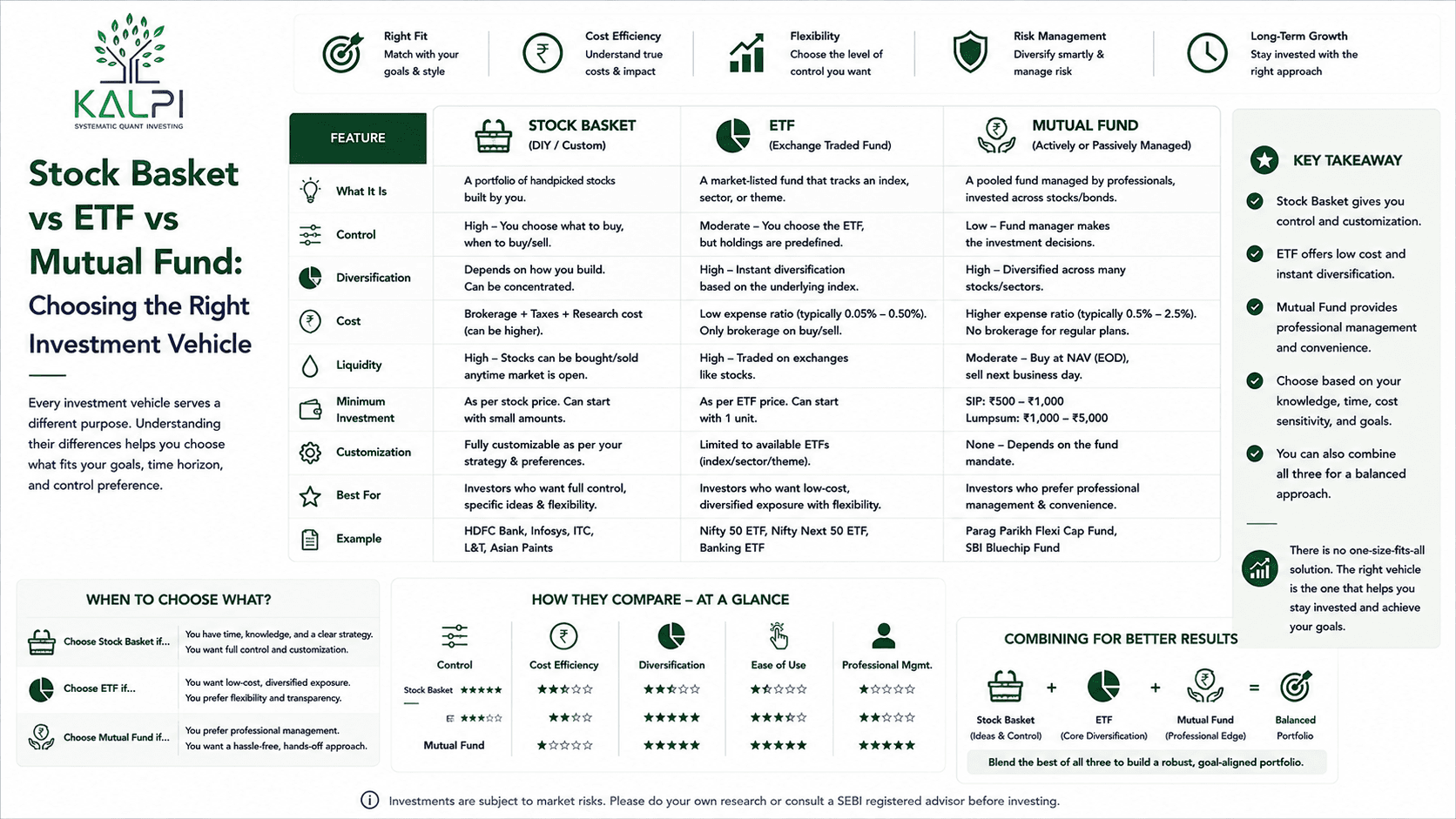
Stock Basket vs ETF vs Mutual Fund: Why the Choice Matters
Choosing between these three options isn’t just about returns. It’s also about how involved an investor wants to be.
Someone who enjoys researching companies may prefer more control through a stock basket.
An investor looking for a simple, low-cost market approach may lean toward ETFs.
Someone who prefers professional management may find mutual funds more suitable.
Knowing these differences helps investors pick an approach they actually understand and can stay comfortable with over the long term.
What Is an ETF?
An Exchange Traded Fund (ETF) is a simple way to invest in a group of assets without buying each one separately. Most ETFs track an index, sector, commodity, or a specific theme.
Instead of researching and buying every stock individually, an investor can buy units of an ETF that already holds a collection of securities.
A simple way to think about an ETF is like buying a ready-made box of ingredients instead of picking every ingredient separately.
For example, instead of purchasing shares of every company in a market index, an investor can buy an ETF that tracks that index. The value of the ETF moves based on the performance of the assets it holds.
ETFs are generally built to follow a specific strategy rather than actively picking stocks through frequent decisions by a fund manager.
How Do ETFs Work?
When investors buy ETF units, their money is pooled into a fund that owns the underlying assets.
For example, an ETF tracking a broad market index may hold shares of multiple companies from that index. If those companies do well, the ETF tends to reflect that movement. If the market falls, the ETF can fall too.
Some common types of ETFs include:
- Index ETFs
- Sector ETFs
- Gold ETFs
- Bond ETFs
The biggest appeal of ETFs is that they let investors get broad market exposure without managing every individual investment themselves.
Advantages of ETFs
1. Lower Cost Structure
One reason many investors consider ETFs is their relatively lower expense structure compared to some actively managed funds.
Since most ETFs follow a passive approach, there’s usually less frequent buying and selling inside the portfolio.
2. Transparency
ETFs generally show investors exactly what they hold, instead of leaving them to depend only on a broad investment objective.
3. Easy Market Exposure
An investor who wants exposure to a particular index or sector doesn’t need to research every company individually. An ETF provides that exposure through a single product.
Limitations of ETFs
While ETFs offer simplicity, they aren’t free from risk.
The value of an ETF depends on how the underlying assets perform. If the market or sector it tracks falls, the ETF loses value too.
Liquidity is another factor. Some ETFs see lower trading volumes, which can affect how easily you can buy or sell.
Investors should also understand what an ETF actually tracks before investing. Two ETFs may look similar on the surface but hold completely different portfolios with different objectives.
ETF vs Mutual Fund India: Understanding the Difference
Many investors compare ETFs and mutual funds because both give exposure to a collection of securities. But the way they operate is quite different.
A mutual fund is managed according to a defined strategy. In an actively managed fund, investment decisions are taken by a fund manager who picks securities based on the fund’s objective.
An ETF, on the other hand, usually follows a specific index or asset category and trades on the stock exchange like a share.
The difference becomes clearer with something most people have seen in their own kitchens, a silbatta (pestle and mortar).
Imagine preparing a traditional spice mixture at home.
With a silbatta, you carefully choose each ingredient, decide the quantity, and grind everything according to your preferred taste. The process involves more involvement, decisions, and personal judgement.
This is similar to a mutual fund approach, where investment decisions are managed according to a defined strategy.
Now imagine buying a ready-made spice mix from the market where the ingredients are already measured and prepared according to a fixed recipe.
That’s closer to how an ETF works. The basket of investments is already created, and it follows a predefined structure.
Both approaches can work well, but the experience and level of involvement are different.
ETF vs Mutual Fund India: Key Differences
| Feature | ETF | Mutual Fund |
|---|---|---|
| Management Style | Mostly passive | Active or passive |
| Buying Method | Traded on stock exchanges | Bought through fund platforms |
| Pricing | Changes during market hours | Based on end-of-day NAV |
| Decision Making | Investor chooses when to buy or sell | Fund manager handles decisions in active funds |
| Cost | Usually lower for passive ETFs | Depends on fund type and expenses |
What Is a Mutual Fund?
A mutual fund collects money from multiple investors and invests it across different securities according to a defined objective.
For example, an equity mutual fund may invest in shares of different companies, while a debt mutual fund may focus on fixed-income instruments.
The biggest difference is that investors don’t directly pick every stock. Instead, they invest in a professionally managed portfolio.
This can work well for people who don’t have the time or expertise to research companies regularly.
Advantages of Mutual Funds
1. Professional Management
A major benefit of mutual funds is that investors get access to research and portfolio management handled by experienced professionals.
The fund management team studies companies, sectors, and market conditions while managing the portfolio.
2. Suitable for Systematic Investing
Mutual funds are commonly used with SIPs, letting investors invest a fixed amount regularly instead of putting in a large amount at once.
This approach can help investors build investing discipline over time.
3. Diversification
A mutual fund can offer exposure to multiple companies or assets through a single investment.
This reduces how much your outcome depends on one particular company.
Limitations of Mutual Funds
Mutual funds also come with certain limitations.
Investors have less control over individual holdings because portfolio decisions are made according to the fund’s strategy.
Costs can also vary depending on the fund type and management style. Active funds may charge more than passive options.
Past performance should also not be treated as a guarantee of future results.
Understanding these differences in ETF vs Mutual Fund India helps investors choose an approach that matches their comfort level, knowledge, and investment style.
There Is No Single Investment Option That Works for Every Investor
A stock basket, ETF, and mutual fund all solve different investment needs. The better choice depends on how much involvement you want, how comfortable you are making decisions, and how much time you can dedicate to understanding your investments.
An investor who enjoys researching companies may prefer a stock basket. Someone who wants simple exposure to the market may find ETFs more suitable. A person who prefers professional management may choose mutual funds.
The goal isn’t to find the “best” option for everyone. The goal is to choose an investment approach you can understand and stick with consistently.

A rule-based stock basket showing individual stock weights and allocations, this is what direct ownership inside a stock basket actually looks like in practice.
Stock Basket vs ETF vs Mutual Fund: Quick Comparison
| Feature | Stock Basket | ETF | Mutual Fund |
|---|---|---|---|
| Control | Higher control over stock selection | Limited control | Limited control |
| Management | Managed by investor or basket creator | Usually follows an index or fixed strategy | Managed according to fund objective |
| Research Requirement | Higher | Moderate | Lower for investors |
| Cost | Depends on platform and transactions | Usually lower for passive options | Depends on fund type |
| Best Suitable For | Investors who enjoy researching businesses | Investors seeking simple market exposure | Investors who prefer professional management |
Which Option May Suit Different Investors?
For Investors Who Like Researching Companies
If you enjoy studying businesses, analysing financial statements, and understanding industries, a stock basket can give you more flexibility.
You can select companies based on your own ideas and build a portfolio around specific themes, sectors, or investment strategies.
That flexibility comes with responsibility, though. You need to review your investments regularly and check whether the original reason for buying a stock still holds up.
A stock basket can work well for investors willing to spend time learning about businesses.
For Investors Looking for Simplicity
ETFs can work well for investors who want exposure to a group of companies without picking each stock individually.
For example, instead of tracking multiple companies separately, an investor can choose an ETF linked to a market index or a specific sector.
This approach suits people who prefer a straightforward investing process. That said, investors should still understand what the ETF tracks and whether it matches their investment objective.
For Investors Who Prefer Professional Management
Mutual funds can suit investors who don’t want to manage every investment decision themselves.
The fund manager and research team study opportunities and manage the portfolio according to the fund’s objective.
This can help beginners, busy professionals, or investors who prefer a structured approach.
That said, picking a mutual fund still needs attention. Factors like investment strategy, expense ratio, portfolio holdings, and consistency should be weighed before investing.
Common Mistakes Investors Should Avoid
Choosing between a stock basket, ETF, and mutual fund gets easier when investors avoid a few common mistakes.
1. Choosing Only Based on Past Performance
A product that performed well in the past may not keep delivering the same results going forward.
Market conditions change, and different investment styles perform differently across cycles.
Past returns can offer useful information, but they shouldn’t be the only reason behind an investment decision.
2. Ignoring Costs
Small costs can add up to a meaningful difference over a long investment period.
Investors should understand expense ratios, transaction charges, and other costs before choosing an investment option.
3. Investing Without Understanding the Product
Every investment vehicle has its own structure and risks.
Before investing, investors should know:
- Where their money is invested
- How the investment strategy works
- What risks are involved
- Whether it matches their financial goals
Understanding the product matters more than simply following market trends.
Can Investors Use More Than One Option?
Yes, investors don’t always need to stick to just one investment vehicle.
Many investors combine different approaches based on their objectives.
For example:
- ETFs can be used for broad market exposure.
- Mutual funds can provide professionally managed portfolios.
- Stock baskets can be used for specific themes or ideas.
The right combination depends on the investor’s knowledge, risk appetite, and long-term plan.
The focus shouldn’t be on collecting multiple products but on building a portfolio that’s easy to understand and manage.
The Importance of Time Horizon
Time plays an important role when choosing an investment option.
All investments go through periods of growth and decline. Short-term market movements can be hard to predict, but long-term investing lets investors focus on business performance, discipline, and consistency.
Whether an investor chooses a stock basket, ETF, or mutual fund, staying patient and avoiding emotional decisions plays a big role in the overall journey.
Final Thoughts
The discussion around Stock Basket vs ETF vs Mutual Fund isn’t about declaring one option the winner.
Each investment vehicle serves a different purpose.
Stock baskets offer more control but demand more research. ETFs offer a simple and cost-efficient way to access markets. Mutual funds offer professional management for investors who prefer a guided approach.
The right choice comes down to understanding your own investing style and picking an option you can stick with over time.
A strong investment decision isn’t only about choosing a product. It’s about knowing what you own, why you own it, and whether it fits into your larger financial plan.
Frequently Asked Questions (FAQs)
1. What is the difference between a stock basket, ETF, and mutual fund?
A stock basket gives exposure to selected stocks based on a theme or strategy. An ETF usually tracks an index or asset category, while a mutual fund is managed according to a specific investment objective.
2. Is a stock basket better than an ETF?
Not necessarily. A stock basket gives investors more control but demands more research. An ETF offers a simpler approach with less involvement.
3. Which is better for beginners: ETF or mutual fund?
Both can work depending on the investor’s needs. Mutual funds may suit people who prefer professional management, while ETFs can work well for those looking for simple market exposure.
4. Are ETFs safer than mutual funds?
Neither is automatically safer. The risk depends on the assets held, market conditions, and the overall investment strategy.
5. Can investors use both ETFs and mutual funds?
Yes. Many investors use different investment options together depending on their goals, time horizon, and preference for active or passive investing.