

Last Updated: July 2026
Open Spotify before heading to the gym. Most people don’t spend time adding songs one by one. They simply choose a playlist that matches the mood and press play.
Building a portfolio isn’t much different.
You can research individual companies, study their financials and build a portfolio from scratch. That also means deciding how much to invest in each stock and how everything fits together. For many investors, that’s where the process starts feeling complicated.
Kalpi templates are designed to solve this problem.
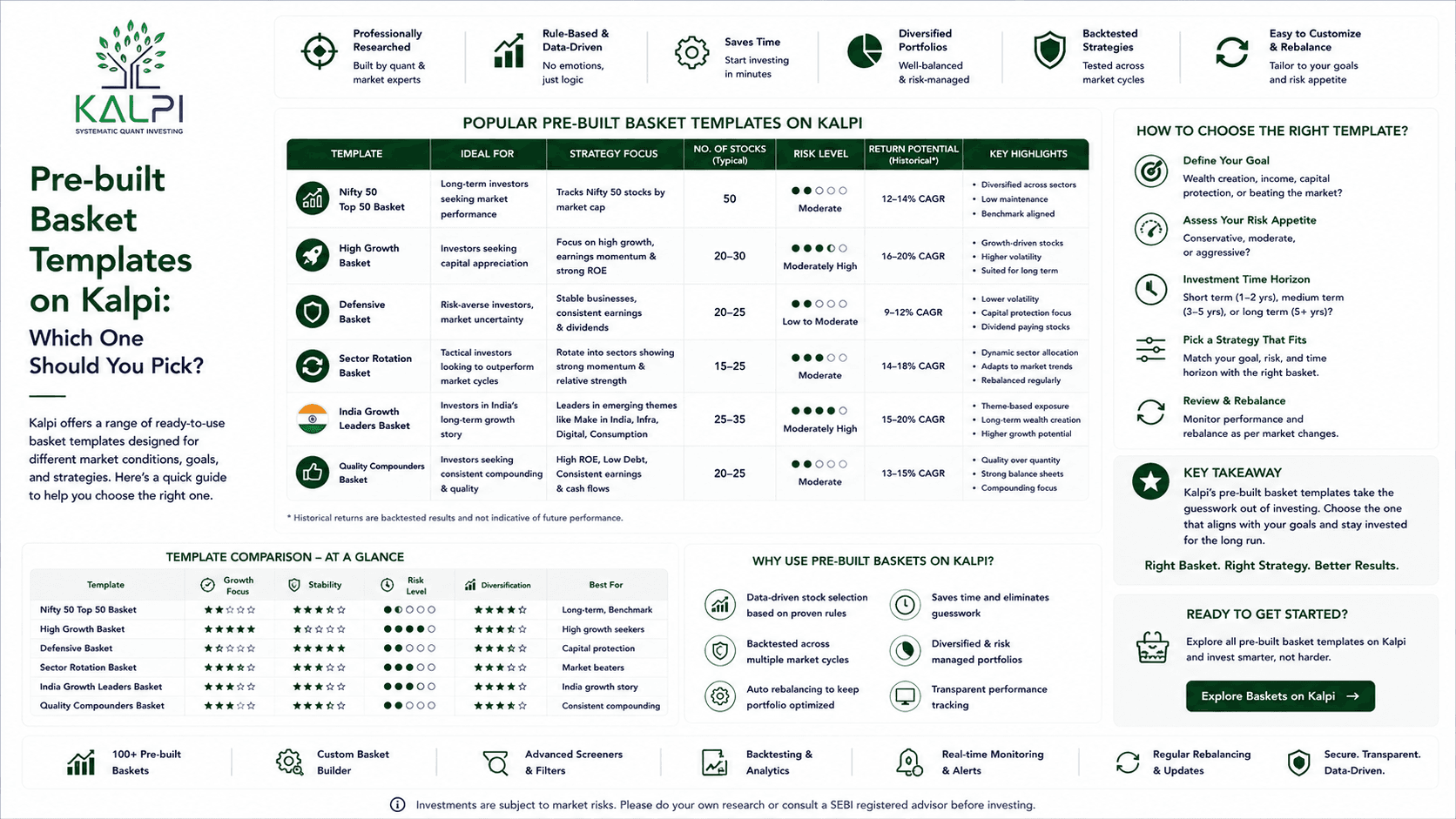
Instead of starting with an empty portfolio, investors can choose from pre-built portfolio strategies that follow different investment styles. Every template is built using a defined methodology, allowing investors to begin with a structured stock basket rather than selecting companies one at a time.
Some templates focus on companies showing strong price momentum. Others look for financially sound businesses with consistent earnings, while certain templates are built for investors who prefer companies with a history of paying regular dividends.
It’s tempting to choose the strategy that has delivered the highest recent returns. In reality, a better approach is to choose the template that matches your financial goals, investment horizon and comfort with risk.
In this guide, we’ll explain how Kalpi templates work, explore the different ready-made stock basket India options available on the platform, and help you understand which strategy may suit your investing style best.
What Are Kalpi Templates?
Kalpi templates are ready-made stock baskets created around predefined investment strategies.
Instead of selecting every stock yourself, you begin with a portfolio that already follows a structured investment framework. Every basket is built using clear selection rules, so companies are included because they meet specific investment criteria rather than because they’re popular or making headlines.
Although every template follows a rules-based process, each one is designed around a different investing style.
A momentum basket focuses on companies that have shown relatively strong price performance over a period of time. A quality basket gives greater importance to businesses with strong financial health, consistent earnings and solid balance sheets. A dividend basket is generally aimed at investors looking for companies with a history of paying regular dividends.
No single template works best in every market. Each follows a different investment philosophy, which means its performance can vary as market conditions change. Choosing the right one is less about finding the “best” strategy and more about finding the strategy that suits you.
Why Many Investors Choose Ready-Made Stock Baskets
Researching companies takes time, patience and consistency.
Finding a good business is only the beginning. Investors also need to think about diversification, sector allocation, position sizes and how the portfolio should be reviewed as markets evolve.
A ready-made stock basket India solution reduces much of this effort.
Instead of building everything from scratch, investors start with a portfolio that already follows a structured investment methodology. The decision shifts from choosing every individual stock to selecting an investment strategy that aligns with personal financial goals.
For someone investing for the first time, this often feels far less overwhelming than creating a portfolio from the ground up.
Even experienced investors use pre-built portfolio strategies as a disciplined starting point before making adjustments based on their own research and preferences.
How Do Pre-built Portfolio Strategies Work?
Every pre-built portfolio strategy follows a predefined set of investment rules.
These rules determine which companies qualify for inclusion. Depending on the strategy, the selection process may evaluate factors such as financial quality, earnings consistency, dividend history, market momentum or other measurable characteristics.
Once a basket has been created, it isn’t changed every time the market moves. Instead, reviews take place at scheduled intervals so the portfolio continues to reflect the investment methodology it was originally built around.
The idea isn’t to respond to every market headline or short-term price movement. It’s to stay consistent with the investment strategy behind the basket while reducing emotional decision-making over the long term.

Kalpi’s pre-configured strategy templates, including Bluechip Compounders, Quality at Core and Growth Master Class, let investors start from a structured basket instead of a blank portfolio.
Which Kalpi Template Should You Choose?
No two investors approach the market in exactly the same way.
Some are comfortable taking higher risk in search of stronger growth. Others prefer businesses with stable financials, while some value regular dividend income alongside long-term capital appreciation.
That’s why Kalpi offers multiple investment templates instead of relying on a single portfolio for everyone.
Each template follows a different investment philosophy. Understanding what each one is designed to achieve makes it easier to choose a strategy that fits your own financial goals and investing style.
Momentum Basket
A momentum basket focuses on companies that have demonstrated relatively strong price performance over a recent period.
The strategy is based on the idea that stocks showing positive momentum can continue performing well for some time before market leadership changes. Rather than trying to predict future winners, momentum investing follows companies already displaying sustained market strength.
Momentum-focused portfolios often perform well during strong market trends. However, they can also experience larger swings when sentiment changes or leadership shifts to different sectors.
This template may suit investors who:
- Prefer growth-oriented investing
- Are comfortable with higher market volatility
- Can remain invested through changing market cycles
- Understand that market leadership changes over time
Momentum investing rewards patience. There will be periods when it outperforms, and others when different investment styles move ahead.
Quality Basket
A quality basket takes a more fundamentals-driven approach.
Instead of concentrating primarily on price movement, it looks for businesses with strong financial characteristics. Companies are generally selected based on factors such as healthy balance sheets, consistent earnings, stable cash flows and efficient capital allocation.
These businesses may not always deliver the strongest returns during aggressive bull markets. However, many investors prefer them because financially stronger companies have often shown greater resilience across different market conditions.
A quality-focused strategy may appeal to investors who:
- Prefer financially strong businesses
- Focus on long-term wealth creation
- Value stable earnings and healthy balance sheets
- Want an investment approach driven by business fundamentals
Quality investing doesn’t remove market risk. Its objective is to build a portfolio around stronger businesses rather than reacting to short-term market movements.
Dividend Basket
For some investors, returns aren’t measured only by rising share prices.
Many also value companies that regularly distribute a portion of their profits through dividends.
A dividend basket focuses on businesses with a history of paying dividends while maintaining relatively stable business operations. These companies are often found in mature industries where earnings tend to be more predictable than in high-growth sectors.
Dividend income can contribute to overall portfolio returns, but it’s important to remember that dividend payments are never guaranteed. Companies may reduce or suspend dividends if business conditions change.
This template may suit investors who:
- Appreciate regular income alongside capital growth
- Prefer established businesses
- Have a long-term investment horizon
- Want greater exposure to relatively defensive companies
For many investors, dividends are one part of a broader long-term investment strategy rather than the only reason for owning a stock.
Choosing the Right Template Starts With Knowing Yourself
Many investors spend a great deal of time trying to identify the next winning strategy but very little time understanding their own investing behaviour.
That often leads to disappointment.
Someone who becomes uncomfortable during every market correction may struggle with a momentum-based strategy, even if it delivers strong returns over certain periods. On the other hand, an investor looking for faster growth may lose patience with a more conservative portfolio.
Instead of asking, “Which template is the best?”, it often helps to ask a different question:
“Which strategy am I most likely to stay invested in during both good markets and difficult ones?”
The answer usually says far more about the right investment choice than any short-term performance chart.
Can You Combine Different Kalpi Templates?
There’s no rule that says your portfolio has to follow only one investment style.
Some investors are comfortable relying on a single strategy. Others prefer blending different approaches so the portfolio isn’t dependent on one type of market environment.
For example, someone focused on long-term wealth creation might combine a quality basket with a momentum basket. The quality strategy brings exposure to financially stronger businesses, while the momentum strategy captures companies benefiting from positive market trends.
Another investor may prefer pairing a dividend basket with a quality-focused portfolio, giving equal importance to relatively regular income and business quality.
The combination itself isn’t what matters most. What matters is understanding why each template deserves a place in your portfolio. Every investment should serve a purpose rather than being added simply because it has recently delivered impressive returns.
A Good Strategy Still Needs Discipline
Even thoughtfully built portfolios can disappoint if expectations aren’t realistic.
One common mistake is abandoning a strategy too quickly. Every investing style goes through periods when it performs well and periods when it doesn’t. That doesn’t necessarily mean the strategy has stopped working.
Another mistake is choosing a template based purely on last year’s returns. Markets have a habit of rewarding different investment styles at different times. A strategy that leads one year may spend the next playing catch-up.
A good investment strategy usually rewards patience more than frequent changes.
Investors who stay committed to a strategy they understand are often in a stronger position than those who keep jumping between portfolios in search of whatever happens to be performing best.

A portfolio health score is a useful periodic check, helping investors see whether their chosen strategy still reflects sound underlying fundamentals rather than reacting to short-term noise.
How Should You Decide?
If you’re unsure where to begin, forget recent return charts for a moment and focus on yourself instead.
Ask yourself a few simple questions.
- Why am I investing?
- How long can I keep this money invested?
- How comfortable am I with market ups and downs?
- Am I looking for faster growth, financially stronger businesses, dividend income or a combination of these?
The answers won’t point everyone towards the same template—and that’s exactly the point.
A portfolio should reflect the investor behind it, not simply the market conditions of the moment.
Final Thoughts
Kalpi templates give investors a structured way to begin building a portfolio without starting from a blank page.
Whether you choose a momentum basket, a quality basket or a dividend basket, each template follows a clear investment philosophy instead of relying on short-term market opinions.
No strategy stays ahead forever. Markets evolve, leadership changes and different investing styles take turns outperforming.
Once you find a strategy that matches your goals, staying consistent often matters more than chasing the next top-performing portfolio.
Frequently Asked Questions
What are Kalpi templates?
Kalpi templates are ready-made stock baskets built around predefined investment strategies. Each basket follows a rules-based methodology designed for a specific investing style.
Which Kalpi template should a beginner choose?
There isn’t a universal answer. The right starting point depends on your financial goals, investment horizon and comfort with market risk.
Can I invest in more than one template?
Yes. Some investors combine different templates to gain exposure to multiple investment styles instead of relying on a single approach.
Are ready-made stock baskets risk-free?
No. Like any equity investment, ready-made stock baskets remain exposed to market risk. Their value can rise or fall depending on market conditions.
Should I switch templates whenever market performance changes?
Frequent switching isn’t always beneficial. Many investors review their strategy periodically, but changing portfolios solely because of short-term performance can lead to inconsistent investment decisions.