

Last Updated: July 2026
Imagine two shops on the same street. One sees customers only during festive seasons, while the other sells everyday essentials and stays busy throughout the year. Both are successful businesses, but one experiences far fewer ups and downs than the other.
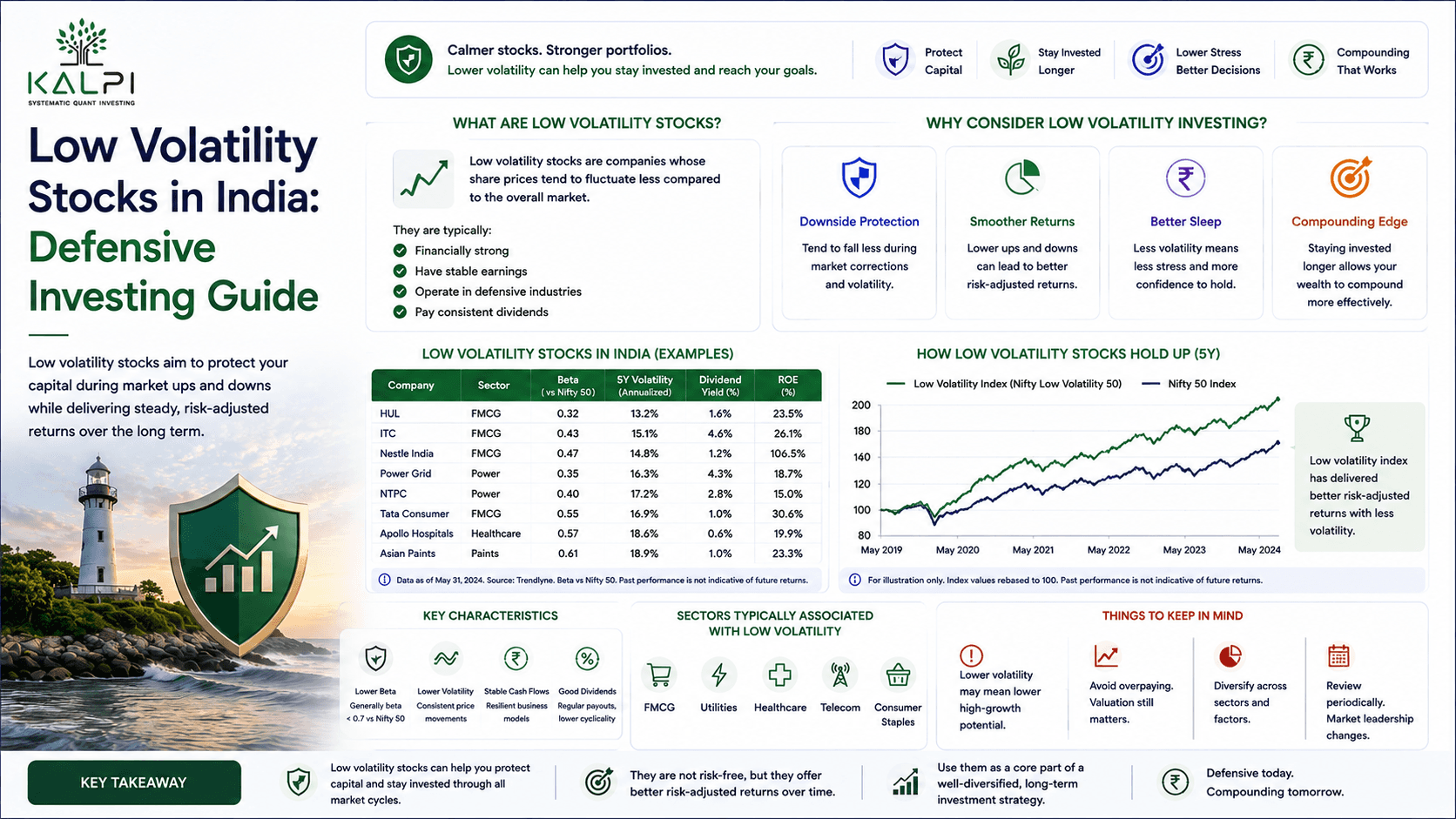
The stock market works in a similar way. Some companies witness sharp price swings whenever market sentiment changes. Others tend to move more steadily, even during uncertain periods. While no stock is completely immune to volatility, certain businesses have historically shown smaller price fluctuations than the broader market. These are commonly known as low volatility stocks in India.
They often attract investors who prefer stability over chasing the highest possible returns. Instead of focusing purely on rapid growth, these investors look for businesses that have shown resilience across different market conditions. That doesn’t mean low-volatility stocks always outperform. During strong bull runs, faster-growing sectors may deliver higher returns, but when markets turn uncertain, companies with steadier price behaviour tend to draw more attention.
This is partly why factor-based investing has grown in popularity. Rather than picking companies solely on market size or popularity, investors now weigh characteristics such as volatility, quality and value while building portfolios.
This guide walks through what makes low volatility stocks India different, unpacks the low volatility factor India, looks at the Nifty100 Low Volatility 30 index, and explains why so many investors lean on these businesses when building a long-term portfolio.
Why Some Stocks Move More Than Others
Not every company’s share price reacts to market events the same way. A young technology company launching new products may swing sharply whenever expectations shift. An established business with predictable earnings and steady demand, by contrast, tends to move more calmly.
The difference usually comes down to the nature of the business rather than the stock itself. Companies with stable revenue, consistent cash flows and an established market position create fewer surprises for investors. Businesses facing uncertain earnings, rapid expansion or shifting industry conditions tend to see much larger price swings.
This gap is the foundation low-volatility investing sits on. The goal was never to eliminate risk, since that’s impossible in equity markets. It’s about identifying companies that have historically moved less while still taking part in long-term wealth creation.
What Is the Low Volatility Factor?
Investment professionals often describe certain characteristics as factors, a factor being a measurable trait that has historically influenced returns over long periods. The low volatility factor India focuses on companies whose share prices have shown relatively smaller fluctuations compared with the broader market.
Decades of market research have found something counterintuitive: stocks with lower historical volatility have, in many markets, delivered competitive long-term returns without exposing investors to the sharpest swings. This pushed back against the popular belief that higher risk always means higher returns.
That said, this is a historical observation rather than a guarantee. Markets change, and no single strategy performs best in every environment. Even so, the low-volatility factor has become one of the most widely followed approaches in factor investing precisely because it leans on consistency alongside growth.

A low volatility strategy template on Kalpi’s platform, showing a defensive, rules-based approach built from the broader market.
What Makes a Company Less Volatile?
Not every stable stock belongs to the same industry, but many share a few common traits. These companies usually run established businesses with products or services people keep using regardless of whether the economy is booming or slowing down, which makes their earnings more predictable and gives investors fewer surprises to react to.
A few traits tend to show up again and again in lower-volatility businesses: consistent earnings over multiple years, healthy cash flows, sensible debt levels, an established market position, steady demand, and disciplined management and capital allocation.
None of this eliminates risk. Every listed company remains exposed to shifts in the economy, competition and market sentiment. What these traits often do, though, is lower the odds of sharp price swings driven by uncertainty about the business itself. That’s why many long-term investors look past short-term price noise and pay closer attention to the quality of the underlying business.
Understanding the Nifty100 Low Volatility 30 Index
One of India’s best-known examples of this approach is the Nifty100 Low Volatility 30 Index. Rather than picking from the entire market, it starts with the Nifty 100 universe and identifies companies that have historically shown relatively lower price volatility.
The aim isn’t to predict which stocks will deliver the highest returns next year. The focus stays on building a portfolio of companies that have shown greater price stability over time, following a predefined methodology instead of individual opinions or market predictions. The index gets reviewed periodically, letting companies enter or exit as they meet or fail the selection criteria.
This rules-based approach keeps the process consistent and strips out much of the emotion that tends to creep into investment decisions. For anyone exploring low volatility stocks India, the index works as a useful benchmark for seeing how this investing style plays out in practice.
Lower Volatility Doesn’t Mean Lower Risk
One of the biggest misconceptions about low-volatility investing is that it shields investors from losses. It doesn’t.
Even financially strong companies can decline during broad market corrections or periods of economic uncertainty. The difference usually lies in the size of the move, not its direction.
Picture two trees standing through the same storm. Both face identical winds, but one bends while the other suffers far less damage because it has grown a stronger root system over the years. Low-volatility stocks can behave in a similar way. They remain exposed to market risk because they’re still equities, but historically, many have experienced smaller price swings than the more aggressive corners of the market. Grasping this distinction helps investors set realistic expectations before adding defensive businesses to a portfolio.
Why Defensive Stocks Attract Long-Term Investors
Every market cycle has its own leaders. There are stretches when investors chase fast-growing companies capable of rapid earnings growth, and other stretches when attention shifts naturally towards businesses with stable operations, predictable cash flows and stronger balance sheets. That’s where defensive stocks India tend to receive more attention.
These companies typically sit in sectors where demand stays relatively steady regardless of where the economy is in its cycle. Consumers may put off buying a new car or renovating a home, but spending on everyday essentials and basic services rarely stops.
That doesn’t mean defensive stocks win in every market. During strong bull runs, high-growth sectors may pull ahead. During uncertain phases, though, investors often place more value on stability than aggressive growth. For most long-term investors, the point was never to build a portfolio made entirely of defensive names. It’s to build one that stays resilient across different market environments rather than leaning on a single investing style.
Can Low-Volatility Stocks Outperform the Market?
One question comes up almost every time someone starts exploring low volatility stocks India: can these stocks actually beat the broader market? The answer is yes, but not consistently.
No investing style leads in every cycle. During strong bull markets, high-growth sectors often grab investor attention and may outrun lower-volatility businesses. The picture looks very different once markets turn uncertain. Periods of volatility tend to shift investor focus towards companies with stable earnings, healthy balance sheets and resilient business models, and many low-volatility stocks have historically held up better than riskier parts of the market during such phases.
That doesn’t make them superior investments on their own. It simply reflects a basic reality of investing: different strategies work well under different conditions. Rather than betting on one approach to outperform every single year, experienced investors tend to build portfolios that can adapt as market environments shift over time.
Should You Include Low-Volatility Stocks in Your Portfolio?
There’s no universal answer here. The right choice depends on your financial goals, risk tolerance and investing style, more than your age or years of experience.
Some investors are comfortable with sharp market swings because they’re chasing maximum long-term growth. Others would rather accept steadier returns if it means fewer dramatic ups and downs along the way.
Low-volatility stocks may be worth considering if you prefer a more balanced investment approach, feel uneasy with large portfolio swings, are investing with a long horizon, want exposure to companies with relatively stable business models, or wish to balance higher-growth bets with more defensive holdings.
None of this means swapping every growth stock for a defensive one. Many well-diversified portfolios blend different investing styles. Holding both growth-oriented companies and steadier businesses gives exposure to a wider range of market conditions instead of depending on a single strategy to carry the portfolio through every phase.

A sector-diversified portfolio on Kalpi spreading exposure across banking, IT, energy and consumer names, the kind of allocation that blends defensive holdings with growth exposure.
Points to Keep in Mind Before Investing
Every investing approach comes with trade-offs, and low-volatility investing is no different. A few practical points are worth keeping in mind before making a decision.
Historical volatility doesn’t guarantee future stability, and even defensive businesses can decline during broad market corrections. Low-volatility strategies may lag during strong bull markets, and company fundamentals matter just as much as historical price movement. Diversification should stretch across sectors, industries and investing styles rather than leaning on a single factor. Volatility, after all, is only one part of a bigger picture.
Strong investment decisions usually come from weighing several factors together, including business quality, valuation, diversification and your own long-term financial goals.
Final Thoughts
Investing isn’t always about chasing the fastest-growing stock or guessing the next market winner. For many investors, success comes down to building a portfolio they can stay invested in through both good markets and difficult ones.
That’s where low volatility stocks India often earn their place. Companies with relatively stable price movements may not top every market rally, but plenty have shown resilience across different cycles, and for investors who value consistency alongside long-term wealth creation, that quality carries real weight.
Whether you invest in individual companies or follow indices such as the Nifty100 Low Volatility 30, it’s worth remembering that no single strategy performs best in every environment. Successful investing rarely comes from chasing whatever approach happens to be popular right now. It comes from building a portfolio you understand, staying patient through market cycles, and sticking to a disciplined process over the long haul.
Frequently Asked Questions
What are low-volatility stocks?
Low-volatility stocks are companies whose share prices have historically experienced smaller fluctuations than the broader market. They’re often associated with stable businesses, predictable earnings and relatively consistent demand.
What is the low volatility factor?
The low volatility factor India is an investing approach that focuses on companies with historically lower price volatility. It’s one of several factor-based strategies used to construct portfolios.
What is the Nifty100 Low Volatility 30 Index?
The Nifty100 Low Volatility 30 Index selects 30 companies from the Nifty 100 universe based on their historical price volatility, using a predefined rules-based methodology.
Are defensive stocks risk-free?
No. Defensive stocks India can still decline during market downturns. While they’ve historically shown relatively smaller price swings than many higher-risk stocks, they remain equity investments and carry market risk.
Who should consider low-volatility investing?
Low-volatility investing may suit long-term investors who prefer a steadier experience, want to reduce portfolio volatility, or are looking to diversify across different investing styles.