

Last Updated: July 2026
Imagine your laptop suddenly stops working a day before an important deadline. You don’t judge it based on how it performed yesterday. You think about how reliable it’s been over the past few years. If it has rarely let you down, you’re far more likely to trust it again.
Investing works in much the same way.
A few months of strong returns rarely tell the whole story. Markets go through rallies, corrections, recoveries and long stretches of sideways movement. That’s why experienced investors tend to look at performance over several years instead of reacting to short-term results.
This is where the comparison between an index fund and a rule-based stock basket becomes useful for anyone thinking long-term.
Both are built to help investors grow wealth, but they take very different routes. An index fund simply mirrors a market index, while a rule-based stock basket selects companies using predefined investment rules. One aims to match the market. The other aims to build a portfolio through a disciplined selection process.
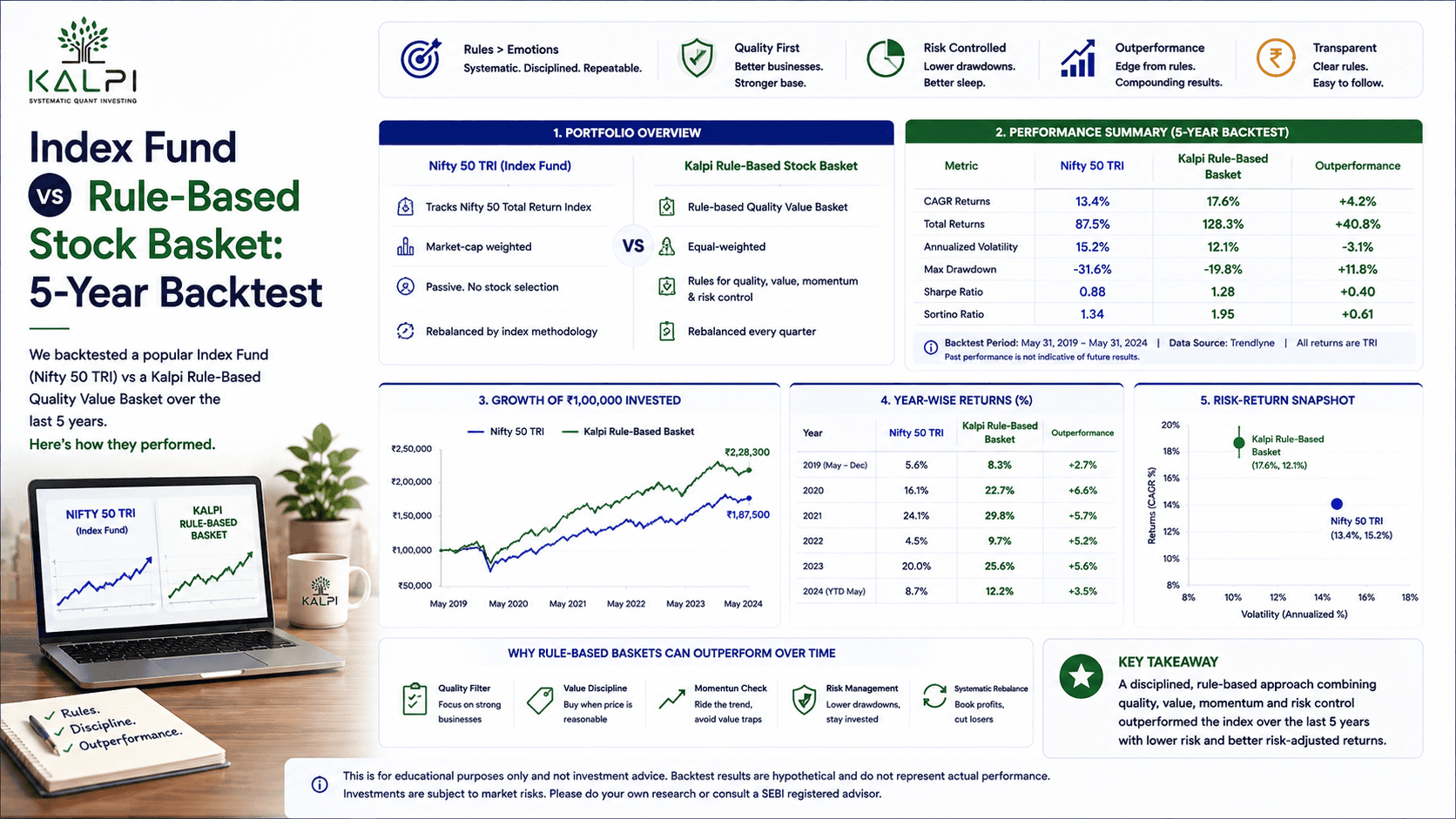
A 5-year backtest cannot predict future returns, but it can show how a strategy would have behaved across different market conditions. Looking beyond short-term performance often gives investors a clearer picture of consistency, volatility and long-term discipline.
In this article, we’ll compare index fund vs stock basket, look at passive vs rule based investing, explore the Nifty index vs basket approach and discuss whether a rule-based strategy can realistically beat the index over time.
Why Do Investors Compare These Two?
Most people don’t start investing because they specifically want an index fund or a stock basket. They just want a reliable way to grow their money.
The confusion begins because both options appear to offer the same thing: exposure to multiple companies through a single investment.
One investor swears by index funds because they’re simple and need almost no maintenance. Another prefers a rule-based stock basket because it follows a structured process instead of owning every company in an index.
Both arguments hold up.
The real question isn’t which option is universally better. It’s which one suits your investment style, goals and how involved you want to be.
Understanding how these approaches actually work is often more useful than comparing returns alone.
What Is an Index Fund?
An index fund is an investment product built to replicate the performance of a market index.
Instead of picking individual stocks, the fund invests in the companies that already form part of the chosen index. When the index composition changes, the fund adjusts its portfolio to match.
For example, a Nifty 50 index fund invests in the companies included in the Nifty 50. If the index rises, the fund generally rises too. If the index falls, the fund usually follows.
The goal isn’t to outperform the market. It’s to move with it.
Because investment decisions are based on the index rather than a fund manager’s stock picks, index funds are considered a passive investment.
What Is a Rule-Based Stock Basket?
A rule-based stock basket is a portfolio built using a predefined investment framework.
Instead of buying every company in an index, the strategy selects stocks only after they meet specific conditions. These conditions may include:
- Financial strength
- Earnings growth
- Valuation
- Quality
- Momentum
- Market capitalisation
Only companies that meet these predefined criteria make it into the basket.
The portfolio is reviewed at regular intervals. If a company no longer meets the criteria, it may be replaced at the next rebalance.
Since every decision follows the same framework, the process cuts down on emotional decision-making and keeps the strategy consistent over time.

Rule-Based Strategy Builder Interface | Alt text: Screenshot of a strategy builder showing universe, filters, ranking and weighting steps for a rule-based stock basket
A rule-based stock basket is built through defined steps, universe selection, filters, ranking and weighting, rather than manual stock picking.
Passive vs Rule Based Investing
The core difference in the passive vs rule based debate comes down to how investment decisions are made.
Passive investing aims to mirror the market exactly as it exists. A passive strategy automatically owns the companies included in the index.
Rule-based investing follows a predefined process to identify and review investments. A rule-based strategy evaluates companies against specific criteria before adding them to the portfolio. As market conditions and company fundamentals shift, the portfolio can change too, but only during scheduled reviews.
Neither approach is inherently better.
Passive investing offers simplicity and broad diversification. Rule-based investing offers a structured framework focused on disciplined stock selection rather than emotion.
The better choice depends on the kind of investor you are and how involved you want to be in managing your portfolio.
Nifty Index vs Basket: Understanding the Difference
Many investors compare the Nifty index vs basket because both provide exposure to multiple companies. The way they’re built, though, is quite different.
A Nifty index follows rules set by the index provider. Companies enter or leave the index only when they meet those eligibility criteria.
A rule-based stock basket follows its own investment methodology. Depending on the strategy, it may include companies outside the Nifty or leave out some companies that are part of the index.
Think about two students preparing for the same competitive exam. One studies every chapter exactly as it appears in the syllabus. The other identifies the topics carrying the highest weightage and builds a study plan around them. Both want the same result, but they get there differently.
Investing works in a similar way. An index fund follows the market as it exists. A rule-based basket follows a predefined process to select investments.
Neither approach guarantees better returns. They simply reflect two different ways of investing.
Why Does a 5-Year Backtest Matter?
Judging a strategy on just a few months of performance can be misleading. A strong year doesn’t automatically make a strategy superior, and one weak year doesn’t necessarily mean it has failed.
That’s why long-term investors tend to study performance across different market phases rather than fixating on short-term numbers.
A 5-year backtest shows how a strategy would have behaved during rallies, corrections and recoveries. More importantly, it answers questions that recent returns alone can’t:
- Was the strategy consistent?
- How deep were the declines?
- How quickly did it recover?
- Did it keep following the same investment process as market conditions changed?
Looking at these answers gives investors a far clearer picture than focusing only on last month’s or last year’s returns.
Can a Rule-Based Stock Basket Beat the Index?
One question almost every investor asks while comparing an index fund vs stock basket is simple: can a rule-based basket actually beat the index?
The honest answer is that it can, but not always.
A rule-based stock basket isn’t designed to outperform the market every single year. Instead, it follows a predefined investment process regardless of whether markets are rising or falling.
There will be periods when the index delivers stronger returns. There will also be phases when a well-constructed rule-based basket does better. The outcome depends on market conditions, the quality of the rules being followed and how consistently those rules are applied.
That’s why experienced investors rarely judge a strategy on one exceptional year. They prefer to evaluate how it performs across an entire market cycle.
What Does a 5-Year Backtest Actually Show?
A backtest applies an investment strategy to historical market data to see how it would have performed in the past.
It’s worth remembering that a backtest isn’t a prediction of future returns. Markets constantly evolve, and no strategy performs the same way forever.
Even so, a backtest offers useful insights. It can help investors understand:
- Whether the strategy stayed consistent across different market conditions
- How much volatility it experienced
- How deep the portfolio declined during corrections
- How quickly it recovered after downturns
- Whether it kept following the same investment process throughout
Together, these insights help investors judge a strategy beyond just yearly returns.
Index Fund vs Stock Basket During Different Market Phases
Markets don’t move in a straight line.
Some years are driven by broad rallies where most companies participate. At other times, only a handful of sectors or businesses lead the market while the rest struggle.
An index fund participates in whatever the index delivers, because it owns every company included in that benchmark.
A rule-based stock basket works differently. Instead of holding every company in an index, it selects businesses using predefined investment rules. The portfolio changes only when those rules require it. If a company no longer meets the selection criteria, it may be replaced at the next scheduled review.
This disciplined process helps reduce emotional decision-making and keeps the portfolio aligned with its original investment framework.
Neither approach guarantees better performance. They simply respond differently to changing market conditions.
Why Consistency Often Matters More Than One Big Year
Imagine two students preparing for the same entrance exam. One studies consistently through the year, while the other crams intensively in the final few weeks.
The second student might score well on a particular test, but the first is more likely to perform consistently over the long run because of steady preparation.
Investing works in a similar way. A strategy that delivers one extraordinary year but struggles for the next four may not create better long-term outcomes than one that grows steadily across different market environments.
That’s one reason experienced investors pay closer attention to consistency than to chasing the highest recent returns.

Portfolio Returns vs Benchmark Comparison | Alt text: Bar chart comparing portfolio and benchmark CAGR, volatility and risk-adjusted returns over a multi-year period
Comparing CAGR, volatility and risk-adjusted returns over several years gives a far more reliable picture than judging a strategy on a single year.
Passive vs Rule Based: Which Approach Fits Different Investors?
The passive vs rule based discussion isn’t about finding a universal winner. It’s about understanding which approach matches your investing style.
Passive investing may suit investors who want broad market exposure without regularly reviewing individual companies. The goal is to participate in overall market growth while keeping the process simple.
Rule-based investing may appeal to investors who prefer a structured selection process built around predefined criteria. Instead of owning every company in an index, the portfolio focuses only on businesses that continue to satisfy those investment rules.
Neither approach removes market risk. Both demand patience, discipline and a long-term perspective.
In the end, the better approach is the one you understand well enough to stay invested in through good markets and difficult ones alike.
Can You Use Both an Index Fund and a Rule-Based Stock Basket?
Many investors feel they have to pick one approach over the other. That isn’t always true.
The index fund vs stock basket debate doesn’t have to end with a single winner. Since both approaches serve different purposes, some investors hold both in the same portfolio.
An index fund can provide broad exposure to the overall market, while a rule-based stock basket follows a predefined process to select companies based on specific investment criteria.
Whether that combination makes sense for you depends on your financial goals, risk appetite and how actively you want to manage your investments.
Rather than asking which option is better, it’s often more useful to ask whether each investment has a clear role within your portfolio.
Common Mistakes Investors Make
No matter which approach an investor chooses, a few mistakes tend to show up repeatedly.
Chasing Recent Performance
A strategy that has performed well over the last year often grabs the most attention. Many investors move their money simply because they see recent returns, assuming the same performance will continue.
Markets don’t usually work that way. Leadership changes over time, and investment styles go through different phases. Choosing an investment based only on recent performance can mean buying after prices have already risen significantly.
Ignoring How the Strategy Works
Returns tell only part of the story. Before investing, it helps to understand how the portfolio is actually managed. Questions worth asking include:
- How are companies selected?
- How often is the portfolio reviewed?
- When are stocks added or removed?
- Does the investment process stay consistent over time?
Understanding these points usually builds more confidence than simply looking at historical returns.
Expecting Outperformance Every Year
Some investors expect a strategy to beat the market every single year. That expectation isn’t realistic.
Even strong investment approaches go through periods when they lag the broader market. Looking at performance across a full market cycle gives a fairer picture than focusing on one exceptional year.
Looking Beyond Returns
When comparing passive vs rule based investing, returns should never be the only consideration. The better choice often depends on the investor rather than the strategy itself.
Think about questions such as:
- How much time can you dedicate to investing?
- Do you enjoy researching businesses?
- Are you comfortable reviewing your portfolio regularly?
- Would you rather follow a structured investment process?
The answers often matter just as much as the performance numbers. Choosing an investment approach that matches your habits makes it easier to stay disciplined over the long term.
Final Thoughts
The comparison between index fund vs stock basket isn’t about declaring one option superior. Both approaches are built with different objectives in mind.
An index fund aims to mirror the performance of a market index, while a rule-based stock basket follows a predefined process to select companies based on specific investment rules.
Neither approach guarantees better returns, and neither avoids market risk.
For investors weighing the Nifty index vs basket question, the more useful question isn’t which strategy performs best in every single year. It’s which approach suits their investment style and helps them stay consistent over the long run.
Successful investing rarely comes from chasing the next best strategy. It usually comes from understanding your investment process, staying patient through market cycles, and following it with discipline.
Frequently Asked Questions
What is the difference between an index fund and a stock basket?
An index fund tracks a market index and gives investors exposure to the companies included in that benchmark. A stock basket is a selected group of companies built around a particular strategy, theme or investment approach.
Can a rule-based stock basket beat the index?
It can, but there’s no guarantee. Performance depends on the investment strategy, market conditions and how consistently the rules are followed. Past performance should never be treated as an indicator of future results.
Which is better: passive investing or rule-based investing?
Neither approach is universally better. Passive investing offers broad market exposure with a simple structure, while rule-based investing follows predefined criteria to select companies. The right choice depends on the investor’s objectives and preferences.
Can I invest in both an index fund and a stock basket?
Yes. Some investors combine both approaches to balance broad market exposure with a more focused strategy. The appropriate mix depends on individual financial goals and risk tolerance.
What should investors compare besides returns?
Investors should also consider the investment process, diversification, costs, review frequency and whether the strategy aligns with their long-term financial goals.