

Last Updated: July 2026
Picture a housing society’s fire safety cupboard. Someone has stocked it generously: extinguishers, torches, first-aid kits. Open it properly, though, and you find six torches, three expired extinguishers, and no bandages at all. From a distance, the cupboard looks well-equipped. Up close, it’s lopsided.
Plenty of Indian equity portfolios have the same problem.
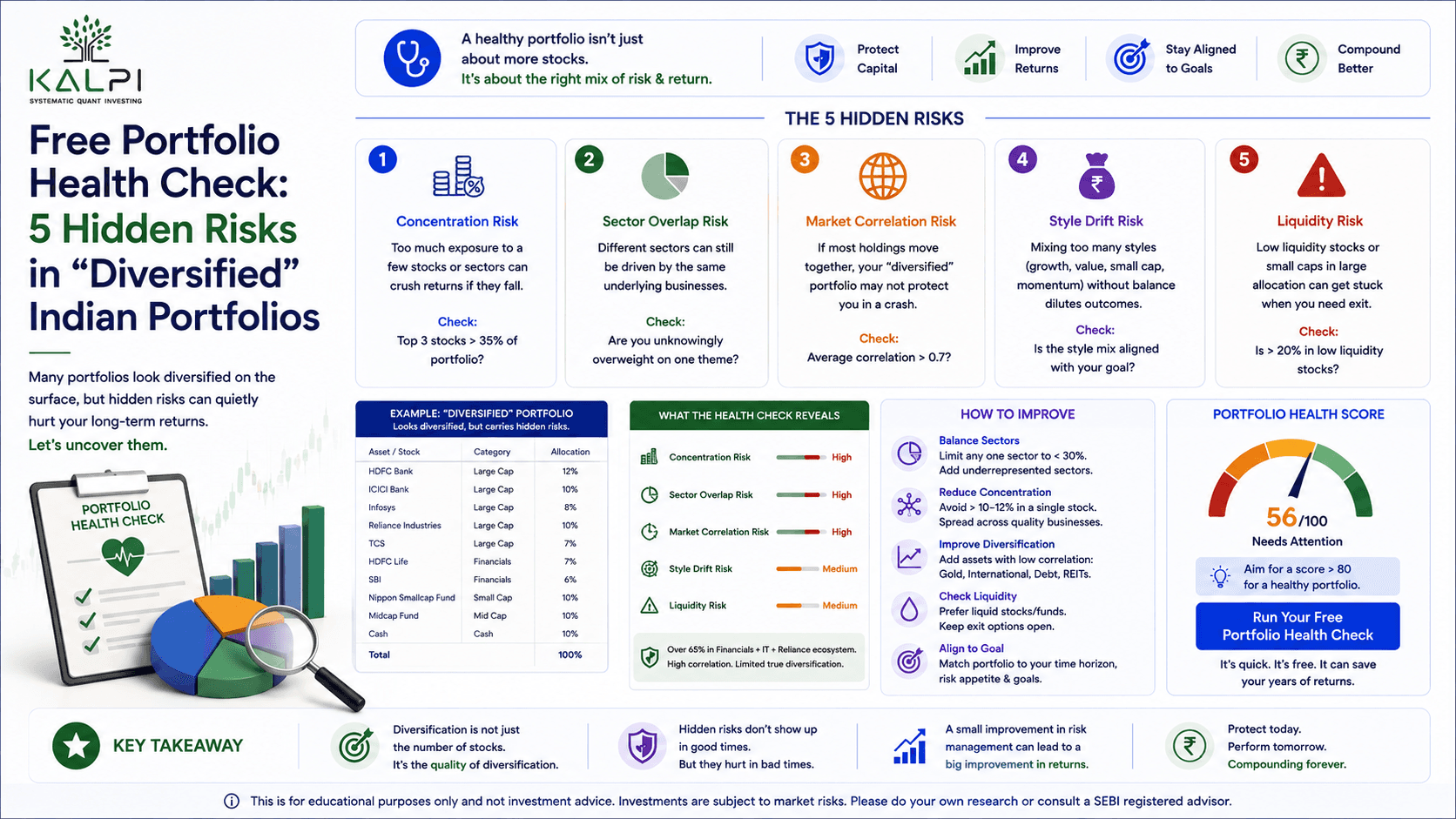
Owning 20 or 30 stocks feels like diversification. Look closer, though, and several of those names often belong to the same sector, respond to the same interest rate cycle, or move on the same set of triggers. The portfolio appears spread out. The risk isn’t.
This is precisely why a periodic portfolio health check earns its place in an investor’s routine. Diversification was never about the stock count. It’s about whether your holdings are actually exposed to different things going wrong.
A free portfolio analyzer now does much of this legwork automatically, flagging concentration risk, allocation gaps and other blind spots that are nearly impossible to catch by eyeballing a stock list.
This piece walks through five hidden risks that show up again and again inside portfolios that look diversified on paper, why each one matters, and how a structured portfolio risk audit helps investors fix what a quick glance would miss.
Why Diversification Isn’t Just About Owning More Stocks
A common assumption among investors is that more holdings automatically mean less risk.
That isn’t quite how it works.
Think of a debate team where every member has prepared the same argument. There’s no shortage of speakers, but the team has one point of view and one blind spot. If the opposition attacks that single weakness, the whole team struggles, regardless of how many people are on stage.
Portfolios run into the same trap. A basket of 25 stocks can still be fragile if most of them sit in one sector or respond to the same economic lever. Load up on banking names, for instance, and the holding count climbs while the underlying dependency stays exactly where it was: on one sector’s fortunes.
Genuine diversification comes from holding businesses that don’t all flinch at the same news.
Seasoned investors, as a result, worry less about how many stocks they hold and more about how differently those stocks behave under stress.
What Is a Portfolio Health Check?
A portfolio health check is a structured review built to surface risks that don’t announce themselves on a statement showing profit and loss.
Instead of stopping at “how much have I made,” it digs into sharper questions:
- Is too much capital sitting in one sector?
- Have one or two stocks quietly become oversized positions?
- Are several holdings exposed to the same economic risk, even if their business models differ?
- Is the portfolio balanced across company sizes and industries?
- Does it still reflect the strategy you originally set out to follow?
Working through these questions shows whether a portfolio is genuinely diversified, or simply looks that way at first glance.
A portfolio review in India now takes minutes rather than hours, thanks to digital tools that analyse sector allocation, concentration risk and diversification without any manual number-crunching.
These tools won’t predict tomorrow’s winners or guarantee returns. What they offer instead is clarity, so decisions are grounded in what the portfolio actually holds rather than in how it feels to own it.

Portfolio allocation and stock-level performance side by side, a quick way to spot whether a handful of holdings are carrying most of the weight.
Sector Concentration: More Stocks Doesn’t Always Mean More Diversification
Fifteen or twenty stocks in a portfolio tend to create a comfortable, well-spread feeling.
That comfort can be misleading. True diversification isn’t a function of headcount. It depends on whether those businesses face different risks.
Take an investor holding a couple of private banks, a housing finance company, an insurer and an asset manager. Four different business lines on paper, yet a large share of the portfolio still rises and falls with one thing: the health of the financial sector.
If interest rates climb, regulations tighten or credit growth slows, several of these positions could move down together, not because the businesses are identical, but because they share the same weather system.
This is sector concentration risk, and it’s one of the most frequent findings in any portfolio health check.
Looking past the headline number of holdings is usually what separates a portfolio that’s diversified from one that only appears to be.
Hidden Stock Overlap
Portfolios rarely get built in a single sitting.
Most investors add positions gradually: a stock here, an index fund there, a thematic basket somewhere down the line. Each purchase feels like its own decision, made independently of the last.
Step back and view the whole portfolio together, though, and a different pattern often surfaces.
A company held directly might also sit inside an index fund, and turn up again in a separate thematic product. Bought one at a time, this overlap is nearly invisible.
The result is that actual exposure to a single company can run far higher than the investor ever intended.
A periodic review pulls this hidden overlap into view and gives a far more honest picture of where the portfolio’s risk is actually sitting.
When Winners Become Too Large
A balanced portfolio rarely stays balanced on its own.
Market movements reshape the weight of each holding over time, quietly and without asking permission.
Consider a joint family kitchen where ingredients start out neatly proportioned. Over months, one shelf keeps filling up because that particular spice gets used, and restocked, more than any other. Nothing looks wrong day to day, but eventually one shelf is doing all the work while the rest sit half-empty.
A stock performing well is never the issue. The trouble starts when it quietly grows into a far bigger share of the portfolio than was ever intended.
Left unchecked, a single strong performer can end up dictating the fate of the entire portfolio.
Reviewing portfolio weights periodically keeps a winning stock from becoming an unplanned concentration risk.

Breaking annual returns into market, factor and unexplained components shows how much of a portfolio’s risk isn’t obvious from the holdings list alone.
Different Companies Can Still Carry the Same Risk
Seeing varied company names in a portfolio naturally creates a sense of diversification.
Sometimes that instinct is right.
Sometimes it isn’t.
Picture a portfolio holding a paint manufacturer, a home improvement company and a housing finance business. Three different industries by classification, yet all three tend to do well in a strong housing market and struggle together the moment housing demand cools.
The businesses look distinct on a spreadsheet, but they answer to many of the same economic forces.
This is correlated risk, and it hides in plain sight because the company names suggest variety even when the underlying drivers don’t.
Spotting these hidden connections makes it far easier to build a portfolio diversified by risk, not merely by the number of logos in it.
A thorough portfolio review in India routinely surfaces these relationships, helping investors see where their holdings are more exposed than the stock list alone would ever reveal.
Hidden Risk : Your Portfolio May No Longer Reflect Your Priorities
Think about your phone’s home screen. A few years ago, the apps you used every day sat right at the top. Today, many of them are buried in folders because your priorities have changed. Investment portfolios can evolve in much the same way.
The investments that suited your goals a few years ago may not be the ones that best fit your life today. A higher income, new financial responsibilities, a growing family or a shorter investment horizon can all change how much risk you’re comfortable taking.
Investments, however, often remain untouched because regular portfolio reviews tend to get pushed aside.
That’s why it’s worth asking yourself one simple question:
“If I were building my portfolio today, would I still choose these same investments?”
A portfolio health check isn’t just about measuring returns. It helps investors understand whether their portfolio still matches their current goals, risk tolerance and long-term plans.
Sometimes the biggest risk isn’t owning the wrong investment. It’s holding the right investments for the wrong stage of life.
Looking Beyond Returns
When investors open their portfolio, the first thing they usually notice is the overall return.
The problem is that returns tell only part of the story.
Two portfolios might have delivered similar performance over the past few years while carrying very different levels of risk. One could be well spread across sectors and businesses, while the other depends heavily on a handful of companies.
A useful review goes a step further. It looks at how the portfolio is built, not just how it has performed. Questions worth asking include:
- Is one sector taking up a larger share of the portfolio than intended?
- Have a few holdings quietly grown much bigger over time?
- Are different investments giving exposure to the same companies?
- Does the portfolio still support today’s financial goals?
The purpose isn’t to predict the market’s next move.
It’s to understand whether the portfolio you’re holding today is still the portfolio you intended to own.
Small Reviews Can Prevent Bigger Problems
Think about a pair of running shoes. They don’t wear out overnight. The changes are gradual, which is why most people notice the problem only when the shoes become uncomfortable. Portfolios often drift in the same way.
One stock performs exceptionally well and grows into a much larger holding. One sector quietly becomes dominant. New investments are added while older ones are rarely reviewed.
None of these changes seem significant on their own.
Together, however, they can leave a portfolio carrying far more concentration risk than the investor ever planned.
That’s why experienced investors review their portfolios periodically. Not because they expect something to be wrong, but because small adjustments are usually easier than major corrections later.
For many long-term investors, reviewing a portfolio once or twice a year is often enough to make sure everything still looks balanced.
Five Questions Worth Asking Yourself
Before making your next investment decision, pause for a moment and ask yourself:
- If I were starting from scratch today, would I build the same portfolio?
- Is my money spread across different sectors or concentrated in just a few?
- Have any holdings become much larger than I originally intended?
- Am I investing because the research supports it, or because recent headlines make it feel attractive?
- Does this portfolio still reflect the financial goals I’m working towards?
These questions don’t require complicated calculations.
Sometimes they simply encourage investors to look at their portfolio from a different perspective.
If the answers reveal areas of concern, a structured portfolio risk audit can help identify where attention may be needed.
Final Thoughts
A portfolio doesn’t become safer simply because it contains more investments.
What matters is whether those investments genuinely reduce overall risk or quietly increase it through concentration and overlap.
That’s why reviewing a portfolio is just as important as building one.
Whether you invest through stocks, mutual funds, ETFs or stock baskets, taking a step back every so often helps ensure your investments continue working together in a balanced way.
Building a portfolio is only the beginning. Reviewing it from time to time helps ensure it continues to reflect your goals instead of yesterday’s decisions.
Frequently Asked Questions
What is a portfolio health check?
A portfolio health check is a structured review of your investments that evaluates diversification, sector allocation, concentration risk and whether the portfolio still aligns with your financial goals.
How often should I review my portfolio?
There’s no universal rule. Many long-term investors review their portfolios once or twice a year, or after major financial or life changes that could affect their investment objectives.
What is a portfolio risk audit?
A portfolio risk audit examines how your investments are distributed across companies and sectors, identifies hidden concentration or overlap, and highlights areas where overall portfolio risk may be higher than expected.
Can a free portfolio analyzer guarantee better returns?
No. A free portfolio analyzer cannot predict future market performance or guarantee returns. Its purpose is to provide a clearer picture of your portfolio’s strengths, weaknesses and potential risks.
Why is diversification important?
Diversification spreads investments across different companies, sectors and asset types. While it cannot eliminate market risk, it can reduce the impact of any single investment or sector having a poor performance.