

Last Updated: July 2026
Imagine you’re travelling to work during the monsoon.
Two people leave home at the same time. One rides a motorcycle, while the other takes the metro. When the rain suddenly gets heavier, the motorcyclist slows down immediately, but the metro continues almost as usual.
Both are travelling towards the same destination, yet one reacts much more sharply to changing conditions.
Stocks behave in a surprisingly similar way.
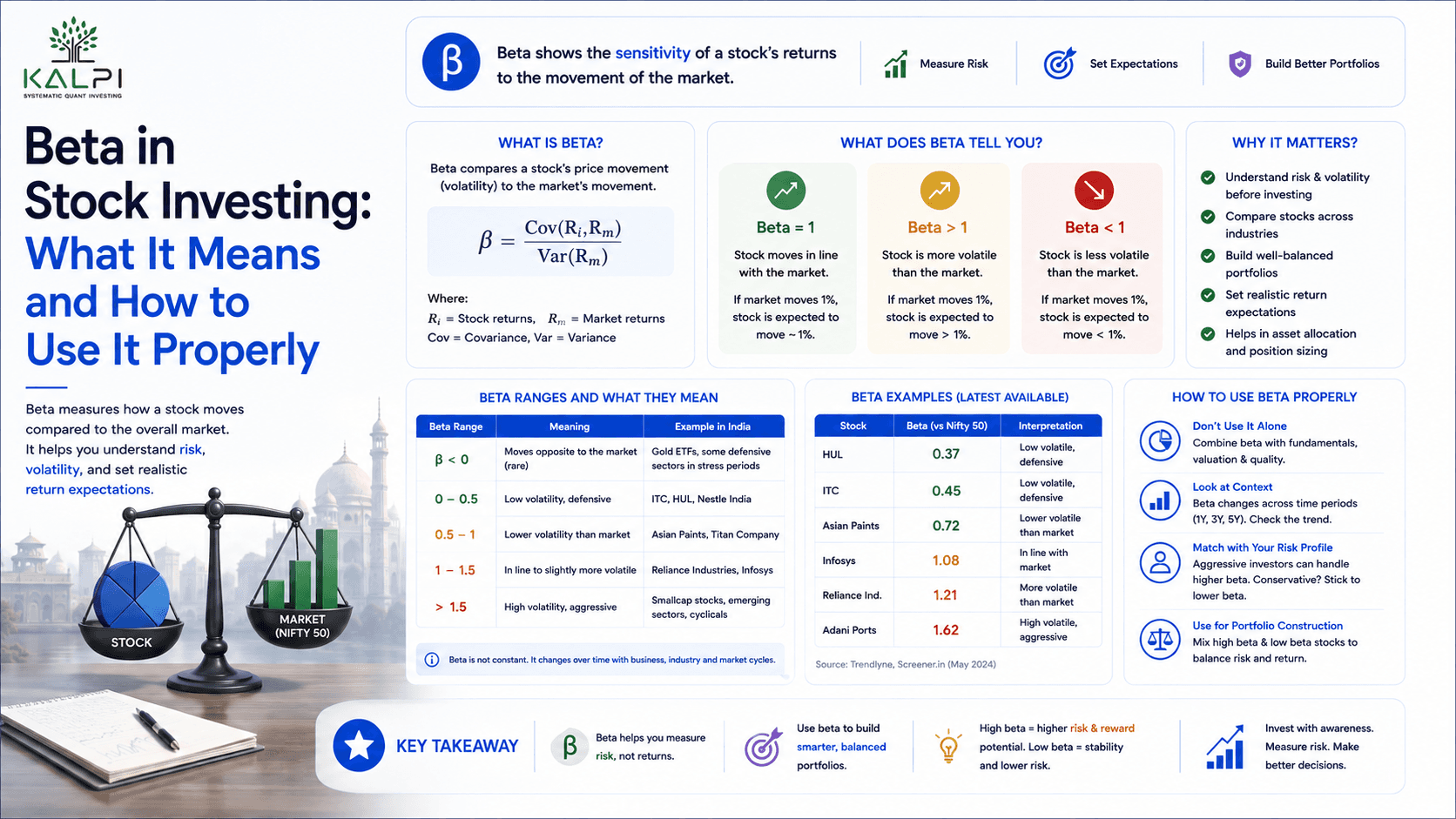
Whenever the market rises or falls, some companies experience much bigger price movements than others. A few stocks barely react, while others can swing dramatically even when the broader market moves only a little. Understanding the Beta Stocks Meaning helps explain why this happens.
Beta is one of the most widely used measures of market risk. Rather than telling investors whether a company is fundamentally strong or weak, it indicates how sensitive a stock has historically been to movements in the overall market.
For long-term investors, Beta isn’t something to look at in isolation. Instead, it serves as another piece of the puzzle, helping explain how a stock might behave under different market conditions.
In this guide, we’ll break down Beta in Stocks India, explain Beta Calculation Stocks in simple terms, compare High Beta and Low Beta Stocks, and explore how investors can use Beta while building a balanced portfolio.
What Does Beta Mean in Stocks?
Beta measures how much a stock has historically moved compared with the overall market.
Think of the market as a large wave moving across the ocean. Some boats rise and fall almost exactly with that wave. Others bounce much higher, while a few remain comparatively steady despite the changing water.
Beta attempts to describe that relationship.
If a stock has a Beta close to 1, it has generally moved in line with the market. When the broader market gained or declined, the stock tended to move by a similar proportion.
A Beta above 1 suggests the stock has historically been more volatile than the market. On the other hand, a Beta below 1 indicates that its price movements have usually been less dramatic.
This doesn’t automatically make one stock better than another.
A higher Beta simply tells us that the stock has tended to react more strongly to changes in market sentiment. Likewise, a lower Beta doesn’t mean a stock is safer in every situation. It only suggests that its historical price movements have generally been less sensitive to market swings.
It’s also worth remembering that Beta is based on past data. It reflects how a stock behaved over a particular period and shouldn’t be treated as a guarantee of how it will behave in the future.
Why Does Beta Matter?
For most investors, returns are the first thing they notice.
Questions like “How much has this stock gained?” or “How fast has it grown?” naturally attract attention.
Equally important, however, is understanding how those returns were achieved.
Imagine two stocks delivering almost identical returns over three years.
The first moved steadily, with relatively small ups and downs along the way. The second regularly experienced sharp rallies followed by equally sharp declines before eventually reaching the same destination.
Although the final return looks similar, the experience of holding those stocks would have felt very different.
That’s where Beta becomes useful.
It adds context by showing how sensitive a stock has historically been to broader market movements. An investor comfortable with larger price swings may not mind owning higher-Beta companies. Someone else may prefer businesses that have historically displayed steadier price behaviour.
Neither approach is universally right or wrong.
The better choice usually depends on your investment horizon, financial goals and personal comfort with market volatility rather than Beta alone.
How Is Beta Calculated?
Many finance websites display a stock’s Beta as a single number, making it appear far simpler than the process behind it.
In reality, Beta Calculation Stocks involves comparing a stock’s historical price movements with those of a benchmark market index over a selected period.
The objective isn’t to measure returns.
Instead, the calculation looks at how closely a stock’s movements have matched—or differed from—the broader market. If a company’s share price has typically moved more sharply than the benchmark, it will generally have a higher Beta. If its movements have been comparatively smaller, the Beta tends to be lower.
The good news is that investors rarely need to calculate Beta themselves.
Most financial platforms already display this figure, allowing investors to focus on interpreting what it means rather than working through the calculation.
Understanding Beta is far more valuable than memorising how it’s calculated. Used alongside business quality, valuation and diversification, it becomes another tool for making better-informed investment decisions rather than a number to follow blindly.

A portfolio’s drawdown compared with its benchmark on Kalpi, the kind of movement pattern Beta is built to describe.
High Beta vs Low Beta Stocks
Once you understand what Beta measures, the obvious question follows.
Is a higher Beta better, or should investors look for a lower one?
Neither.
Beta doesn’t rank companies from good to bad. It simply shows how strongly a stock has historically reacted when the overall market moved.
Imagine two friends on a roller coaster.
One enjoys the fastest ride in the amusement park because every twist and drop feels exciting. The other chooses a slower ride that still offers the experience but without the sudden jolts.
Both leave the park having enjoyed themselves. They simply preferred different kinds of rides.
Investing isn’t very different.
Some investors are comfortable watching their portfolio swing sharply if they believe it could deliver higher long-term returns. Others would rather accept a steadier journey, even if it means giving up some upside during strong market rallies.
Beta helps explain where a stock has historically fallen on that spectrum.
What Are High Beta Stocks?
A stock with a Beta greater than 1 has historically moved more than the broader market.
When markets have been optimistic, these stocks have often climbed faster than the benchmark. During market corrections, however, they’ve also tended to fall more sharply.
That behaviour doesn’t automatically make them risky investments in the traditional sense. It simply means their share prices have been more sensitive to changes in overall market sentiment.
Companies operating in sectors such as technology, capital goods or automobiles sometimes display higher Beta values because investor expectations in these industries can change quickly. Still, Beta is calculated for individual stocks, so companies within the same sector may have very different readings.
Higher-Beta stocks often appeal to investors who:
- Can tolerate larger price swings.
- Have a long investment horizon.
- Understand that periods of stronger gains may also come with deeper declines.
Looking only at the potential upside without recognising the added volatility can create unrealistic expectations. Beta is useful because it reminds investors that higher returns and higher fluctuations have often gone hand in hand.
What Are Low Beta Stocks?
Low Beta Stocks have historically shown smaller price movements than the market.
That doesn’t mean they’re protected from falling prices. If the broader market declines, these companies can decline too. The difference is that their movements have often been less pronounced.
Many businesses with lower Beta operate in industries where demand remains relatively steady regardless of economic conditions. Consumers may postpone buying a new car, but they still need medicines, electricity or everyday household products.
That’s one reason healthcare, utilities and consumer staples are frequently associated with lower-Beta companies, although every stock should be assessed on its own merits.
For investors who value consistency, lower-Beta stocks can make it easier to stay invested during volatile periods instead of reacting to every market headline.
Can a Stock’s Beta Change?
Absolutely.
Beta isn’t a permanent label attached to a company.
It reflects historical behaviour, and history changes.
A business expanding into new markets, taking on additional debt or entering a faster-growing industry may begin reacting differently to market movements than it did a few years earlier.
Market conditions also play a role. During periods of uncertainty, investors often respond more aggressively to news, which can influence how individual stocks move relative to the benchmark.
That’s why experienced investors treat Beta as a reference point rather than a fixed characteristic. Reviewing an old Beta value without considering what’s changed since then can paint an incomplete picture.
Understanding Beta in the Indian Market
The concept behind Beta in Stocks India is no different from the rest of the world.
The comparison is usually made against a broad market benchmark, such as the Nifty 50, to understand how closely a stock has moved alongside the market over a period of time.
A Beta close to 1 suggests that the stock has broadly tracked the benchmark. A reading above or below that level indicates that its historical movements have generally been more aggressive or more restrained.
Even so, Beta answers only one question.
It tells you how a stock has moved compared with the market.
It doesn’t explain whether the company has strong management, healthy cash flows, sustainable profits or an attractive valuation.
That’s why Beta works best as one part of a broader research process rather than as a shortcut for making investment decisions.
Should Beta Influence Every Investment Decision?
Beta is a useful metric, but it was never designed to answer every investment question.
Imagine buying a car.
Fuel efficiency might matter to you, but it probably wouldn’t be the only thing you looked at. Safety, reliability, maintenance costs and comfort would all play a part before making a decision.
Investing works in much the same way.
Beta explains how a stock has historically reacted when the broader market moved. It doesn’t tell you whether the business has strong cash flows, sensible management or a sustainable competitive advantage.
Looking at Beta on its own leaves part of the story untold.
That’s why investors often treat it as one input among many instead of allowing a single number to drive an entire investment decision.
Using Beta While Building a Portfolio
Looking at one stock is useful.
Looking at an entire portfolio is where Beta often becomes more meaningful.
Imagine a cricket team made up entirely of fast bowlers. Every player may be talented, but the team would still have an obvious weakness.
A portfolio can face a similar problem.
If every holding reacts sharply whenever the market moves, the overall portfolio may become more volatile than the investor intended. On the other hand, filling a portfolio only with lower-Beta companies may reduce fluctuations but could also limit exposure to businesses capable of stronger growth during favourable market conditions.
For many investors, the objective isn’t to build a portfolio filled with either high- or low-Beta stocks.
It’s to understand how different businesses work together and whether the overall level of risk matches their financial goals.
Seen this way, Beta becomes less about selecting individual winners and more about building a portfolio that’s comfortable to stay invested in through changing market conditions.

A correlation matrix and asset returns table on Kalpi, the kind of view investors use to check whether their holdings move too closely together before relying on Beta alone.
What Beta Doesn’t Tell You
Beta answers one specific question.
It tells you how a stock has historically moved in relation to the market.
It doesn’t explain whether the company earns consistent profits, carries manageable debt or trades at an attractive valuation.
Two companies can have similar Beta values while being completely different businesses.
One may have steadily growing earnings and a healthy balance sheet. Another could be struggling with declining profits or operational challenges.
That’s why experienced investors rarely stop their research after checking Beta.
Understanding the business itself remains just as important as understanding how its share price has behaved in the past.
Final Thoughts
Understanding the Beta Stocks Meaning helps investors see the market from a different perspective.
Some companies have historically moved more than the broader market, while others have shown relatively steadier price behaviour. Neither characteristic is automatically good or bad. It simply reflects how those stocks have responded to changing market conditions over time.
Beta becomes far more useful when it’s viewed alongside business quality, valuation and diversification instead of replacing them.
Used thoughtfully, it can help investors set realistic expectations about portfolio behaviour and make decisions that better match their financial goals and risk tolerance.
No single number can tell you whether a stock deserves a place in your portfolio.
Beta simply adds another piece to that decision—and that’s exactly where its value lies.
Frequently Asked Questions
What is Beta in stocks?
Beta measures how much a stock has historically moved compared with a broader market index. It helps investors understand a stock’s historical sensitivity to market movements.
What does a Beta greater than 1 indicate?
A Beta above 1 suggests that the stock has historically experienced larger price movements than the overall market. Both gains and declines have often been more pronounced.
Are Low Beta Stocks always safer?
Not necessarily. Low Beta Stocks have generally shown smaller price fluctuations than the market, but they can still lose value. Beta measures historical volatility, not investment quality or future performance.
How is Beta calculated?
Beta Calculation Stocks compares a stock’s historical price movements with those of a benchmark index over a selected period. Most investors rely on financial platforms that already publish this figure.
Should Beta be used on its own when selecting stocks?
No. Beta works best alongside other factors such as financial performance, business quality, valuation and diversification. Looking at a single metric rarely provides a complete picture of an investment.