

Last Updated: July 2026
Most of us have a phone or laptop charger that just stays plugged in all day. It feels convenient, the battery never runs low, and there is nothing to think about. But battery manufacturers will tell you that keeping a device on charge all the time is not actually the healthiest habit. It works fine for a while, until it does not.
An investment portfolio behaves in a strangely similar way.
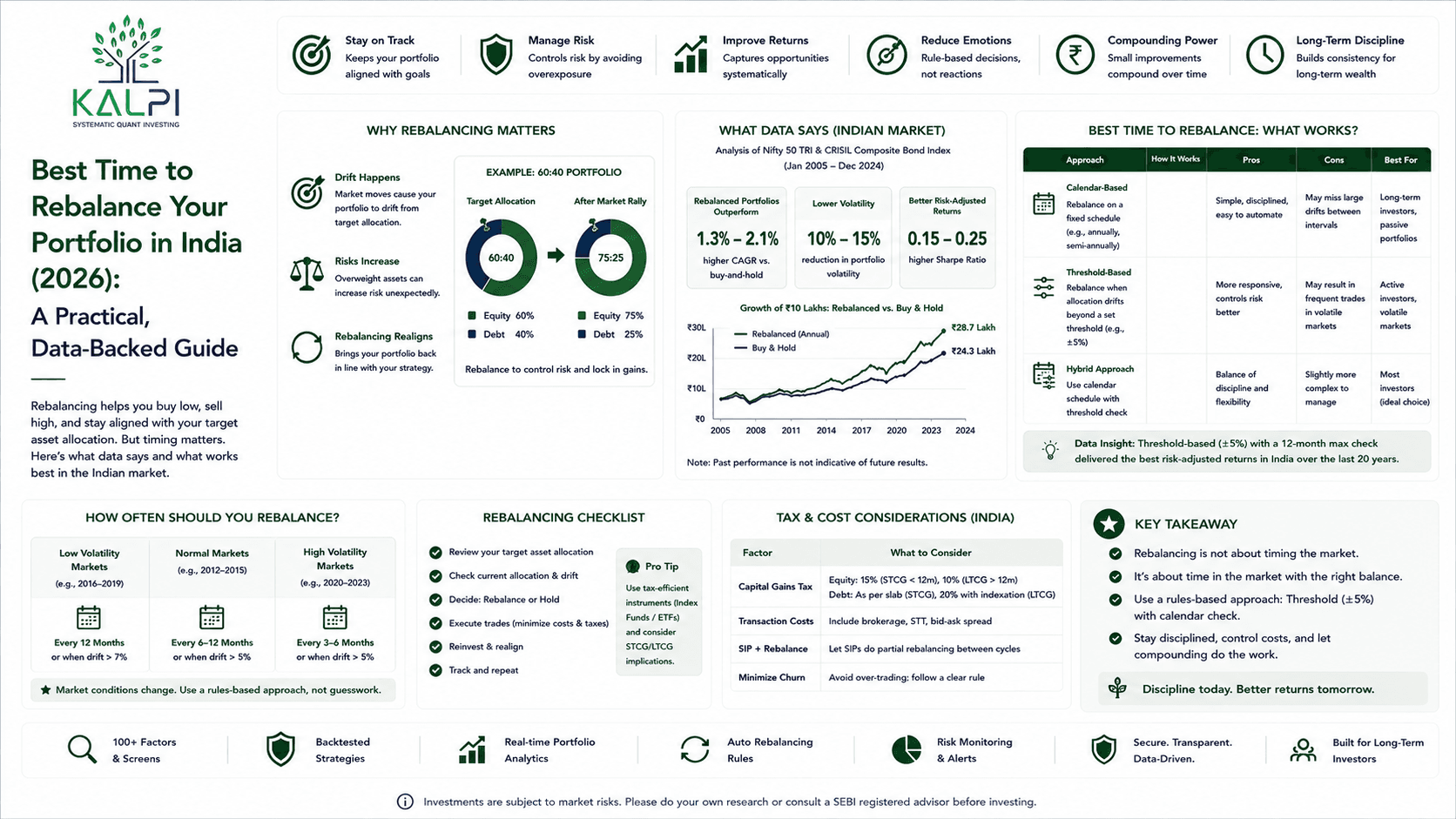
When you first invest, you pick an allocation that suits your goals. Say you decide on 60% equity and 40% debt because that mix matches how much risk you are comfortable carrying. A year passes. Equities have had a strong run while debt has grown at its usual steady pace. You have not added a single rupee, yet your portfolio has quietly drifted to 72% equity and 28% debt.
Your goals have not changed. Your investment horizon has not changed. Your appetite for risk certainly has not changed. But your portfolio is now carrying more risk than you originally signed up for.
This is exactly the gap that portfolio rebalancing is meant to close.
Plenty of investors spend hours researching which mutual fund or stock to buy, but very few sit down and check whether their portfolio still looks the way they planned it. Over time, even a well built portfolio can drift simply because different asset classes grow at different speeds.
Knowing when to rebalance portfolio India investors should focus on is not about timing the next rally or predicting a correction. It is about staying disciplined, keeping risk in check, and making sure your investments still work toward the goals you originally set. This guide walks through rebalancing timing India investors typically follow, compares the two most common rebalancing strategies, looks at what the research actually says, and shows how to stay consistent without reacting to every market swing.
What Is Portfolio Rebalancing?
Portfolio rebalancing is simply the process of adjusting your investments so they return to the asset allocation you originally intended.
Think of your asset allocation as the blueprint for your investment plan. When you decided on a 60:40 split between equity and debt, that was not a random number. It reflected your financial goals, your time horizon, and how much risk you could stomach.
The problem is that markets rarely move in step with each other. Some investments do well, others move slowly, and a few may even decline for a stretch. Over time, this pulls your portfolio away from where it started. A 60:40 portfolio can quietly turn into 70:30, or even 75:25, without you making a single active decision.
Rebalancing is simply the act of bringing those percentages back closer to your original target. And no, that does not mean selling everything and starting over. Most of the time, a few careful adjustments are enough to restore the balance.
A Quick Example: How Drift Actually Happens
Say you invest ₹10 lakh with a 60:40 split, which works out to ₹6 lakh in equity and ₹4 lakh in debt. Over the next 18 months, equities rally hard while debt grows at a modest, steady pace, which is fairly typical of Indian market cycles.
Without you adding or withdrawing a single rupee, your equity portion could grow to around ₹8.6 lakh while debt inches up to roughly ₹3.4 lakh. Your portfolio is now worth ₹12 lakh, but the split has moved to nearly 72:28. You still feel like you own a 60:40 portfolio, but you are actually carrying meaningfully more equity risk than you signed up for. This is the drift that rebalancing is designed to fix.

A sample portfolio allocation view. Even a well diversified portfolio needs periodic checks to confirm the actual weights still match the intended ones.
Why Rebalancing Matters
A common belief among investors is that if the portfolio is growing, there is no real need to touch it. That sounds reasonable on the surface, but it misses an important point. A growing portfolio is not always a balanced one.
Picture two investors who each start with ₹10 lakh in identical investments. The first reviews the portfolio once a year and rebalances whenever the allocation drifts too far from plan. The second never looks at it again.
Five years down the line, both portfolios might show similar returns on paper. But the second investor is likely carrying far more equity exposure than they originally intended. If the market corrects sharply, that investor could see losses well beyond what they were prepared for.
Rebalancing is not designed to squeeze out extra returns every year. Its real job is to make sure your portfolio keeps matching the level of risk you agreed to take when you first built it, which is really the core idea behind smart rebalancing.
Benefits of Portfolio Rebalancing
Regular portfolio reviews offer a few practical benefits that are easy to overlook until you actually need them.
| Benefit | Why It Matters |
|---|---|
| Controls portfolio risk | Prevents one asset class from becoming too dominant. |
| Maintains target allocation | Keeps investments aligned with long-term financial goals. |
| Encourages disciplined investing | Decisions are guided by strategy instead of emotions. |
| Reduces emotional investing | Helps avoid chasing recent market winners. |
| Supports long-term consistency | Keeps the investment plan on track through different market cycles. |
Notice that none of these benefits promise higher returns. That is because good portfolio management is not about beating the market every single year. It is about staying consistent enough to avoid unnecessary risk while letting your investments compound over time.
What the Research Actually Says About Rebalancing
This is where the data side of the conversation comes in, and it is worth being upfront about what studies actually show, since a lot of financial content overstates this.
Vanguard’s long-running research on rebalancing has consistently found that rebalancing does not meaningfully boost long-term returns. What it does reliably do is reduce portfolio volatility and keep risk closer to an investor’s original target. Vanguard’s own conclusion is that the main value of rebalancing is risk control, not return enhancement.
Morningstar’s research points in a similar direction. Their analysis of rebalancing frequency has generally found that annual or threshold-based rebalancing performs about as well as more frequent rebalancing, while keeping transaction costs and taxes lower. In other words, rebalancing more often does not necessarily make you better off.
The CFA Institute’s body of work on strategic asset allocation echoes the same theme. Rebalancing is framed as a risk management discipline meant to keep a portfolio’s actual risk profile aligned with an investor’s stated risk tolerance and investment policy, rather than a tool for generating alpha.
Put together, the research is fairly consistent. Rebalancing is not a return-boosting strategy. It is a risk discipline. That is exactly why this guide keeps circling back to consistency and process over trying to time the market.
When Should You Rebalance? Calendar vs Threshold Rebalancing
This is probably the question investors ask most often, and the honest answer is that there is no single formula. Every investor follows a slightly different approach based on their own comfort level.
Broadly, portfolio rebalancing tends to happen in one of two ways:
- Calendar-based rebalancing, where you review your portfolio at fixed intervals, such as every six or twelve months.
- Threshold-based rebalancing, where changes are made only after your allocation moves beyond a predetermined limit.
Both approaches have their strengths, and neither is universally better than the other. The right choice really comes down to your investment style, the size of your portfolio, transaction costs, and personal preference. This calendar vs threshold rebalancing decision is really the crux of building a workable routine.
Calendar-Based Rebalancing
Calendar-based rebalancing means reviewing your portfolio at fixed intervals, regardless of what the market has done in between. Some investors review every six months, others prefer once a year.
The idea is simple. Instead of reacting to market headlines, you follow a schedule. Suppose your review date is every January. On that date, you compare your current allocation to your original target, and if the gap is meaningful, you rebalance.
Many long-term investors prefer this approach because it removes emotion from the decision. You are not reacting to a good month or a bad month, you are just following the calendar.
Threshold-Based Rebalancing
Threshold-based rebalancing works on a different logic. Instead of reviewing on a fixed date, you act only when your allocation crosses a predetermined limit.
For example, say your target allocation is 60% equity and 40% debt. You decide you will rebalance only if equity rises above 65% or falls below 55%. As long as the allocation stays within that range, you leave the portfolio untouched.
This approach avoids unnecessary transactions while still keeping portfolio risk within a defined boundary.
Calendar-Based vs Threshold-Based Rebalancing: A Quick Comparison
| Feature | Calendar-Based | Threshold-Based |
|---|---|---|
| Trigger | Fixed review dates | Allocation drift |
| Monitoring | Low | Moderate |
| Trading Frequency | Predictable | Depends on market movement |
| Suitable For | Passive investors | Investors who monitor portfolios regularly |
| Emotional Decisions | Lower | Lower when rules are followed consistently |
Neither approach guarantees higher returns. The point of rebalancing is not to outperform the market, it is to make sure your portfolio keeps reflecting the level of risk you originally set out to take.
Which Rebalancing Strategy Is Right for You?
There is not a single “best” method here. The right choice depends largely on how actively you manage your investments.
| Investor Type | Suggested Approach |
|---|---|
| New Investor | Annual calendar review |
| SIP Investor | Review every 6 to 12 months |
| Large Portfolio | Threshold-based review |
| Retired Investor | Annual review with focus on capital preservation |
| Active Investor | Threshold-based with regular monitoring |
A simple strategy followed for years usually works better than constantly switching your approach based on the latest market news.

Portfolio performance versus a benchmark over time. Charts like this make it easy to see how allocations that are left untouched can drift far from where they started.
Common Mistakes Investors Make
Understanding rebalancing is the easy part. Actually following through on it, year after year, is where most investors struggle.
That is why it helps to set a simple rebalancing rule in advance, rather than trying to make decisions in the middle of market volatility.
One common mistake is waiting too long. Some investors go years without reviewing their portfolio. By the time they finally check, the allocation has drifted so much that restoring balance becomes difficult, and sometimes tax inefficient as well.
Another mistake is rebalancing too often. Checking your portfolio every week usually creates more activity than value. Frequent buying and selling adds up in brokerage costs, taxes, and unnecessary stress.
Many investors also fall into the trap of chasing recent winners. When one asset class performs exceptionally well, the temptation is to pour even more money into it. Ironically, disciplined rebalancing often calls for the opposite, trimming exposure to the best performer and adding to the ones that have lagged behind.
And finally, investors sometimes overlook taxes and transaction costs altogether. Before making any adjustment, it is worth asking a simple question. Does the benefit of rebalancing justify the cost of making the change? Sometimes the answer is yes. Sometimes letting a small drift sit for a little longer is the smarter call.
Does Portfolio Rebalancing Improve Returns?
This is probably the most misunderstood part of the whole topic, and the honest answer is, not necessarily.
Portfolio rebalancing is built to manage risk, not to maximise returns. Think of it as a seat belt rather than an accelerator. A seat belt does not make the car go faster, it protects you when the ride turns unpredictable. Rebalancing works on the same principle.
It does not promise higher returns, but it does help investors avoid carrying significantly more risk than they originally planned for. During a strong bull run, an unrebalanced portfolio may actually show better short-term returns because equity exposure keeps climbing. But that same portfolio can also suffer sharper losses once markets correct, as the research from Vanguard and Morningstar referenced earlier both confirm.
The real objective here is consistency, staying aligned with your long-term financial plan instead of letting short-term market swings reshape your portfolio for you.
Final Thoughts
Building a portfolio is only the first step. Maintaining it matters just as much.
Markets will keep rising, falling, and surprising investors along the way. As they do, your portfolio will naturally drift from the allocation you originally planned. Rebalancing is simply the process of bringing it back into line.
Whether you prefer a calendar-based review or a threshold-based approach, the real advantage comes from following a disciplined process rather than reacting emotionally to every market move. That, in the end, is what smart rebalancing really means, not chasing the market, but staying honest about your risk.
If you are still wondering when to rebalance portfolio India investors like yourself should aim for, the simplest answer is this. Pick one approach, whether calendar-based or threshold-based, and follow it consistently over time. The best portfolios are not the ones adjusted the most often. They are the ones that stay aligned with the investor’s financial goals through every phase of the market.
Frequently Asked Questions
What is portfolio rebalancing?
Portfolio rebalancing is the process of adjusting your investments to restore your original asset allocation, based on your financial goals and risk tolerance.
When to rebalance portfolio India investors should watch for?
Most Indian investors either review once or twice a year on a fixed calendar, or rebalance only when their equity to debt split moves beyond a set range, such as 5 to 10 percentage points from target. Both are valid approaches, and the right one depends on how closely you like to track your investments.
Does portfolio rebalancing increase returns?
Not necessarily. Research from sources like Vanguard and Morningstar shows its main purpose is to manage portfolio risk and maintain your desired asset allocation, not to maximise returns.
Which is better, calendar-based or threshold-based rebalancing?
Neither approach is universally better. The right choice depends on your investment style, how closely you monitor your portfolio, and personal preference.
Is portfolio rebalancing suitable for beginners?
Yes. Even a simple annual review can help beginners stay disciplined and prevent their portfolio from becoming riskier than intended.