

Last Updated: July 2026
AI stock picking in India is catching on fast as investors look for smarter ways to spot good opportunities. AI can chew through huge amounts of market data in no time, while rule-based investing sticks to a fixed set of rules instead of trying to predict what happens next. Both have their place, and knowing how they differ makes it much easier to pick the one that actually suits you.
A few years back, most investors leaned on company reports, financial news and their own homework before buying a stock. Now, a different question keeps popping up. Can artificial intelligence actually find better opportunities than a person can?
Open pretty much any finance app or website and you’ll spot headlines claiming AI can pick winning stocks faster than humans ever could.
Yet plenty of seasoned investors still put their faith in rule-based investing rather than handing every decision over to an AI model.
So which one actually works better in Indian markets?
The honest answer isn’t as neat as the ads make it sound.
Both rely on data, sure, but they arrive at decisions in completely different ways. Artificial intelligence chews through massive volumes of information within seconds. Rule-based investing sticks to a fixed set of criteria, never letting emotions or market hype creep into the picture.
Once you understand these differences, it’s a lot easier to choose an approach that fits your goals instead of just following whatever’s trending.
Why Is AI Stock Picking Becoming Popular?
Artificial intelligence isn’t just a tech-company thing anymore.
Banks use it to catch fraudulent transactions. Shopping sites recommend products based on what you bought last time. Streaming apps suggest shows based on your viewing history.
Naturally, the investment world has jumped in too.
Modern AI tools can go through company reports, earnings updates, news articles, price charts and a dozen other data points far quicker than any single investor could manage.
Instead of spending days buried in financial statements, AI can sort through all of that in minutes and pick up on patterns a person might easily miss.
That kind of speed is bound to catch the eye of investors hunting for an edge.
It sounds tempting, doesn’t it?
If AI can process so much more information than we can, does that mean it picks better stocks too?
Honestly, it comes down to how the tool is used and what you expect from it going in.
What Is AI Stock Picking?
AI stock picking simply means using artificial intelligence to spot investment opportunities through data, rather than gut feeling or personal opinion.
Different platforms go about it differently.
Some zero in on company fundamentals like revenue growth and profitability. Others track price trends, trading volumes, earnings reports or market sentiment. The more advanced systems even dig through news articles and economic indicators to generate ideas.
Unlike us, AI doesn’t get tired, doesn’t get impatient, and definitely doesn’t get emotional.
It simply processes whatever data it’s been trained to look at.
That said, this doesn’t mean AI can predict the market with pinpoint accuracy.
Artificial intelligence learns from historical data and hunts for patterns that repeat. But markets can flip overnight because of something no amount of historical data could have warned anyone about.
That’s really why AI works best as a research tool that supports your decisions, not something that promises guaranteed profits.
What Is Rule-Based Investing?
Rule-based investing takes a completely different route.
Rather than trying to guess what’s coming next, investors set a fixed list of rules and stick to them, no exceptions.
The exact rules differ from strategy to strategy, but a lot of investors tend to look at things like:
- Consistent earnings growth
- Healthy Return on Equity (ROE)
- Reasonable valuation
- Low debt
- Strong price momentum
Every company gets judged against the same yardstick.
If a stock meets the criteria, it earns a closer look. If it doesn’t, it’s set aside, no matter how much buzz it’s getting on social media or financial news.
This approach strips out a lot of the emotional noise that trips investors up during both bull runs and market crashes.
Plenty of professional investors lean on systematic investing precisely because it keeps decisions steady instead of reacting to every headline that comes along.
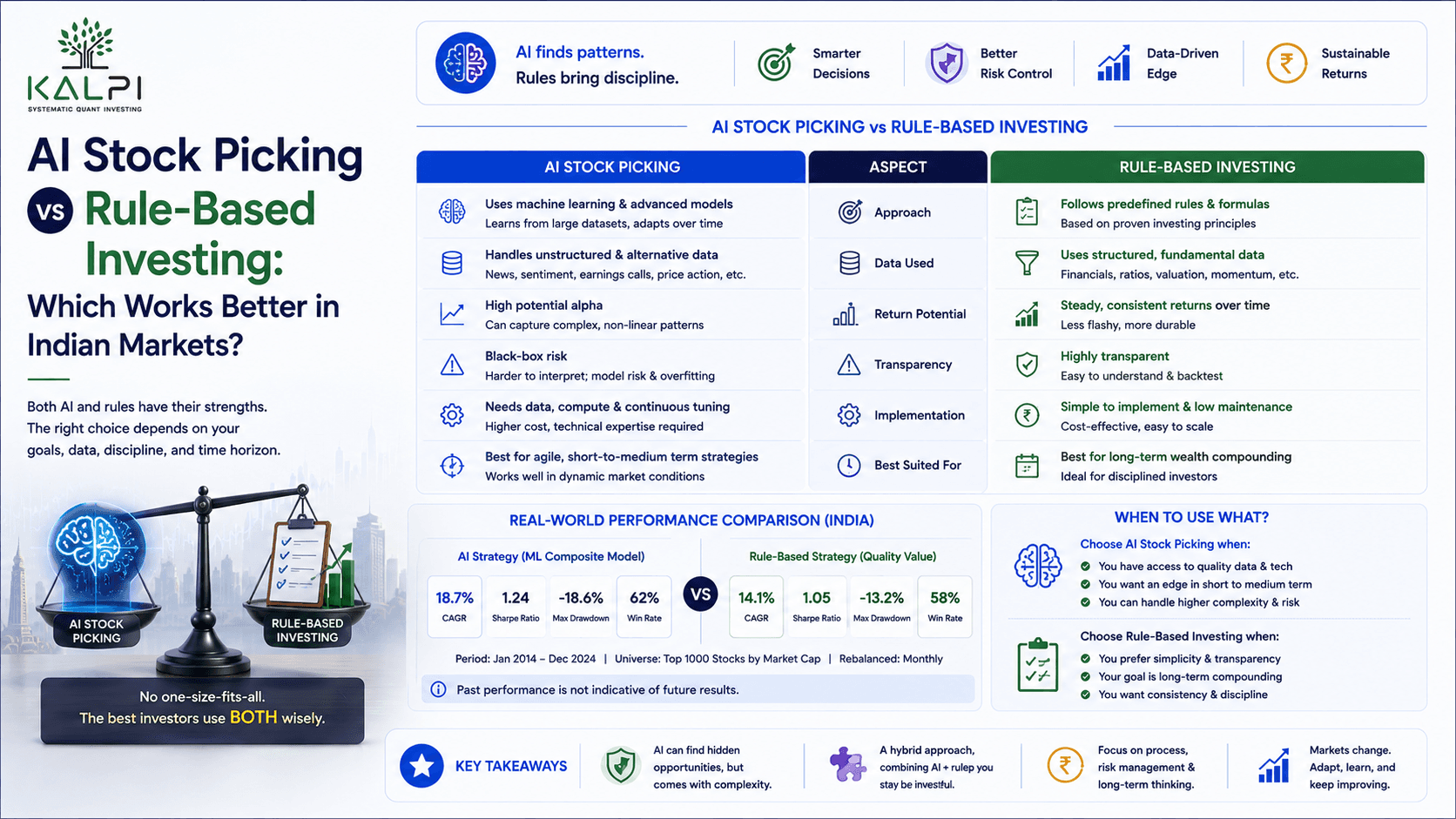
AI Stock Picking vs Rule-Based Investing
Both approaches lean on data, but they use it in very different ways.
Artificial intelligence hunts for patterns that might not be obvious to a human analyst. Rule-based investing sticks to a set of conditions that don’t shift with the market’s mood.
Picture two cricket coaches picking their squad.
One uses advanced software to study thousands of past matches and figure out which players are likely to perform well in the next tournament.
The other goes with a simpler approach, judging players on recent form, fitness and discipline.
Both are working with information. The difference is purely in how they use it.
Investing plays out much the same way. AI digs for hidden connections buried in enormous datasets, while rule-based investing leans on transparency, consistency and discipline.
Neither one comes out on top in every market condition. Which one works better for you really depends on your investing style, how much you trust the process, and what you actually want out of your portfolio.
Where AI Has an Advantage
Artificial intelligence brings a few real strengths to the table that make it appealing for today’s investors.
Speed tops the list.
A human analyst might spend days going through hundreds of annual reports. AI gets through the same pile in minutes.
Scale is another big one.
An individual investor can only realistically follow a handful of companies closely. AI can track thousands of stocks at once, which makes it much easier to spot opportunities across the entire market.
AI also takes emotional bias out of the research process.
It doesn’t panic when the market corrects, and it doesn’t get overconfident after a rally. Every call is based purely on the data in front of it, not fear or excitement.
These strengths explain why AI stock picking in India has picked up so much attention lately.
That said, speed is useful, but investing was never a race. Crunching through more data doesn’t automatically translate into better investment decisions.
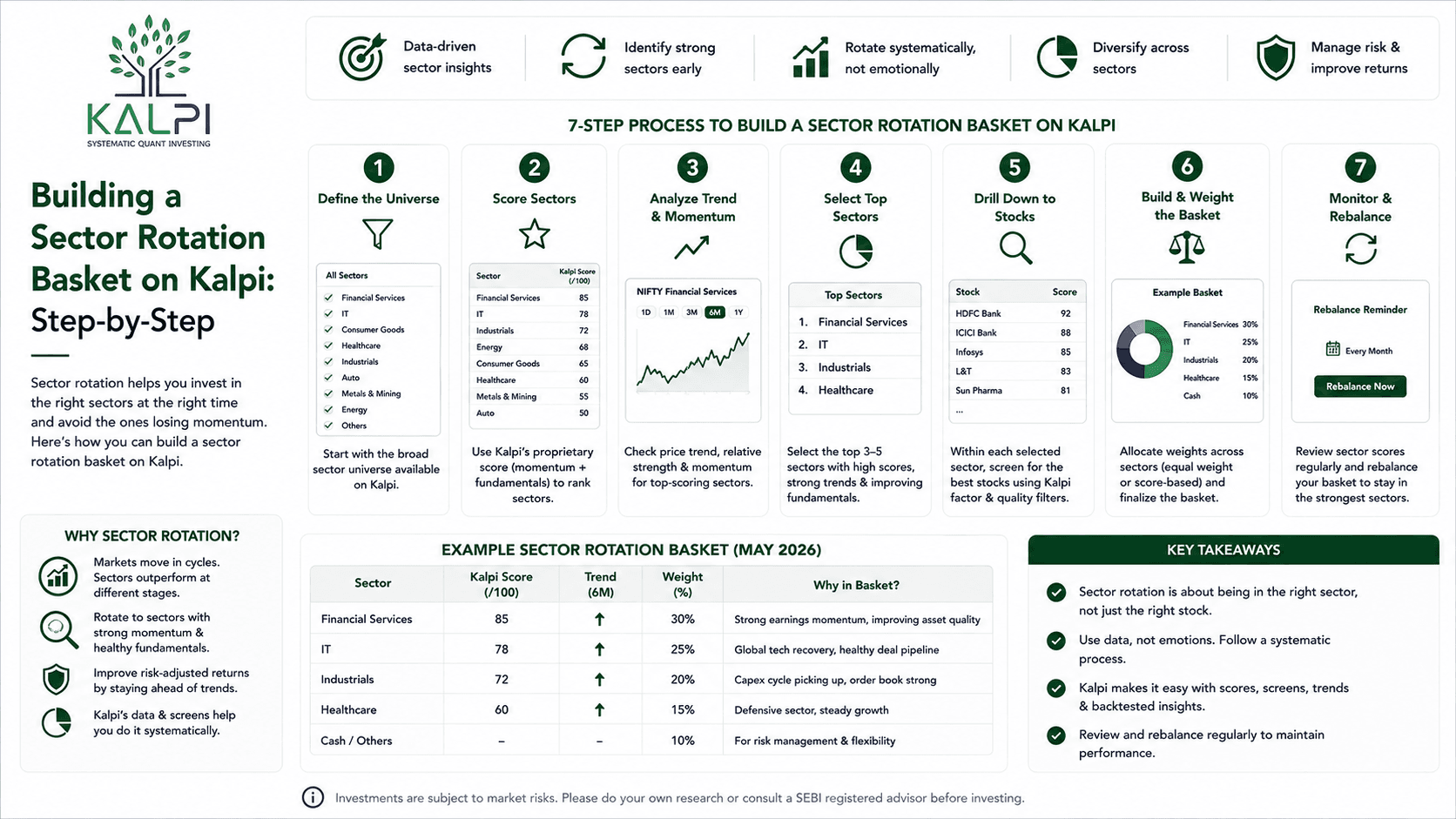
Here’s a look at how a structured, rule-based process actually shows up on a real investing platform.

Seeing the actual weights, ranks and allocations laid out like this makes it obvious how a rule-based system removes guesswork from stock selection. Every position earns its place because it met a specific criterion, not because it made headlines.
Where Rule-Based Investing Has an Edge
AI has made investing faster, no doubt, but faster doesn’t always mean better. There are plenty of situations where a straightforward rule-based strategy makes more sense in practice.
One of the biggest reasons investors stick with rule-based investing is consistency.
Every decision follows the same process, whatever the market mood or breaking news happens to be. There’s no room for panic buying during a rally or emotional selling during a dip.
Say an investor decides to only buy companies that meet certain quality, valuation and momentum criteria.
If a company checks those boxes, it becomes a candidate. If it doesn’t, the investor simply moves on to the next one.
Once the rules are set, every company gets judged by the same standard. Personal opinions don’t get a say.
This kind of discipline helps investors dodge common traps like chasing hot stocks or reacting to short-term noise.
Transparency is another big advantage.
With rule-based investing, you always know exactly why a stock made the cut, because it’s tied to a clear, predefined rule.
AI models, on the other hand, can sometimes act like a black box. They might flag a stock without really explaining what drove that call.
For a lot of long-term investors, understanding why they own something matters just as much as knowing what to buy in the first place.
AI vs Quant Investing: Are They the Same?
A lot of investors assume AI investing and quant investing are basically the same thing.
They’re not.
Quant investing runs on mathematical models and fixed rules to pick investments. Those rules stay pretty stable unless the strategy itself gets revised.
AI takes a different path.
Rather than sticking only to fixed rules, it learns from historical data and keeps hunting for new relationships within that information.
Think of it this way. A recipe book tells you exactly how to cook a dish, step by step. AI is more like a chef who keeps tweaking the recipe after tasting the results and learning from what worked.
Neither one is automatically the better choice. In fact, a lot of professional investment firms use both together instead of picking just one.
Can AI Predict Every Market Move?
This is probably the biggest myth floating around AI investing.
The short answer is no, and expecting that from any technology just isn’t realistic.
Financial markets get pushed around by countless factors. Government policy changes, interest rate moves, geopolitical events, natural disasters, company scandals and sudden economic shocks can all shift markets within hours.
A lot of these events simply can’t be predicted from historical data alone.
Artificial intelligence does well when markets behave the way they have before. But when something completely out of the blue happens, those old patterns can stop working overnight.
That’s exactly why even the most advanced AI systems can’t erase investment risk entirely.
Technology speeds up research. It doesn’t remove uncertainty from investing.
What About AI Investing Platforms?
Over the last few years, several AI-powered investment platforms have gained a real following among Indian investors.
Search for a Jarvis Invest review and you’ll find all kinds of opinions floating around.
Like any investment platform, it has its fans and its critics. Some investors like its data-driven approach, while others feel no software can consistently beat the market.
The lesson here is pretty simple. Don’t pick an investment platform just because it slaps “AI” on its homepage.
Instead, take the time to understand how the platform actually selects stocks, manages risk and updates its calls.
A solid investment process matters far more than the technology sitting behind it.
Can AI and Rule-Based Investing Work Together?
A lot of investors treat AI and rule-based investing as if they’re rivals.
In practice, they often work really well side by side.
AI can churn through enormous amounts of financial data and flag companies worth a closer look. A rule-based framework then filters that shortlist using consistent, predefined criteria.
Think of AI as a powerful search engine. It narrows thousands of companies down to a manageable list. Rule-based investing then steps in to decide which of those companies actually deserve a spot in your portfolio.
Here’s another way to picture it: Google Maps. The app might suggest the fastest route, but you still slow down the moment you spot a roadblock or heavy traffic ahead.
Technology offers guidance. The final call still rests with human judgement.
Using both together lets investors get the benefit of technology without giving up on discipline.
To see what that discipline looks like in practice, here’s a snapshot of how a portfolio’s performance gets tracked against its benchmark over time.

Tracking cumulative returns against a benchmark is the kind of consistent check-in that keeps a rule-based approach honest, whether or not AI helped shortlist the stocks in the first place.
Common Mistakes Investors Make
Whether investors go with AI or rule-based investing, the same mistakes tend to show up again and again. A few of the most common ones:
- Assuming AI can accurately predict every market movement
- Following recommendations without understanding the strategy behind them
- Switching investment methods after every market correction
- Ignoring risk management while chasing returns
- Believing technology can completely remove uncertainty from investing
Most successful investors don’t spend their time hunting for the perfect tool. They focus on following a process they trust and sticking with it, consistently.
Which Approach Is Better for Indian Investors?
There’s no single right answer here, because every investor comes with different goals, experience levels and appetite for risk.
Some investors genuinely enjoy digging into businesses, reading annual reports and making calls on their own. For them, a rule-based strategy offers the structure and discipline they’re after.
Others would rather use technology to cut down the time spent researching hundreds of companies. For them, AI makes a genuinely useful research tool.
What matters most is understanding what each approach can realistically deliver.
Artificial intelligence can process huge amounts of information within seconds, but it can’t predict every market event. Rule-based investing takes emotion out of the equation, but it still depends on picking sensible rules and actually sticking to them.
That’s why a lot of experienced investors don’t see AI and rule-based investing as competitors at all.
Instead, they combine both. AI helps surface companies worth researching, while a rule-based framework decides whether those companies actually deserve a place in the portfolio.
For many investors, that combination works better than leaning entirely on either one alone.
Final Thoughts
Artificial intelligence is changing how investors research stocks, but the fundamentals of good investing haven’t budged.
Good investing was never about finding a shortcut. It’s always been about making informed decisions, managing risk sensibly and staying disciplined over the long haul.
AI can analyse information far faster than any human and surface opportunities that might otherwise slip past unnoticed. Rule-based investing brings consistency and helps investors sidestep emotional decisions when markets swing up or down.
Neither approach can promise better returns. Technology can support your decisions, but it can’t replace patience, discipline and plain common sense.
Instead of asking whether AI beats rule-based investing, ask yourself something more useful.
Will this approach help me make better investment decisions, consistently, over the long run?
If the answer is yes, you’re already focusing on what actually matters.
Frequently Asked Questions
1. What is AI stock picking?
AI stock picking uses artificial intelligence to analyse company data, market trends and financial information to identify potential investment opportunities.
2. Is AI stock picking better than rule-based investing?
Not necessarily. AI is excellent at analysing large amounts of data quickly, while rule-based investing provides consistency and removes emotional decision-making. The better choice depends on your investment style and goals.
3. What is the difference between AI and quant investing?
Quant investing follows predefined mathematical rules to select investments. AI investing learns from historical data, identifies patterns and keeps refining its analysis instead of relying only on fixed rules.
4. Are AI investment platforms reliable?
AI-powered investment platforms can be useful research tools, but they should not be followed blindly. Before using any platform, understand how it selects stocks, manages risk and updates its recommendations.
5. Can AI and rule-based investing be used together?
Yes. Many investors use AI to shortlist potential opportunities and then apply a rule-based strategy to evaluate those companies before making a final investment decision.