

Last Updated: July 2026
| IN SHORTMany investors choose active mutual funds hoping that professional fund managers will deliver better returns than the market. However, SPIVA India reports continue to show that a large number of active funds struggle to beat their benchmark over long periods. This does not make active funds bad investments, but it does raise an important question: is consistently beating the market harder than most investors think? |
The Question Every Investor Eventually Asks
Imagine you have two choices.
The first one is simple. You invest in an index fund and accept whatever return the market gives.
The second one sounds more exciting. A fund manager studies companies, buys and sells stocks, and tries to beat the market for you.
If you ask ten investors, quite a few of them will probably pick the second option.
It just feels nice to think that someone experienced is trying to do better than the market for you.
But the answer is not as straightforward as it looks.
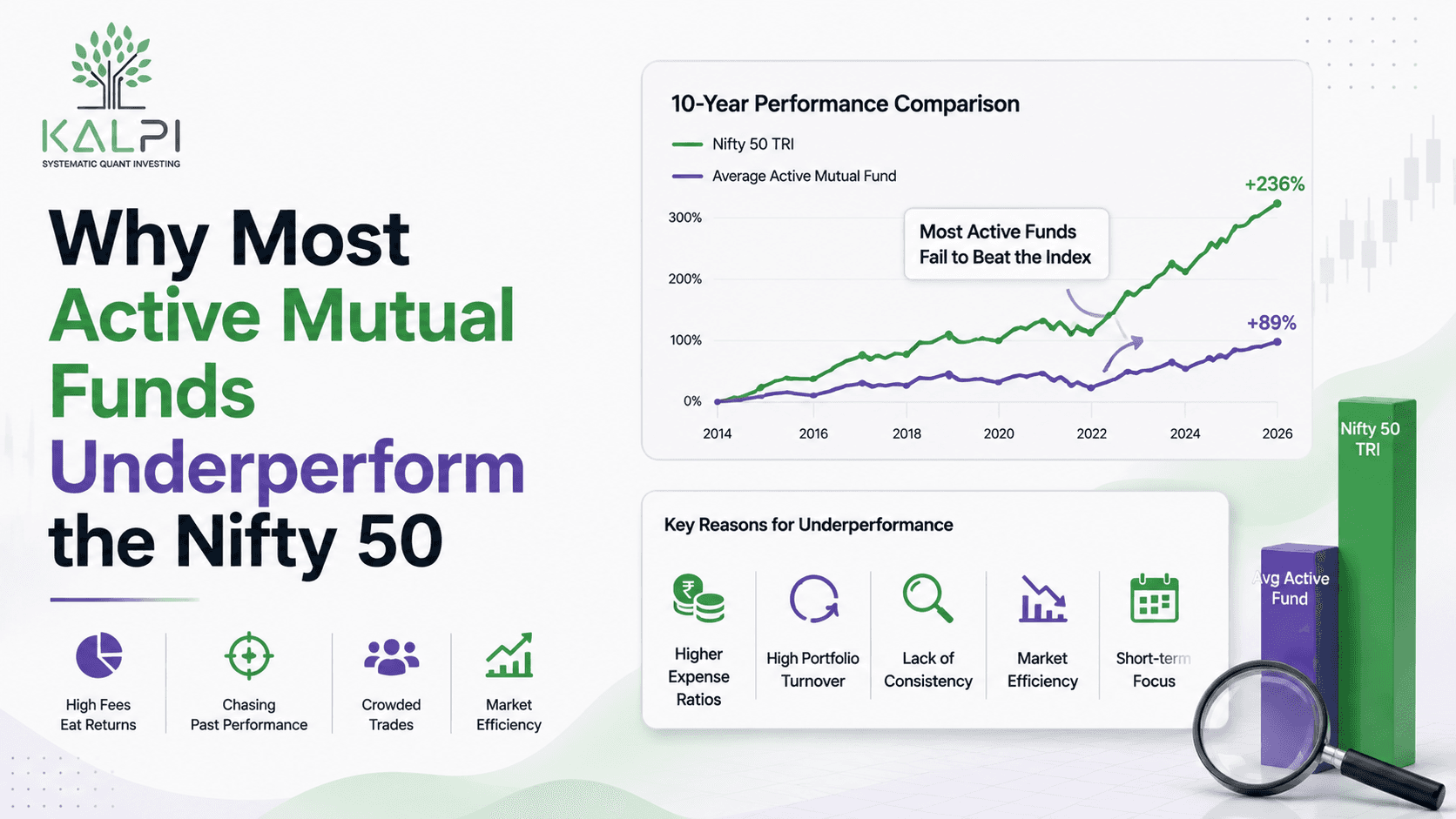
Year after year, many active mutual funds fail to outperform the Nifty 50 and other benchmark indices over longer periods.
That is why the SPIVA India Report gets so much attention.
It answers a simple question.
Do mutual funds beat the Nifty?
The numbers usually catch people off guard.
A Simple Switchboard Example
Think about the switchboard in your room.
There is one switch for the fan, one for the light, and maybe another for the charging socket.
Now imagine someone says they can switch the fan on and off at exactly the right time every single day to save electricity.
They may get it right on some days.
But doing it correctly every day for years would be difficult.
Most people simply turn the fan on when they need it and turn it off when they do not.
Investing works in a similar way.
An active fund manager constantly makes decisions.
Which stock should be bought?
Which stock should be sold?
Which sector should receive more money?
Getting a few calls right is possible.
Doing it again and again for ten years is where things become difficult.
That is one of the reasons many active funds struggle to beat broad market indices.
What Is an Active Mutual Fund?
An active mutual fund is managed by professionals who actively select stocks and make investment decisions.
The goal is simple.
Generate returns that are better than the benchmark.
The fund manager decides:
- Which companies to buy.
- Which companies to avoid.
- When to increase exposure.
- When to reduce exposure.
Investors pay a higher expense ratio because they expect these decisions to create better returns.
What Is the Nifty 50?
The Nifty 50 tracks fifty of the largest and most traded companies listed on the National Stock Exchange.
It is often used as a benchmark because it represents a significant part of the Indian stock market.
An index fund that follows the Nifty 50 simply mirrors the index.
There is no attempt to predict winners.
There is no effort to time the market.
The fund follows the benchmark and keeps things simple.
What Is the SPIVA India Report?
The SPIVA India Report, published by S&P Dow Jones Indices, studies how active funds perform compared with their benchmarks.
The report looks at:
- One-year performance
- Three-year performance
- Five-year performance
- Ten-year performance
Over the years, the report has shown a similar pattern.
Many active funds struggle to outperform their benchmark consistently over long periods.
That is why the report is widely followed by investors and professionals.
Why Do Active Mutual Funds Underperform?
It usually comes down to a mix of things.
1. Costs Matter
Active funds generally charge higher fees than index funds.
Even a small difference in expenses can affect long-term returns.
A fund may perform close to the benchmark before expenses and still end up behind after costs are deducted.
2. Information Moves Faster Today
Years ago, information travelled slowly.
Today, news spreads in seconds.
Thousands of investors and analysts study the same companies.
Finding opportunities that nobody else has seen has become much harder.
3. Consistency Is Difficult
A fund manager may beat the market in one year.
One good year is not the problem.
Doing it over and over again is.
Markets change.
Economic conditions change.
Sectors move in and out of favour.
No strategy works perfectly forever.
4. The Size Problem
As a mutual fund becomes larger, managing it becomes more difficult.
Buying and selling large positions takes time.
Some opportunities become too small to make a meaningful difference.
What Does the Data Suggest?
The latest SPIVA India reports tell an interesting story.
The longer the investment period becomes, the harder it is for active funds to stay ahead of their benchmark.
Across several categories, the percentage of underperforming funds generally rises over three, five, and ten years.
In simple words, getting one or two good years is possible.
Delivering market-beating returns consistently for a decade is much harder.

How a portfolio’s sensitivity to its benchmark shifts over time. The same benchmark-tracking idea sits at the heart of the active versus index debate.
Active Fund vs Index Fund
| Feature | Active Fund | Index Fund |
|---|---|---|
| Goal | Beat the market | Match the market |
| Management | Professional fund manager | Passive tracking |
| Expense Ratio | Usually higher | Usually lower |
| Stock Selection | Active decisions | Follows an index |
| Risk of Underperformance | Higher | Lower relative to benchmark |
A portfolio analyzer scoring individual stocks. Active management is built on judgment calls like these, made stock by stock, year after year.
Why Do Investors Still Prefer Active Funds?
If many active funds struggle to beat the market, why do investors still buy them?
The answer is simple.
People like the possibility of better returns.
Nobody dreams about average performance.
Some investors also believe that skilled managers can identify opportunities that the market misses.
And to be fair, some active funds have delivered impressive returns.
The hard part is knowing which fund will continue doing well before everyone else figures it out.
Do Mutual Funds Beat Nifty?
This is one of the most searched questions among investors.
The honest answer is simple.
Some do. Many do not.
A fund may outperform for a year or two.
That does not guarantee it will continue doing so.
Past performance is useful information, but it is not a promise about the future.
That is why choosing a fund only because it performed well last year can be risky.
Does This Mean Active Funds Are Bad?
No.
None of this means active funds are a bad option.
Some active funds manage downside risks differently.
Some avoid expensive sectors.
Some hold cash during uncertain periods.
Some managers have built strong long-term records.
The point is simply this.
Beating the market consistently is harder than it looks.
Why Index Funds Have Become Popular
Index funds have become popular for three simple reasons.
Simplicity
There is no need to analyse fund manager decisions every year.
Lower Costs
Lower expenses mean investors get to keep more of their returns.
Predictability
The idea is pretty simple.
The fund tries to stay in line with the benchmark instead of trying to beat it.
For many long-term investors, that simplicity is appealing.
What Usually Happens Over Time
| Investment Period | What Usually Happens |
|---|---|
| 1 Year | Some active funds beat the benchmark |
| 3 Years | The number of outperforming funds usually falls |
| 5 Years | Many funds struggle to stay ahead |
| 10 Years | Consistent outperformance becomes much harder |
Should Investors Stop Buying Active Funds?
There is no universal answer.
Some investors prefer index funds.
Others prefer active management.
Many use a combination of both.
The important thing is understanding what you are paying for and what the long-term data says.
Choosing an active fund simply because it performed well recently may not be enough.
Looking at consistency matters too.
Questions Every Investor Should Ask
Before investing in an active mutual fund, ask yourself:
- Why am I choosing this fund?
- Has it performed well over different market cycles?
- Am I comfortable paying higher expenses?
- What happens if it underperforms its benchmark?
- Would an index fund meet my goals just as well?
Asking these questions first can save you from making decisions in a hurry.
Final Thoughts
Investors have been arguing about active and passive investing for years, and that conversation is not ending anytime soon.
Active mutual funds are not disappearing.
Neither are index funds.
The SPIVA India Report simply reminds investors of an important reality.
Beating the market consistently is extremely difficult.
Some active funds succeed.
Many do not.
That does not make one approach right and the other wrong.
It simply means investors should understand the probabilities, costs, and expectations before making a decision.
Sometimes the smartest investment decision is not chasing the market’s top performer.
It is choosing an approach that you understand and can stick with for the long term.
Frequently Asked Questions
1. What is an active mutual fund?
An active mutual fund is managed by professionals who select stocks and make investment decisions with the goal of outperforming a benchmark.
2. What is the SPIVA India Report?
The SPIVA India Report is published by S&P Dow Jones Indices and compares the performance of active mutual funds with their benchmarks over different time periods.
3. Do mutual funds beat the Nifty?
Some mutual funds do beat the Nifty, but many struggle to outperform consistently over long investment periods.
4. Why are index funds becoming more popular?
Index funds have lower costs, simple strategies, and aim to match market returns rather than trying to outperform them. That combination appeals to many long-term investors.
5. Should I choose active funds or index funds?
There is no single answer. The choice depends on your goals, investment style, and comfort with risk. Many investors prefer using a mix of both approaches.