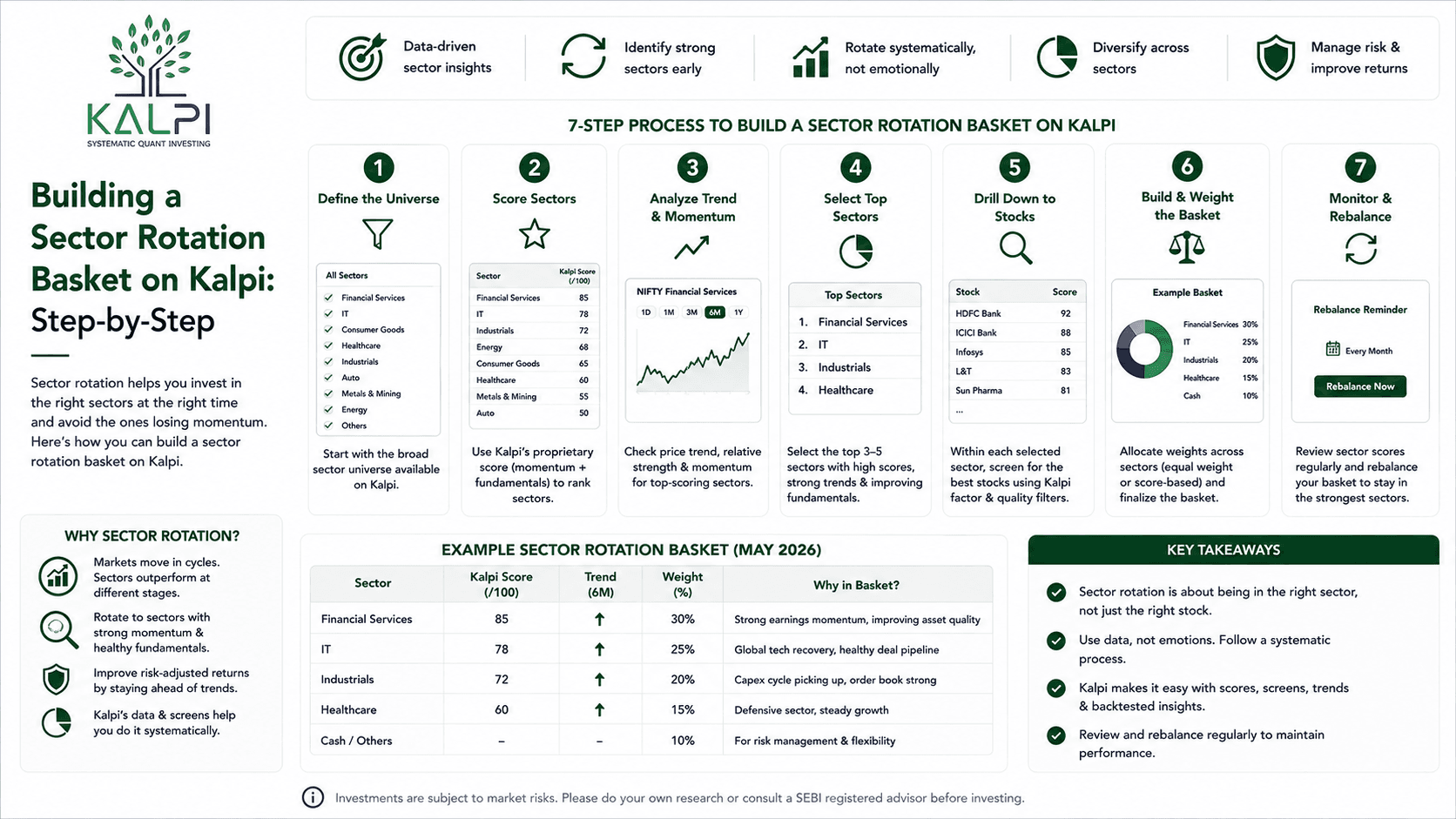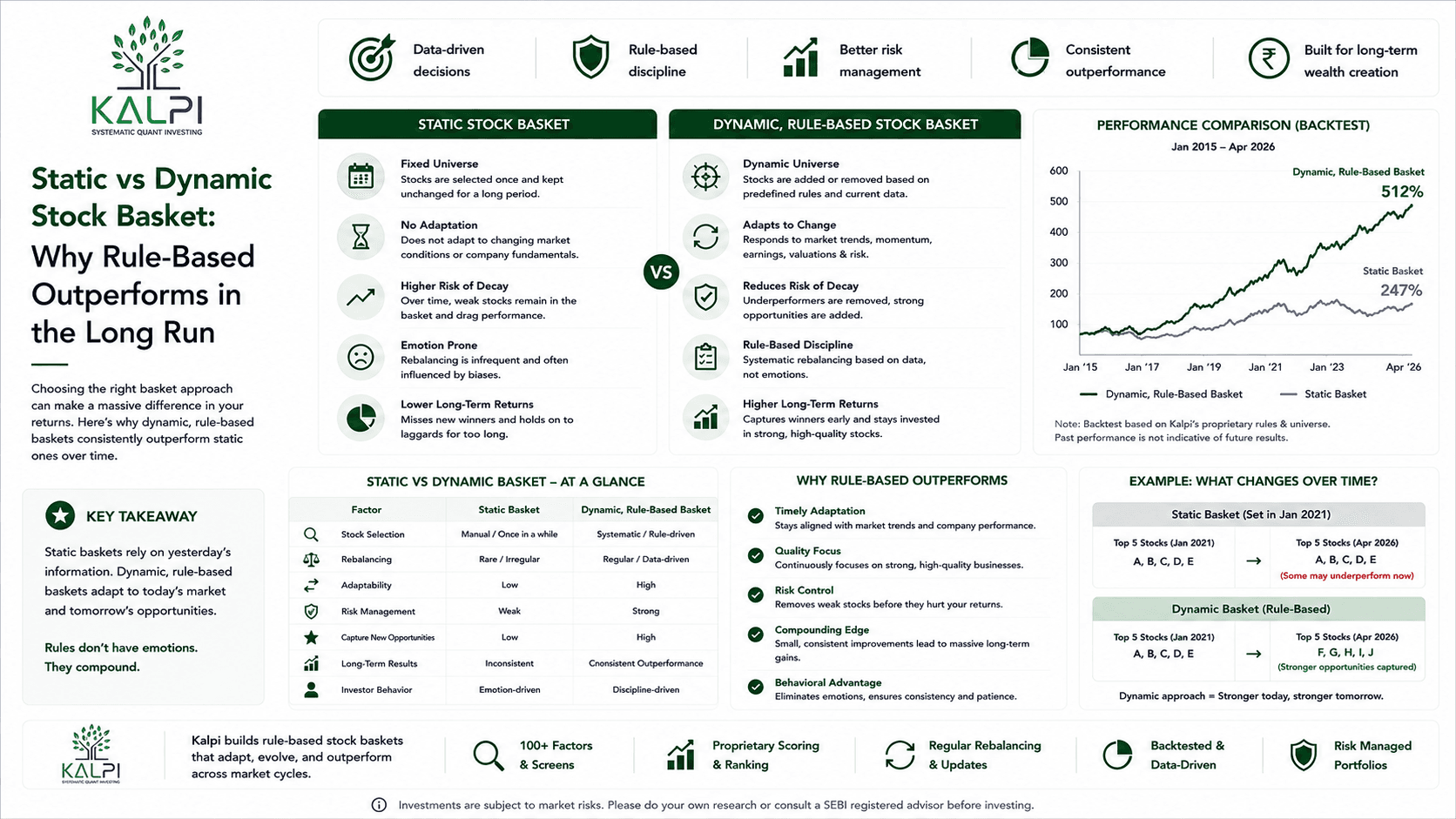



Rule based investing uses fixed, data driven criteria instead of emotion to pick stocks. Learn how factor investing, momentum strategies and backtesting work.
Most Indian investors do not lose money because they are bad at maths. They lose money because they are human. The moment markets fall 8 percent in a week, fear takes over and the sell button gets pressed at exactly the wrong time. When a stock is trending on Twitter, FOMO kicks in and a rushed buy happens at exactly the wrong price.
This is not a knowledge problem. It is a behaviour problem. And rule based investing is the most practical fix for it.
Instead of making decisions based on gut feeling or breaking news, rule based investing gives you a fixed system — a clear set of criteria that tells you what to buy, when to sell, and how much to hold. Your emotions are taken out of the equation completely. The process runs the same way every single time.
Key Takeaways
- Rule based investing removes emotion from every investment decision
- Works on pre-defined filters: momentum, value, quality, low volatility
- Strategies can be backtested on real historical data before using real money
- NOT passive investing — needs active rule setting and quarterly rebalancing
- Beginners can start with a simple single factor screen and build from there
- It rewards patience — this is a long term system, not a shortcut
1. What Is Rule Based Investing?
Rule based investing is a systematic way of managing a portfolio where every decision — what to buy, when to sell, how much to hold — is driven by a pre-defined set of rules, not by market noise or gut instinct.
Think of it like a recipe. A good chef does not improvise a biryani differently each time based on their mood. They follow a tested recipe — specific ingredients, specific ratios, specific timing. Systematic investing works the same way.
A simple rule set might look like this: buy a stock only if return on equity is above 15 percent. Exit if it falls more than 10 percent from its recent peak. Rebalance the full portfolio every three months, no exceptions. Every rule has a clear logical reason. And once set, you follow them regardless of what Dalal Street is doing that week.
2. Why Traditional Investing Often Fails
Most retail investors in India follow discretionary investing — reading financial news, watching YouTube channels, picking up tips from family WhatsApp groups, and making decisions based on a mix of all that filtered through emotion. The problem is not lack of information. It is inconsistency.
Research consistently shows retail investors underperform the market for four recurring reasons:
- They buy high after hype and sell low after fear
- They overtrade and pay unnecessary brokerage and short term capital gains tax
- They hold losing stocks too long hoping for a recovery
- They exit winning stocks too early, locking in small gains instead of letting big ones run
Rule based investing does not promise magic returns. But it delivers consistency — and in long term wealth building, consistency beats brilliance almost every time.
3. How Rule Based Investing Works
The process has five steps. Simple in theory, powerful when followed with real discipline over time.
| 01 | Define Strategy | Decide what factors matter — momentum, value, quality, or a combination. |
| 02 | Set Rules | Translate your strategy into specific, measurable criteria every stock must pass. |
| 03 | Backtest | Test your rules on real historical data. How did it hold through 2018? Through COVID 2020? |
| 04 | Execute | Apply the rules to today’s market. Only stocks that pass every filter make it in. |
| 05 | Rebalance | Review every quarter. Remove what no longer qualifies. Replace with what does. |
4. A Real Example for Indian Investors
Say you want to build a Momentum plus Quality basket from the Nifty 500. Here is what a simple rule set for that actually looks like in practice.
| Filter | What it means |
|---|---|
| Universe | Nifty 500 stocks only |
| Revenue growth | Above 15% in the last 12 months |
| Return on equity | Above 18% |
| Momentum rank | Top 20 stocks by 6 month price return |
| Portfolio size | 20 stocks, equal weight |
| Rebalance | Every 3 months, no exceptions |
| Exit rule | Remove if stock drops outside top 50 momentum rank |
Every quarter you run this screen, apply the filters, and update the portfolio. You do not care what the business channel said that morning. When Sensex drops 500 points you do not panic — the rules already tell you exactly what to do.
5. Popular Rule Based Investing Strategies
There are four well tested factor strategies used widely by Indian investors. Each has a different risk and return profile and performs differently across market cycles.
| Strategy | The idea behind it | Key number |
|---|---|---|
| Momentum | Stocks going up tend to keep going up for a while | 6 month price return |
| Value | Buy good companies when market has priced them too low | P/E ratio, P/B ratio |
| Quality | Strong financials and steady earnings growth over years | Return on equity above 18% |
| Low Volatility | Stocks that swing less tend to lose less when things go bad | 1 year standard deviation |
Many experienced investors combine two or more of these. Momentum plus Quality is a popular pairing. So is Value plus Low Volatility. Multi factor strategies tend to be more stable across different market conditions than single factor ones.
6. Benefits of Rule Based Investing
The most obvious benefit is removing emotional bias completely. Your pre-defined rules make the decision on a bad market day — not your fear.
Beyond that, the consistency is what really matters over time. The same process works in bull markets, bear markets, and every sideways phase in between. You are not trying to time anything.
Everything is also fully transparent. You always know exactly why a stock is in your portfolio and exactly what condition would trigger its exit. Because the system tells you what to do, you are far less likely to exit the market during corrections — which is where most retail investors quietly destroy their long term returns.
And when you backtest on Kalpi before investing, this is what the numbers actually look like — CAGR, volatility, Sharpe ratio and Sortino ratio, all clearly compared against the benchmark. You see the full picture before putting in a single rupee.

Kalpi backtest performance stats — CAGR 23.46% vs benchmark 11.41%. Sharpe ratio 0.88 vs 0.69. Sortino ratio 1.10 vs 0.78. All visible before investing.
7. Common Mistakes to Avoid
The first and most common mistake is overcomplicating the rules. A clean three factor model often outperforms a fifteen factor one because it avoids fitting too tightly to historical patterns that will not repeat.
The second is ignoring drawdowns during backtesting. A strategy with 25 percent CAGR that also had a 60 percent drawdown in 2020 would have caused most investors to quit at exactly the wrong moment. Always check the worst case scenario before committing real money.
Third — and this is the one that undoes the whole system — is changing rules mid cycle. The moment you override your system because this time feels different, you have lost the entire advantage. Trust the rules or change them at the next rebalance. Not in the middle of a crash.
And finally, do not treat backtests as guarantees. Past performance is evidence, not certainty. Use them to validate your logic, not to predict the future.
The monthly heatmap from Kalpi below shows every single month from 2017 to 2026 — green months, red months, the brutal March 2020 crash — all laid out before you commit real money. No surprises.

Kalpi monthly returns heatmap — portfolio (left) vs Nifty benchmark (right), 2017 to 2026. Every month colour coded by return.
8. Is Rule Based Investing Good for Beginners?
Yes — but only if you actually understand the rules you are following and are not just blindly copying someone else’s system. Platforms like Kalpi make rule based strategies accessible without any coding or advanced finance knowledge.
For beginners, start with a simple single factor strategy — a quality screen is usually the safest entry point. Use small amounts while you observe how the system behaves. Stick with it through at least one full market cycle before evaluating results. Add complexity only when you genuinely understand what each rule is doing and why.
Rule based investing rewards patience and process. It is not designed for quick gains. It is designed for consistent, long term wealth creation for people who can follow a system even when markets are uncomfortable.
9. Final Thoughts
The Indian stock market is loud. Tips everywhere — YouTube channels, WhatsApp forwards, Instagram reels from people who were right once and never stopped talking about it. Most of it is noise. Some of it is genuinely dangerous.
Rule based investing cuts through all of that. It gives you a process, a system, and the discipline to follow it even when markets are making you uncomfortable.
It will not make you rich overnight. No honest approach will. But it will protect you from the single biggest threat to long term wealth — your own emotions at the worst possible moment.
“If you are ready to move from reactive investing to systematic investing, rule based strategies are the most rational place to start in 2026.”
Frequently Asked Questions
What is rule based investing?
It is a systematic investment approach where every buy, sell, and hold decision is governed by pre-defined rules based on factors like momentum, value, quality, or low volatility. Human emotion is completely removed from the process.
Is rule based investing safe?
No investment strategy is fully risk free. But rule based investing significantly reduces the risk from emotional decision making, which is the main reason most retail investors underperform over time. You still carry market risk — you just do not carry panic risk on top of it.
Is it good for beginners?
Yes, actually more so than most approaches. Beginners are most vulnerable to emotional decisions because they have not been through enough market cycles yet. A fixed system removes that vulnerability. Start simple, stick to it, scale slowly.
What are the most popular strategies?
Momentum, value, quality, and low volatility are the four most widely used. Many experienced investors combine two or more for greater stability across different market conditions.
Does rule based investing work in India?
Yes. Factor based strategies — particularly momentum and quality — have shown strong historical performance in the Indian market. The Nifty 500 gives enough depth for most rule based approaches to work effectively.
How often should I rebalance?
Quarterly rebalancing works well for most strategies. Too frequent and you rack up transaction costs and short term capital gains tax without improving returns. Too infrequent and the rules lose their edge.
What platforms support rule based investing in India?
Kalpi is one of the most complete platforms for this. It lets you build your own strategy using filters and ranking rules, backtest on 8 or more years of real NSE data, and execute with automatic quarterly rebalancing — no coding needed.