

Last Updated: July 2026
Visit any local market near closing time and you’ll notice an interesting pattern. A few shopkeepers start lowering prices to clear their remaining stock. Some products are genuine bargains. Others are discounted because demand has dried up or newer models have already replaced them. From a distance, both simply look cheaper. The real challenge is knowing why they’re cheaper.
Investing works much the same way. A falling share price or a low valuation doesn’t automatically make a company a good investment. Sometimes the market has overlooked a fundamentally strong business. At other times, the lower price reflects problems that deserve closer attention. Learning to tell the difference sits at the heart of Value Investing India.
For decades, value investors have searched for businesses trading below what they believe those companies are truly worth. That principle hasn’t changed. What has changed is the market around it. Information now spreads within minutes, industries evolve more quickly than before, and investors have access to far more data than they once did. Yet the central question remains exactly the same: is the market undervaluing a good business, or is the lower price justified?
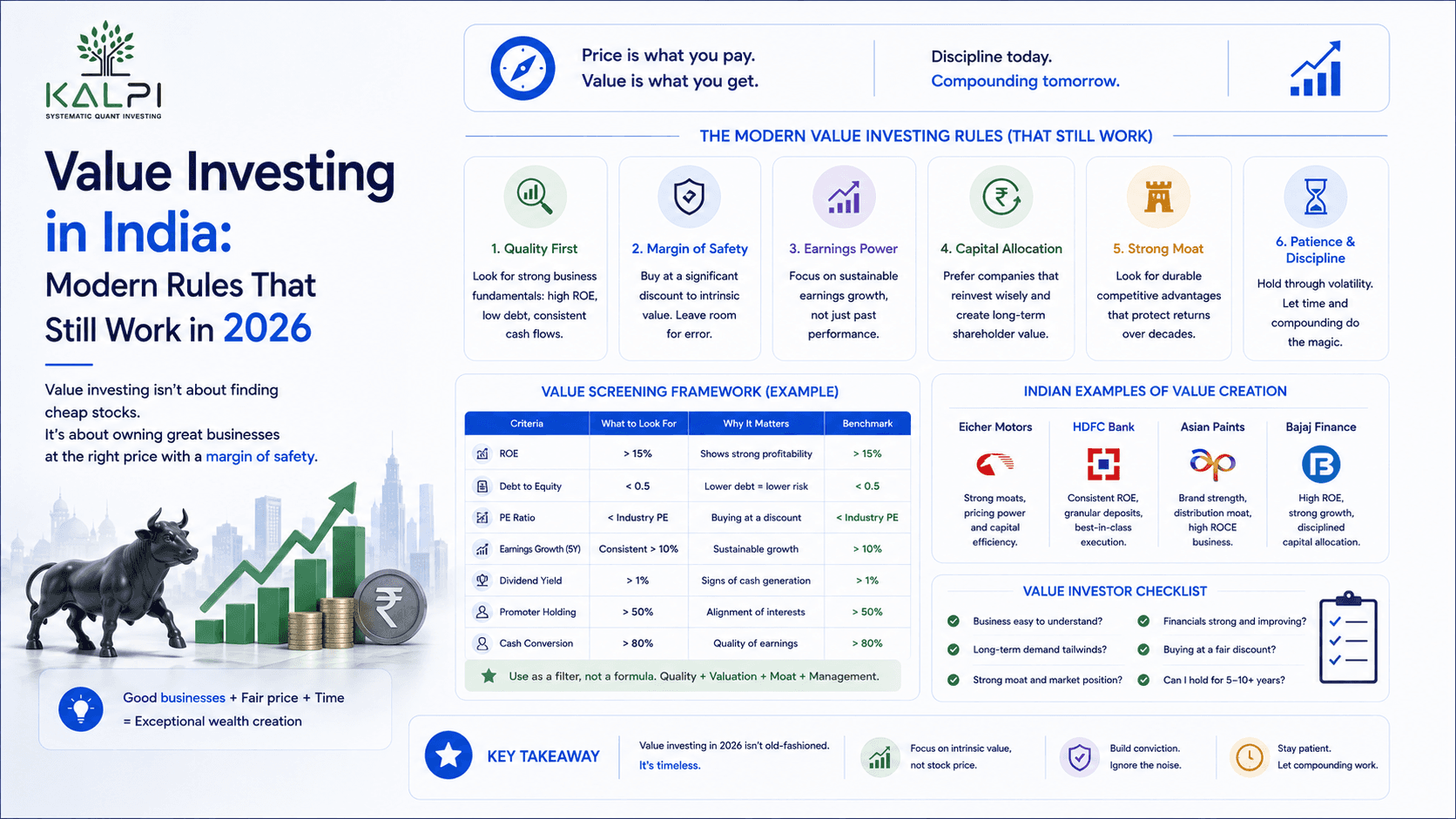
This guide explains how Value Investing India has evolved, what separates genuine opportunities from value traps, how investors often evaluate Value Stocks India, and why Modern Value Investing goes well beyond searching for Low PE Stocks.
What Is Value Investing?
At its simplest, value investing is the practice of buying a business for less than what you believe it’s worth. Notice the emphasis on the business, not the stock price.
Imagine a family-owned restaurant that’s been serving customers for years. It has loyal customers, healthy profits and a good reputation. If the owner suddenly decided to sell it at a price well below similar restaurants nearby, most buyers wouldn’t rush to sign the papers immediately. They’d first ask an obvious question:
why is it available at that price? Only after understanding the reason would they decide whether they had found a genuine bargain or a business facing deeper challenges.
Value investors approach listed companies in much the same way. Instead of beginning with excitement around a rising stock price, they start by asking whether the market has accurately valued the business itself. Sometimes the answer is yes. Sometimes short term fears, temporary setbacks or market sentiment push prices lower than the company’s long-term fundamentals appear to justify. Finding those situations is where value investing creates its opportunity.
Of course, not every inexpensive stock deserves attention. Some businesses trade at lower valuations because profits are shrinking, debt is rising or their competitive position has weakened. A lower price alone never tells the full story. That’s why experienced value investors spend far more time understanding the quality of a business than simply searching for cheap stocks.
Why Value Investing Still Matters in 2026
Today’s market looks very different from the one investors knew even ten years ago. News reaches investors almost instantly, quarterly earnings are analysed within minutes, and global events can influence Indian markets before the trading day is over. Prices often react long before investors have finished reading the headlines.
Despite that speed, markets still behave the way they always have. Optimism sometimes pushes prices higher than fundamentals can comfortably support, while fear can pull prices lower even when the underlying business hasn’t changed very much. Those moments continue to create opportunities for patient investors.
That is one reason Modern Value Investing remains relevant. The philosophy has never been about buying the cheapest stock available. It has always been about understanding whether the market’s current opinion matches the long-term reality of the business. Today’s investors simply look at that question through a wider lens, examining business quality, cash flows, competitive advantages, capital allocation and future earnings potential alongside the usual valuation ratios.
A company may appear inexpensive because its business is steadily weakening. Another may trade at a higher valuation while still offering attractive long-term value, because the quality of the business justifies that price. Modern value investing recognises that price matters, but price only becomes meaningful after understanding what is actually being purchased.
Value Investing vs Growth Investing
Value investing and growth investing are often described as if they belong on opposite sides of the market. In practice, the difference is usually where the analysis begins. A value investor asks whether today’s price fairly reflects the worth of the business, while a growth investor asks how much the business could expand over the coming years.
Those questions aren’t competing with each other, and in many situations they complement one another. A well-managed company purchased at a sensible valuation can offer both steady business growth and attractive long-term returns.
That idea has gradually shaped Modern Value Investing. Many investors today no longer search only for companies with the lowest valuation ratios. They also look for businesses capable of compounding earnings, maintaining healthy balance sheets and strengthening their competitive position over time.
The objective isn’t simply to buy what’s cheap. It’s to avoid paying more than a business is reasonably worth. That distinction has kept value investing relevant across changing market cycles and remains one of its strongest principles today.

A rule-based stock selection screen showing rank, ideal weight and actual allocation. This kind of structured process is what separates disciplined value investing from simply chasing cheap stocks.
What Makes a Stock Undervalued?
One of the most common misconceptions about Value Investing India is that a lower-priced stock automatically represents a good investment. That’s rarely the case. A stock trading at ₹120 instead of ₹250 doesn’t automatically mean it’s a bargain. The market may have reduced its valuation because earnings have weakened, debt has increased or future growth has become uncertain.
Experienced investors therefore ask a different question: is this business worth more than the market currently believes? That shift in thinking separates value investing from simply buying cheap stocks.
Imagine two houses in the same neighbourhood. One owner is selling below the usual market price because they need to relocate quickly. The other house is also available at a discount, but it has expensive structural problems hidden beneath a fresh coat of paint. Both look inexpensive, yet only one is likely to offer genuine value.
The stock market presents similar situations. Some companies become temporarily undervalued because of weak market sentiment, a disappointing quarter or broader economic uncertainty. Others trade at lower valuations because the business itself is struggling. Learning to recognise the difference is one of the most important skills a value investor can develop.
Metrics Value Investors Commonly Examine
A company’s share price tells only part of the story. To understand whether a business appears reasonably valued, investors usually compare its market price with different aspects of its financial performance. No single ratio should be viewed in isolation. Each one highlights a different aspect of the business, and together they provide a more complete picture.
The table below summarises some of the measures commonly used during fundamental analysis in India.
| Metric | What It Indicates | Why Investors Look At It |
|---|---|---|
| Price-to-Earnings (P/E) Ratio | Price compared with earnings | Helps assess whether the stock appears reasonably valued relative to profits |
| Price-to-Book (P/B) Ratio | Price compared with net assets | Useful when evaluating asset-heavy businesses |
| Debt-to-Equity Ratio | Borrowings relative to shareholders’ equity | Indicates how dependent the company is on debt financing |
| Return on Equity (ROE) | Profit generated from shareholders’ capital | Shows how efficiently management uses investor capital |
| Free Cash Flow | Cash remaining after operating and capital expenses | Indicates whether profits are supported by actual cash generation |
Looking at a single metric can often create a misleading impression. A company with a low P/E ratio may appear attractive at first glance, but if profits have been declining for several years or debt has risen sharply, that lower valuation may simply reflect the market’s concerns.
The opposite can also be true. A business trading at a higher valuation may still represent good value if it continues to grow earnings consistently, maintains a strong balance sheet and operates in an industry with favourable long-term prospects. Financial ratios become far more useful when they’re interpreted alongside the company’s overall business performance.

A fundamentals comparison view showing P/E ratio against a benchmark. On its own, a higher or lower number says very little until it’s weighed against the quality of the underlying business.
Looking Beyond Low PE Stocks
Many investors begin their search by filtering companies with low valuation ratios, and there’s nothing wrong with that. The mistake is assuming every company with a low valuation is automatically undervalued.
A lower P/E ratio may exist because investors expect slower earnings growth, rising competition or weakening fundamentals. In such cases, the market may simply be pricing in those risks. That is why Low PE Stocks deserve further investigation rather than immediate attention.
Before treating a stock as undervalued, investors often ask questions such as:
- Are earnings reasonably consistent over time?
- Is the company generating healthy cash flows?
- Has debt remained under control?
- Does the business enjoy a durable competitive position?
- Has management allocated capital responsibly?
Answers to these questions often reveal much more than a valuation ratio alone.
Value Stocks India: What Investors Often Look For
Although every investor follows a slightly different approach, many look for similar characteristics when evaluating Value Stocks India. The objective isn’t simply to buy companies trading at lower valuations. It’s to identify businesses whose long-term fundamentals appear stronger than the market currently recognises.
Some of the qualities investors commonly look for include:
| Characteristic | Why It Matters |
|---|---|
| Consistent earnings | Suggests the business has remained resilient across different market conditions |
| Healthy cash flows | Indicates reported profits are supported by real cash generation |
| Sensible debt levels | Lower financial pressure can improve long-term stability |
| Stable competitive position | Strong businesses often recover more effectively from temporary setbacks |
| Disciplined management | Good capital allocation supports sustainable shareholder value |
No company will perform perfectly across every measure. Experienced value investors rarely stop after comparing valuation ratios. They spend far more time understanding how the business earns money, how it competes, and whether its financial strength is likely to remain intact over the years ahead. That patient approach helps investors avoid one of the most common mistakes in the market: buying a stock simply because it appears inexpensive.
In the next section, we’ll look at the mistakes that frequently trap new value investors, explain why some cheap stocks never recover, and discuss how investors can apply value investing principles without falling into common valuation traps.
Common Mistakes New Value Investors Make
One of the biggest advantages of value investing is that it encourages patience. Ironically, many beginners lose that advantage by rushing into stocks simply because they appear inexpensive. A low valuation should always be the beginning of your research, not the conclusion.
One common mistake is assuming that every beaten-down company will eventually recover. Markets certainly overreact from time to time, but they also recognise genuine business problems. Declining profits, shrinking market share or weak management can keep a stock undervalued for years.
Another mistake is relying on a single financial ratio. A low P/E ratio may look attractive until you discover that earnings have been falling steadily. A low Price-to-Book ratio may appear appealing, but if the company’s assets no longer generate healthy returns, that discount may be justified.
Perhaps the biggest mistake is ignoring the business itself. Successful value investors spend far more time understanding how a company earns money, how it competes and whether its competitive strengths are likely to remain relevant over the next decade. Buying a stock simply because it looks cheap is very different from buying a strong business at an attractive price.
Value Investing Is More Than Numbers
Financial statements provide valuable information, but they don’t tell the entire story. Two companies can report similar earnings, cash flows and valuation ratios while delivering very different results over the long term. The difference often comes from factors that don’t fit neatly into a spreadsheet.
For example, a company with a trusted brand, disciplined management and a durable competitive advantage may continue creating value for years, even if its valuation appears slightly higher today. Another business may look considerably cheaper, yet struggle because demand is falling or competitors are steadily taking away market share.
That’s why Modern Value Investing combines financial analysis with an understanding of the business itself. The numbers explain where a company stands today. The business explains where it might be tomorrow.
Building a Balanced Value Investing Approach
Value investing doesn’t require investors to avoid every company trading at a higher valuation, nor does it encourage buying every stock that appears inexpensive. Instead, it encourages balance. A sensible process often looks something like this:
| Step | Purpose |
|---|---|
| Understand the business | Learn how the company generates revenue and profits |
| Review financial statements | Examine earnings, cash flow and balance sheet strength |
| Compare valuation | Assess whether the current price appears reasonable |
| Consider future prospects | Evaluate whether the business can continue creating value |
| Make a decision patiently | Invest only when the overall picture supports it |
Each step adds another piece to the decision. Skipping any one of them increases the chances of reaching the wrong conclusion.
Does Value Investing Still Work Today?
This question appears in almost every market cycle. Whenever fast-growing sectors dominate headlines, many investors wonder whether value investing has become outdated. History suggests otherwise.
Different investing styles tend to perform well under different market conditions. Growth-focused companies may lead during periods of strong optimism and expanding earnings expectations. During more uncertain phases, investors often place greater importance on stable businesses with reasonable valuations and predictable cash flows.
Neither approach wins every year. That is precisely why experienced investors avoid treating investing styles as permanent winners or losers. Instead, they focus on understanding businesses, paying sensible prices and remaining patient enough to allow their investment decisions to play out over time. Those principles remain just as relevant today as they were decades ago.
Final Thoughts
The idea behind Value Investing India has remained remarkably consistent. Markets will continue to move through periods of optimism and pessimism, but the objective stays the same: understand what a business is worth before deciding what you’re willing to pay for it.
That doesn’t mean every undervalued stock will become a successful investment. It means investors should combine valuation with business quality, financial strength and long-term prospects instead of relying on a single metric.
Successful investing rarely comes from finding the cheapest company on the market. More often, it comes from recognising a good business before the wider market fully appreciates its value. Patience, careful research and disciplined decision-making continue to be some of the strongest advantages a value investor can have.
Frequently Asked Questions
What is value investing?
Value investing is an approach that focuses on buying businesses trading below what an investor believes to be their intrinsic value, based on financial performance and long term prospects.
Are Low PE Stocks always good investments?
No. Low PE Stocks may appear inexpensive for valid reasons, such as declining earnings or weakening business fundamentals. A low valuation should always be supported by deeper research.
What are Value Stocks India?
Value Stocks India generally refer to companies that appear undervalued relative to their financial performance, assets or future earning potential. Investors usually evaluate several factors before reaching that conclusion.
Is value investing suitable for beginners?
Yes, provided investors are willing to learn basic financial analysis and remain patient. Value investing rewards research and long term thinking rather than frequent trading.
Does Modern Value Investing differ from traditional value investing?
Yes. Modern Value Investing still values attractive pricing but also gives greater importance to business quality, competitive advantages, management and long term growth potential.