

Last Updated: July 2026
Selling stocks while managing a stock basket can create a tax bill, because capital gains are generally worked out the moment eligible shares are sold. Depending on how long you held those shares, the gain falls under Short-Term Capital Gains (STCG) or Long-Term Capital Gains (LTCG). Knowing how STCG LTCG stock basket rules work helps you avoid nasty surprises when the tax statement finally lands in your inbox.
Why Taxes Matter More Than Most Investors Realise
Building a stock basket usually starts simple. You shortlist a few companies, look across sectors, and slowly put together a portfolio that fits your goals. Once the money is invested, most people just track returns and hope the portfolio keeps climbing.
There is another piece that quietly shapes the final number, though. Tax.
Unlike a stock price, tax does not show up on your screen every morning, so it is easy to forget about. The day you actually sell something, it becomes very real.
Ever noticed how two investors can earn almost identical returns but walk away with different amounts in hand? Tax is often the reason. Experienced investors rarely stop at profit. They also ask, how much of this will I actually keep after tax? That one question, asked consistently over the years, can end up making a real difference to your wealth.
What a Stock Basket Actually Is
A stock basket is just a bunch of different stocks grouped into one portfolio. Instead of putting all your money into one company, you spread it across sectors and themes, say banking, IT, pharma, autos, and consumer goods, all sitting in the same basket.
The logic is simple. Sectors rarely move together at the same time. When one slows down, another often keeps performing. Spreading your money will not remove risk completely, but it stops your entire outcome from depending on one company or industry.
It is a bit like a football team. If every player wants to be a striker because strikers get the goals and the glory, the team falls apart without defenders and a goalkeeper. Winning is not about stacking strikers, it is about balance across the field. A portfolio works the same way. If one sector grows too large, your whole outcome starts riding on that one sector, and keeping things balanced usually matters more than chasing whichever stock did best last month.
Why Selling Stocks Can Trigger Tax
A lot of new investors assume tax only shows up when you actually withdraw money from the market. That is not how it works. The taxable event happens the moment you sell an investment and lock in a gain.
Say you sell shares of one company and use that money right away to buy shares of another. Your money never really left the market. Even so, the profit from that first sale can still attract capital gains tax under the applicable rules.
Looking only at returns without factoring in tax can lead to decisions you regret later. Once you look at both together, you get a far more honest picture of what your investment actually earned you.
STCG and LTCG Explained Simply
STCG and LTCG sound complicated at first, but the idea behind them is fairly straightforward.
Short-Term Capital Gains (STCG)
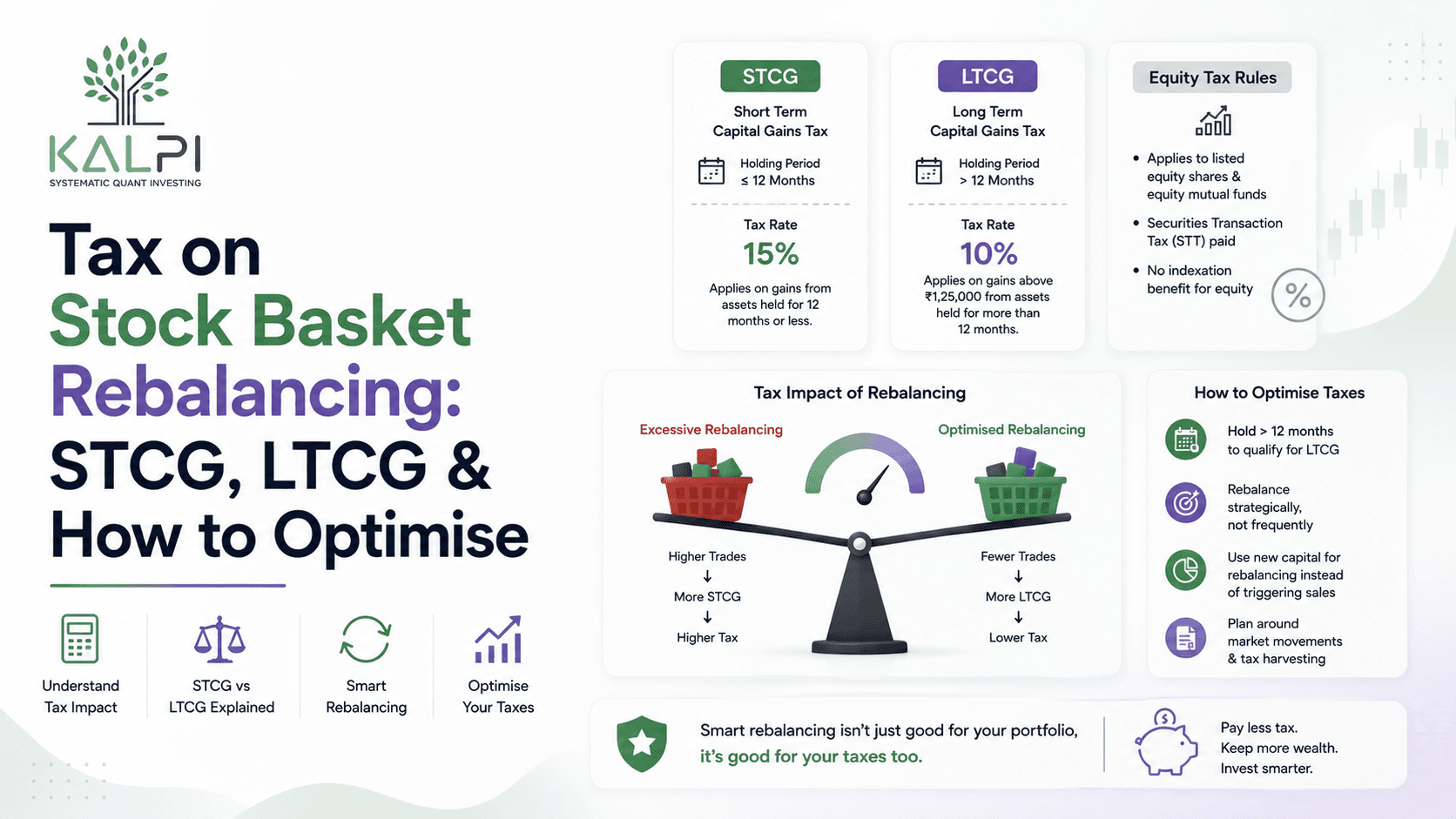
When listed equity shares are sold within the short-term holding period set under the applicable tax rules, the profit is generally treated as a Short-Term Capital Gain. Since these gains are taxed differently from long-term ones, anyone who buys and sells frequently should know exactly how this affects their overall returns.
Long-Term Capital Gains (LTCG)
When listed equity shares are held beyond the prescribed long-term period before being sold, the profit generally falls under Long-Term Capital Gains. The tax treatment can differ from STCG depending on the rules in force at the time. This is exactly why many long-term investors think twice about the holding period before deciding to exit an investment.

A long-term diversified portfolio tends to build steady gains over time, which is why holding period matters so much for tax treatment.
Why the Holding Period Makes Such a Difference
The tax outcome on two similar investments can look completely different if one is sold earlier and the other later, even when both delivered a similar return on paper. That is the entire point of the holding period rule. Looking only at the percentage gain never tells the full story.
There is a similar logic in hockey. If a forward scores two quick goals in the first half, a good coach does not suddenly pull out all the defenders and load up on attackers. A balanced team performs better across the full match than one that leans entirely on a single strength.
Managing a stock basket works the same way. One sector might perform brilliantly and slowly turn into a much bigger chunk of your portfolio than you intended. Selling a part of it to restore balance can be the right call, but it is worth understanding the tax hit before making that move. You cannot always dodge tax, but understanding when it kicks in helps you make a decision before the sale happens, not scramble to explain it afterward.
Table 1: STCG vs LTCG at a Glance
| Question | STCG | LTCG |
|---|---|---|
| When does it apply? | Sale of eligible shares held for a shorter period | Sale of eligible shares held for a longer period |
| What creates the tax? | Profit realised after selling eligible shares | Profit realised after selling eligible shares |
| Why does it matter? | Frequent selling may increase tax liability | Holding investments longer may receive different tax treatment under applicable rules |
Does Managing a Smallcase Have Tax Implications?
A common question investors ask is whether updating or rebalancing a Smallcase creates tax. The answer depends on what is actually happening inside that update.
If a Smallcase swaps one stock for another, and that swap involves selling shares that have gained value, the sale can create a taxable event depending on how long those shares were held. Buying the replacement stock by itself does not usually create tax. The sale is what matters.
Smallcase tax becomes important here because portfolio updates can quietly trigger capital gains that investors do not notice until much later. The same logic applies to stock basket taxation India more broadly. A portfolio can look great on paper, but what actually lands in your bank account depends on tax as well, and that gap is worth understanding upfront.
Tax Optimisation Is Not About Avoiding Tax
Plenty of investors think tax optimisation means finding clever ways to dodge tax completely. That is the wrong way to look at it.
A better approach is making thoughtful decisions that cut down unnecessary taxable transactions while keeping your portfolio aligned with your goals. A few habits that actually help:
- Think about the holding period before selling a stock.
- Avoid buying and selling often without a clear reason.
- Look at multiple transactions together instead of one at a time.
- Keep proper records of every purchase and sale.
- Never hold on to a weak investment purely to delay paying tax.
Good tax planning should support your investment strategy. It should never replace one.
Does Every Portfolio Update Create Tax?
Not always. Buying more shares generally does not create a capital gains liability. The taxable event happens when investments are sold and profits are locked in.
This matters a lot if you use stock baskets or platforms that periodically suggest portfolio changes. Whenever an update means selling one stock to buy another, it is worth checking whether that sale actually creates a taxable gain. Getting a clear picture of tax on rebalancing helps you avoid unpleasant surprises when you finally check your investment statement or sit down to calculate your tax liability.

Rebalancing settings like these decide how often shares get sold and replaced, which is exactly where tax on rebalancing quietly builds up.
Common Mistakes Investors Make
Tax usually gets attention only after a transaction is already done, and by then there is not much left to change.
Selling Only Because a Stock Has Risen
A rising stock is not automatically a reason to sell. Strong companies often keep performing well for years. Selling purely because the price has gone up can create a tax bill without actually improving your portfolio.
Looking Only at Individual Transactions
Many investors work out the profit on each stock separately and never step back to see the combined tax impact of everything they sold through the year. A portfolio can show healthy returns, yet the amount left after tax can be far lower than expected. Looking at the full picture usually leads to smarter decisions.
Reacting to Every Portfolio Update
Markets shift constantly, and so do investment recommendations. That does not mean every single update needs immediate action. Taking a moment to understand why a change is being suggested usually leads to a better decision than reacting on the spot.
Table 2: Simple Ways to Make Tax-Aware Investment Decisions
| Situation | Better Approach |
|---|---|
| A stock has risen sharply | Review business fundamentals before deciding to sell. |
| A portfolio update is received | Check whether selling creates a taxable event. |
| Multiple stocks are being sold | Consider the combined tax impact instead of looking at each transaction separately. |
| Unsure about the holding period | Understand how it affects capital gains before selling. |
| Reviewing investments | Focus on long-term financial goals instead of short-term market movements. |
Looking Beyond Taxes
Tax matters, but it should never be the only reason behind an investment decision. Picture a football coach who refuses to substitute an injured player simply because changing the lineup feels inconvenient. The team dodges one small adjustment and loses the match because of it.
Good coaches make substitutions when they genuinely improve the team, not out of habit or hesitation. Investors can think the same way instead of reacting to every market wobble. Sometimes selling a stock is the right call even if it triggers a tax bill. The better approach is making decisions that strengthen your portfolio over the long run while staying aware of what they cost you in tax.
Final Thoughts
Getting a handle on STCG LTCG stock basket rules is not just about memorising tax terms. It is about knowing how tax shapes the money you actually keep at the end of an investment.
Whether you manage your own portfolio or invest through a stock basket, knowing how stock basket taxation India works, along with tax on rebalancing and smallcase tax, helps you make sharper decisions. Tax is simply part of investing, the same way market ups and downs are. You cannot control every tax bill that comes your way, but you can control the choices that create it.
Spending a little time on the rules today can save you from costly surprises later and help you invest with a lot more confidence.
Frequently Asked Questions
1. What is STCG in a stock basket?
STCG, or Short-Term Capital Gains, generally applies when eligible shares are sold within the prescribed short-term holding period. The exact tax treatment depends on the rules in force at the time.
2. What is LTCG in a stock basket?
LTCG, or Long-Term Capital Gains, applies when eligible shares are sold after being held beyond the prescribed long-term period. The tax treatment can differ from STCG depending on current regulations.
3. Does updating a Smallcase create tax?
It can. If the update involves selling shares that have gained value, that sale may trigger a capital gains liability. Simply buying new shares does not usually create tax on its own.
4. Can I avoid tax by buying another stock right after selling one?
No. Reinvesting the proceeds into a different stock does not remove the tax liability created by the original sale. Capital gains are calculated the moment eligible investments are sold, regardless of what you do with the money next.
5. Why does understanding stock basket taxation matter?
Because it lets you estimate your real after-tax returns instead of just the headline number, avoid tax surprises down the line, and make long-term investment decisions with a clearer head.