

Rahul and Priya are not finance people. Neither of them grew up reading the business section. They work normal jobs, earn decent salaries, and somewhere around late 2024 both of them had roughly the same thought keeping money in a savings account at 3.5 percent while inflation sits at 6 is basically losing money slowly. So they decided to do something about it.
Rahul found Smallcase first. Clean app, plugged straight into his Zerodha account, hundreds of ready-made baskets. He chose one called EV Opportunities, put in around 50,000 rupees, and more or less forgot about it. Which, honestly, is exactly what the platform is designed for.
Priya took a bit longer. She found Kalpi and spent maybe three evenings figuring out how to build something she actually understood stocks filtered by revenue growth and return on equity, ranked by momentum. Then she backtested it. Sat there and watched how those exact rules would have played out in 2018, through COVID in 2020, through the 2022 selloff. Only after all that did she actually invest.
For a few months, nothing dramatic happened for either of them. Markets went up a bit, came down a bit. Both checked their phones way more than they needed to.
Then one Tuesday, the Sensex dropped 1,400 points in a single session. News alerts everywhere. WhatsApp groups are on fire. Everyone’s portfolio was red.
“Rahul opened his app, stared at the numbers, and genuinely did not know what to do. Sell? Wait? Add more? Nothing in the app had an answer for that.”
Priya opened hers, checked her rules, saw that the underlying filters still held, closed the app, and went to make chai.
That difference one person frozen at the screen, one person in the kitchen has nothing to do with how experienced they are or how calm they are as people. It is about what the platform gave them when things got uncomfortable. That is what this whole blog is actually about.
First what even is a stock basket?
Think of it like a thali at a good dhaba. You do not just order one sabzi and hope for the best. You get dal, rice, roti, achaar the whole plate, already thought through. A stock basket works the same way. Instead of buying one company’s stock and praying, you invest in a group of stocks picked using some kind of logic sector, theme, financial criteria, or insights derived from Sector wise Stock Analysis. This approach helps investors spread risk while gaining exposure to multiple opportunities within carefully selected industries and market segments.
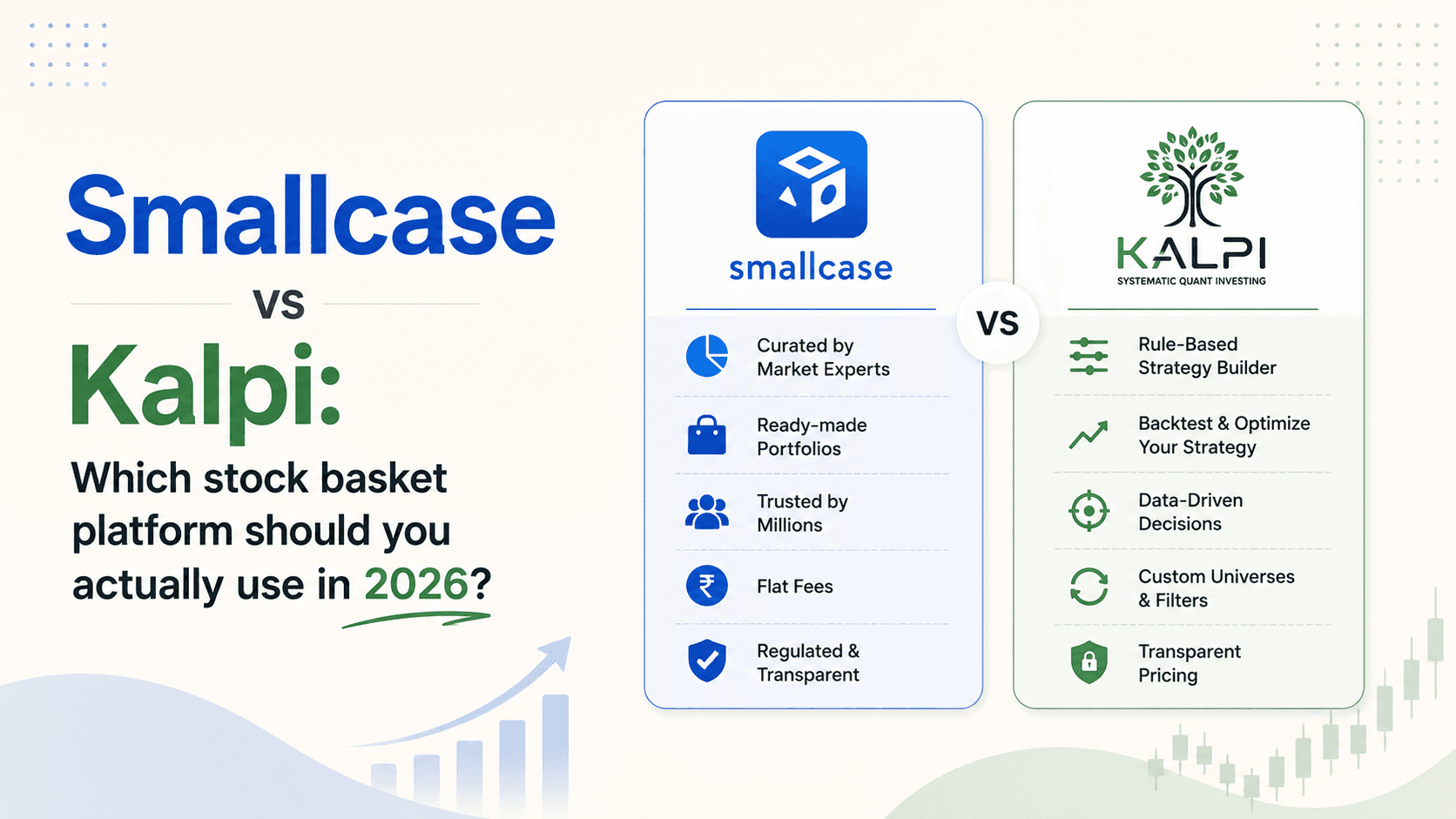
Both Smallcase and Kalpi give you these baskets. But how they build them, who decides what goes in, and what happens when markets get messy that is where the two become very different things.
Smallcase the one everyone seems to start with
Smallcase launched in 2016 and grew really fast. The reason was pretty simple it plugged directly into brokers like Zerodha and HDFC Securities. No new account needed, no learning curve, nothing complicated to set up. You browse baskets, find one whose theme makes sense to you, and invest with one click. Your existing broker handles the actual buying.
The baskets are put together by SEBI-registered advisors and fund managers. You see what is inside maybe EV companies, maybe top dividend payers, maybe PSU banks you trust whoever built it, and you put money in.
For someone who has never invested before, this is actually a decent starting point. Every friction is removed. You do not need to understand anything deeply. You just need a demat account and some money.
The problem shows up when markets fall. You know what stocks you own but often not why they are there or what would make the advisor remove them. So when things go red and you are staring at the screen, there is nothing in the platform to tell you what to do. Just wait, basically. Hope the person who built your basket was right.
Kalpi you actually understand what you own
Kalpi launched in 2024 and takes a completely different approach to the whole thing.
The easiest way to explain it Smallcase is a restaurant where someone else cooked the food. Kalpi is a kitchen where you cook it yourself, using a recipe that has been tested on years of real data. You pick every ingredient. You know why it is there. Nothing is hidden from you.
You set the rules yourself. Something like I want stocks from the Nifty 500 where revenue grew more than 15 percent last year, return on equity is above 18 percent, and momentum rank is in the top 20. Every quarter, the system re-runs those exact rules, removes whatever no longer qualifies, adds what does, rebalances automatically. You are not making any emotional decisions. The rules decide.
And before you put in a single rupee this is the part that surprises most people you can backtest that strategy on 8 or more years of real NSE data. See what actually happened in 2018, in March 2020, in the 2022 bear market. Real numbers, not someone’s projections.

Kalpi’s strategy library pre-built templates across Growth, Quality, Momentum, Large Cap and more. Beginners can start here; advanced users can build their own from scratch.
You do not need to know coding. You do not need a finance degree. The strategy builder is a visual flow pick your universe (Nifty 50, 200, or 500), add your filters, set your ranking logic, choose equal weight. That is it. The system does the rest.
The moment that actually separates them
Forget features for a second. The real difference between these two platforms does not show up on a normal day. It shows up when things go wrong.
Picture a bad Tuesday afternoon. Sensex down 1,400 points. Your portfolio is red. Your phone has not stopped buzzing WhatsApp groups, news alerts, that one uncle who forwards everything. Everyone either panicking or suddenly claiming they knew this was coming.
If you are on Smallcase, you open the app, you see red numbers, and then… what? You do not know why the stocks were picked. You do not know what would make them worth exiting. The advisor who built your basket has not said anything. The next quarterly email is weeks away. So you just sit there, refreshing, wondering if you should do something.
If you are on Kalpi, you open the app and check the actual rules. Is revenue growth still above the threshold you set? Yes. Is ROE still healthy? Yes. Is momentum rank still in the top 20? Yes. Nothing in the rules has actually changed. So you hold. Not because you are brave because the system told you to.
At a glance the key differences
| Feature | Smallcase | Kalpi |
|---|---|---|
| Started | 2016 | 2024 |
| Ready-made baskets | Yes curated by advisors | Yes with full logic shown |
| Basket transparency | See stocks, not the why | See stocks + exact rules behind them |
| Build your own strategy? | No | Yes rule-based, no coding needed |
| Backtesting on real data? | No | Yes 8+ years NSE |
| Who decides? | An external advisor | You with data |
| Rebalancing | Quarterly alert only | Automatic, rule-based |
| Analytics shown | Basic returns | CAGR, Sharpe, Drawdown + attribution |
What actually makes Kalpi different
The table above shows the features. Here is what those features actually mean for you as an investor.
01 Transparent + Logic-Driven Investing
- Every basket on Kalpi shows you the logic, not just the stock list.
- You can see exactly why each stock is included what rules it passed.
- This is different from just following a template blindly.
- You build understanding and control at the same time.
02 Rule-Based Portfolio Creation
- Kalpi lets you build your own dynamic portfolios from scratch.
- You are not limited to picking from someone else’s pre-made baskets.
- You define the strategy. The system applies it, rebalances it, tracks it.
- More flexibility and personalisation than any basket-only platform.
03 Backtesting Before You Invest
- Run your strategy against 8+ years of real NSE data before putting in a rupee.
- See exactly how it behaved in 2018, March 2020, and the 2022 selloff.
- This removes guesswork and helps you invest with actual conviction.
- The goal is not to predict it is to prepare.
04 Deep Portfolio Analysis + Attribution
- Kalpi shows you what is driving your returns and what is not working.
- Not just CAGR and P&L. You get Sharpe ratio, drawdowns, sector exposure.
- Attribution analysis tells you which factors or stocks are contributing most.
- This makes investing more analytical and less emotional over time.
Watching the crash before it actually happens to you
This is the Kalpi feature that most people underestimate when they first hear about it.
Before Priya put a single rupee in, she ran a backtest on her strategy. What that means is Kalpi took her exact rules, her filters, her ranking logic, and ran them against real NSE data going back to 2017. She sat there and watched her portfolio on screen as it lived through eight years of actual market history.
She saw the 2018 correction. She watched her portfolio fall nearly 44 percent in March 2020 when COVID hit and everything collapsed in about three weeks. And then this is the part that matters she watched it come back. Slowly, messily, not in a straight line, but all the way back and past where it started.
Here is why that changes things. When you have already watched your portfolio drop 44 percent on a screen with zero real money involved the actual crash does not hit you the same way. You have seen this before. You know what the recovery looked like last time. That is not a guarantee of anything, but it gives you something most investors never have: context.

Kalpi backtest: Rs 10 lakh invested in April 2017. Portfolio (blue) grew to Rs 64.5 lakh vs Rs 26 lakh for the Nifty benchmark (green) by 2026. Max drawdown was -44% worse than the benchmark’s -38%. That is the honest trade-off, shown upfront.
Look at that chart. Both lines start at the same point in April 2017. By 2026, the portfolio is at Rs 64.5 lakh. The Nifty benchmark is at Rs 26 lakh. Same time period, same market conditions, same crashes.
But also notice the max drawdown minus 44 percent at the worst point, versus minus 38 for the benchmark. That means this strategy fell harder than the market in the bad times. That is the trade-off. More risk, more return. Kalpi does not hide that. It shows you both numbers right there, before you invest anything.
Okay but which one should you actually use
Honest answer it depends on where you are right now.
If you have never invested in stocks before and the whole thing feels overwhelming, start with Smallcase. It is genuinely beginner-friendly. The app is clean, it works with your existing broker, and you do not have to understand anything complicated to get started. Pick a basket whose theme makes sense to you, put in a small amount, and just see how it feels to have money in the market. That learning has real value.
But if you have already been through a correction even a small one and you remember that feeling of not knowing what to do, that is when Kalpi starts making more sense. Because what you were missing in that moment was not information. It was a system. Rules that tell you what to do when everything looks scary.
Worth saying though Kalpi is newer. Launched in 2024. The backtests are based on real historical data, but the platform itself has not been through a real live market crash yet as a product. That is worth knowing. It does not make it a bad choice, but it is a fair thing to keep in the back of your head.
So what happened to Rahul and Priya?
A year after that Tuesday both still invested. Neither sold.
Rahul held on. He panicked a little, called a friend, the friend talked him out of selling, and eventually the market recovered. He was fine. But he will tell you himself that it was mostly luck that he did not sell at the bottom.
Priya held because her rules said hold. She did not need luck or a phone call from a friend. The system handled it.
Both outcomes look the same on paper right now. One year in, both portfolios are up. But the next correction is coming it always does and the difference in how they handle that one will probably be a lot bigger.
“One platform gave Rahul a basket. The other gave Priya a process. Over seven, ten years of real market noise that process is what actually builds wealth.”
And honestly, that is probably the biggest difference between the two platforms. One gives you ready-made baskets. The other helps you understand the logic behind what you own and how the system behaves when markets get uncomfortable.
Questions people usually have
Is Kalpi safe to use?
Your stocks sit in your own demat account Kalpi does not hold your money, same as Smallcase. That part is fine. The honest caveat is that it is a newer platform and has not been stress-tested through a real-life market crisis yet as a product. Worth keeping that in mind, even if the underlying strategy logic is based on years of historical data.
Do I need to know finance or coding to use Kalpi?
No to both. The strategy builder is visual you are basically selecting filters from a menu, not writing code. They also have ready-made templates for Growth, Quality, Momentum, and Low Volatility if you do not want to build from scratch. Most beginners start with those.
Does backtesting mean the returns are guaranteed?
No, and anyone telling you otherwise is either confused or lying. Backtesting shows you how a strategy behaved in the past on real data. Markets change, conditions change, what worked from 2017 to 2026 might not look the same over the next decade. The real value of backtesting is not the return number it is seeing the drawdowns, the bad years, the slow recoveries. That is what prepares you psychologically.
Can I use both platforms at the same time?
Yes, plenty of people do. Keep a simple Smallcase for a sector or theme you believe in, and use Kalpi as your main systematic portfolio. They are not mutually exclusive.