


How data, rules and a bit of discipline are quietly changing the way retail investors think about markets.
Most Indian investors don’t lose money because they’re bad at maths. They lose money because they’re human. The moment Nifty drops 8% in a week, fear kicks in and the sell button gets pressed at exactly the wrong time. When a stock is trending on some WhatsApp group, FOMO kicks in and a buy happens at exactly the wrong price. When a stock is sitting at a 30% loss, the brain convinces itself it’ll come back and it stays in the portfolio for two more years doing absolutely nothing.
Every investor who’s been through this knows they’re doing it wrong. It just doesn’t feel that way when it’s happening. Quant investing in India is how a lot of people are starting to deal with that gap.
What Quant Investing Actually Means Not the Wikipedia Version
Your local kirana uncle doesn’t reorder stock based on how he’s feeling that morning. He looks at what sold last week, what’s been sitting on the shelf too long, what margin he’s making per item and then decides. No mood, no gut call, just the numbers in front of him.
Quant investing is that same idea applied to markets. A Rule-Based Investing Platform helps you define rules based on data, price patterns, financial ratios, and earnings history, then follows them without exception. The stock either fits the criteria or it doesn’t. There’s no room for “but I have a good feeling about this one.’
What separates quant strategies in India from regular retail investing is that the system doesn’t have bad days. An analyst changes their view after a rough news cycle. A quant model runs the same filter on a panicked Tuesday as it does on a quiet one. That’s not a small thing when compounded over a few years.
Why Regular Investors Started Paying Attention
For most of India’s retail investing history, quantitative investing for retail investors was something that happened inside Bloomberg terminals at hedge fund offices. Regular people didn’t have the data, the tools, or the access.
A few things changed around the same time. Zerodha built Kite Connect and opened API access to anyone willing to learn. Smallcase turned systematic portfolios into something you could put money into with three taps on your phone. Screener.in lets people filter 5,000 stocks across 40 financial parameters without writing a single line of code. Data vendors who used to charge lakhs started charging a few thousand a year.
And then COVID hit. Markets fell 38% between February and March 2020. People who’d spent years telling themselves they were long-term investors panicked and sold near the bottom. The market recovered fast. Those same people bought back in at higher prices taking losses on both sides of the same crash.
After that, the conversations shifted. People stopped asking which stock to buy and started wondering why they keep making the same call every single time the market gets scary. That’s when algorithmic investing in India started getting real traction with regular investors. The tools were there, the data was affordable, and people had just had enough of their own decision-making.
What a Portfolio Health Dashboard Actually Shows
This is what a systematic investor actually looks at a health score, live risk signals, what’s working and what isn’t all before any emotional reaction has a chance to cloud the decision.

Portfolio Health Analysis Real-time risk and performance signals across a live portfolio
The Strategies People Are Actually Using
Go into any quant investing group in India Reddit, Discord, Telegram and these are the approaches that keep coming up. Things people are actually putting money behind, not just reading about:
| Strategy | What It Does | Who It Suits |
|---|---|---|
| Momentum | Buys stocks rising strongest over 6-12 months | Patient rebalancers, quarterly reviews |
| Quality + Value | Filters fundamentally strong stocks at fair prices | Long term holders, low churn |
| Mean Reversion | Bets on beaten-down stocks bouncing back | More active, shorter timeframes |
| Factor Combinations | Layers momentum with quality or low volatility filters | Wants stability, fewer false signals |
Momentum is where most people start. The idea is almost uncomfortably simple stocks going up tend to keep going up for a while. Rank the Nifty 500 by 6 or 12-month returns, pick the top 20 to 25, rebalance every quarter. Decades of data across global markets including India back this up.
Factor investing goes deeper. Think of how a good CA picks clients. They don’t take everyone who walks in there are criteria, things they won’t bend on no matter how impressive someone seems in the first meeting. Factor screens work the same way for stocks. Minimum return on equity, manageable debt, consistent earnings no exceptions for stocks that just have a good story going right now.
Serious retail quant investors in India usually layer two or three of these. Momentum filter plus quality check only looking at stocks moving up that are also financially solid. Not just whatever is running hot this week.
What the Data Actually Tells You
Track a real portfolio against a benchmark over time and you start catching things that emotional investing keeps buried.
A negative Sharpe ratio means the portfolio is carrying more risk than a fixed deposit and earning less back. Most investors never catch this. They see they’re up 8% and move on without noticing the benchmark returned 16% in the same period at the same risk level.
A quant framework makes you look at these numbers honestly CAGR against benchmark, volatility, how deep the drawdown went, and how long it stuck around. Not because it’s fun but because those numbers tell you whether the risk you’re sitting on is paying you anything.
Correlation matters too. If all your stocks fall together telecom, IT, oil, and materials all dropping in the same week your supposedly diversified portfolio is really just one big bet on market direction. A Backtest Portfolio analysis helps uncover these hidden correlations before they hurt performance, while a factor screen catches the risks before they become costly.
The Part Nobody Talks About Enough
There’s a student who prepares for board exams by memorising the last five years’ question papers. Mock tests go brilliantly. Then the actual exam has a slightly different paper and it all unravels. That’s overfitting a model so tuned to old data it doesn’t know what to do when the market throws something it hasn’t seen. Systematic and safe are not the same thing, and most people find that out the hard way.
A backtest showing 50% CAGR over five years is a warning sign, not a green light. Real markets are messier. A momentum strategy that runs smoothly in a trending bull market can go completely quiet for six months in choppy conditions. The model doesn’t register the change. It just keeps running.
People also stop questioning quant once it feels logical. They hand the output the same trust they’d give a calculator. But if the formula is wrong, the calculator gives you a wrong number every single time no hesitation, no warning.
Emotional Investing vs. Running a System
Most investors will admit their emotions have cost them money. More than once. The difference between these two approaches isn’t about being smarter it’s what actually happens when the market moves against you:
| Emotional Investing | System-Driven Investing |
|---|---|
| Sell everything when markets fall 10% | Exit conditions are set before the fall happens |
| Hold a loser for 2 years to avoid admitting it | Rebalance runs regardless of how it feels |
| Buy because the whole office is making money | Only enters when the criteria are met |
| Swap strategy after 3 bad months | Runs the same process through the rough patch |
| Decisions at 11pm watching business news | Decisions run on schedule, by the model |
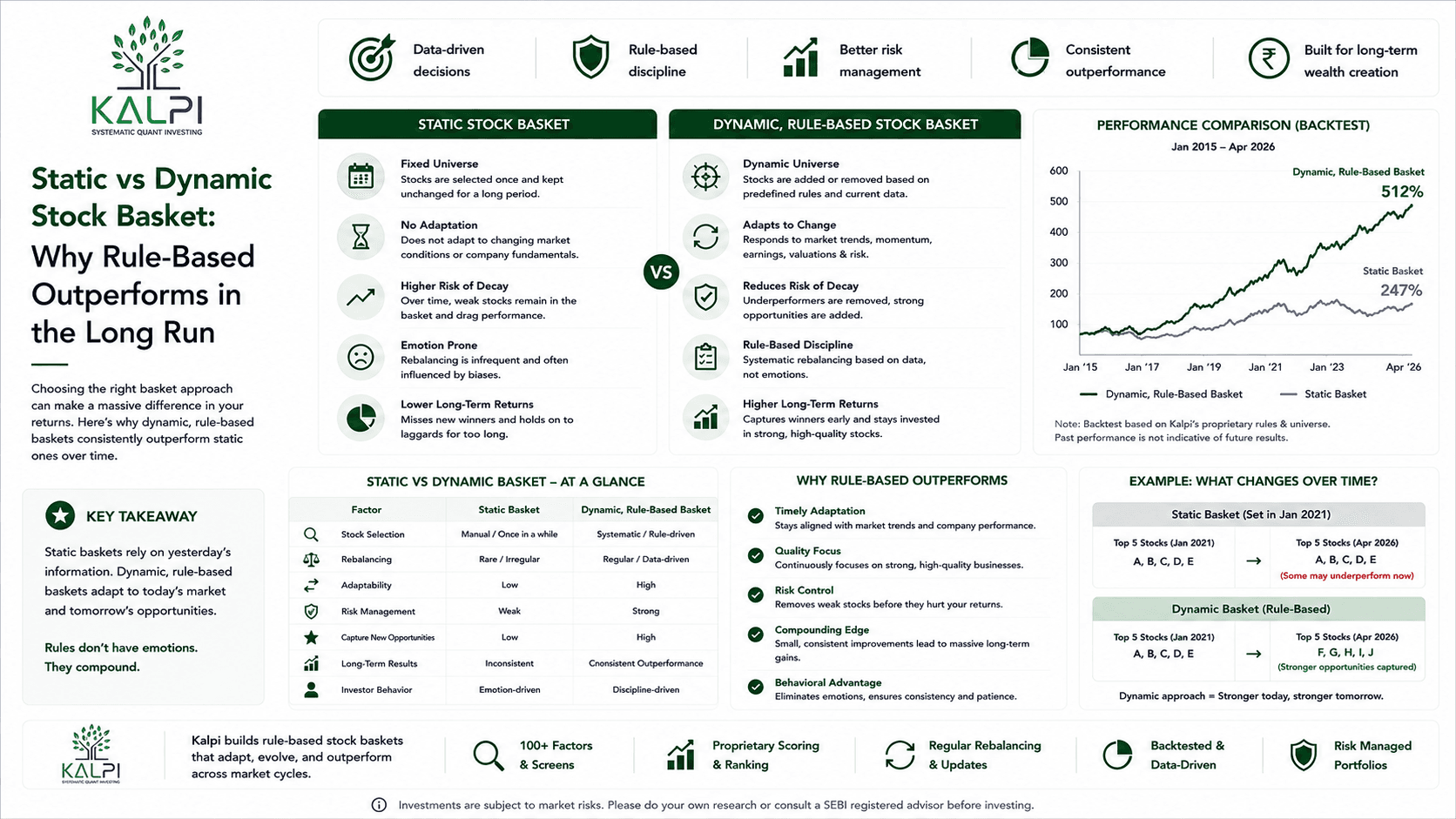
Switching to a rules-based approach doesn’t make anyone smarter. What it does is take the decision out of your hands at the exact moment you’re most likely to get it wrong. Most people don’t realise how much that matters until they look back.
Before You Start A Few Honest Things
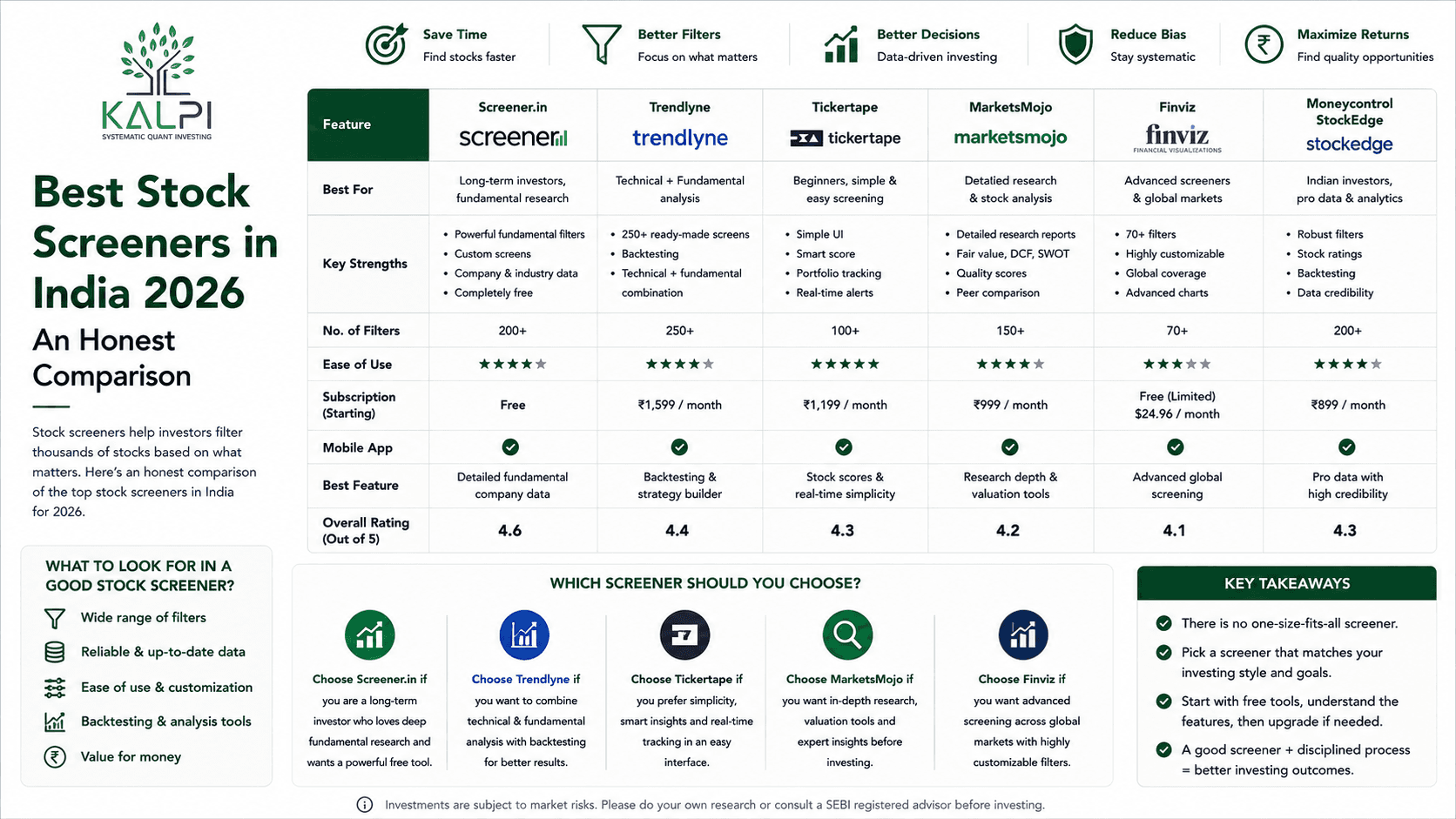
Not every platform calling itself quant actually is. Some are screeners with a better interface. Worth digging into what’s actually running underneath before putting real money behind it.
Data quality is something most beginners don’t think about until it hurts them. If the historical data only shows stocks that survived not the ones that went to zero along the way the backtest looks much cleaner than it should. Wrong data going into a clean model still comes out wrong on the other side.
Tax needs to go into your calculation from day one. Rebalancing every quarter in India triggers short-term capital gains on a lot of trades. The gross return in a backtest and what actually shows up in your account after tax and brokerage can be quite different. Look at those numbers before you commit to anything.
The hardest part of running a system isn’t building it it’s keeping your hands off it during a bad stretch when something else seems to be working better. Three months of underperformance feels like forever when it’s your money. Most people make a change at exactly that point. The ones who don’t are usually glad they didn’t.
| Key Takeaways Quant investing removes emotion from every investment decision. It works on pre-defined filters momentum, value, quality, and low volatility. Strategies can be backtested on real historical data before using real money. Not passive investing needs active rule setting and quarterly rebalancing. Beginners can start with a Nifty 500 momentum screen and build from there. Sitting still during underperformance is harder than building the system |
Most investors don’t struggle because they lack stock ideas. They struggle because every sudden market fall changes their decisions. That’s why more retail investors are slowly moving toward systems built on rules, data, and consistency instead of reacting to every headline that comes their way.
Explore quant investing strategies in India.
Frequently Asked Questions
| Q1. Do you need a finance degree to start quant investing in India?No. A lot of people running systematic portfolios in India have no formal finance background at all. What actually matters is being okay with sitting with numbers and having the patience to let a system run without constantly poking at it. |
| Q2. What is the simplest place to start?A Nifty 500 momentum screen rank stocks by 6 or 12-month returns, pick the top 20 to 25, rebalance every quarter. Smallcase and Screener.in let you do this without any code. Start simple, watch how it behaves over a few rebalances, then go deeper. |
| Q3. Is algorithmic investing in India legal for retail investors?Yes. Using automated tools through a registered broker for your own portfolio is fine under SEBI rules. Running a systematic advisory for other people’s money is a completely separate regulated category. |
| Q4. How is quant investing different from just using a stock screener?A screener finds stocks matching certain numbers. Quant investing puts rules around what you actually do with those stocks how much to buy, when to exit, when to rebalance and you follow them every time, not only when the results look good. |
| Q5. Do quant strategies always beat the market in India?No. They have rough stretches sometimes months of going nowhere. A lot of people exit right in the middle of those phases and miss the recovery. The ones who stay tend to do better, but it’s not comfortable while it’s happening. |