

Last Updated: July 2026
Quality stocks in India are companies with strong business models, consistent earnings growth, healthy financials and the ability to create long-term value for shareholders. Spotting them means looking past short-term price moves and focusing on the business itself, its management, its profitability and where it can realistically grow from here.
What Makes a Stock a Quality Stock
When people start investing, most of them go looking for the next big winner. A stock that doubles in a few months feels exciting, and it’s tempting to chase that.
But investors who’ve been in the market a while usually stop chasing quick wins. They look for strong businesses that can keep growing steadily for years. These are often called compounder stocks.
A compounder is simply a business that keeps growing its profits year after year, which lets your money grow along with it through compounding.
Here’s a way to think about it. A cheap perfume might smell nice the first time you spray it, but the scent fades fast. A well-made perfume, built with better ingredients and a strong brand behind it, holds its value much longer.
Picking quality stocks works the same way. A stock going up today doesn’t tell you much on its own. What matters is whether the business behind it has strong fundamentals, loyal customers, efficient operations and room to keep growing for years.
What Are Quality Stocks, Exactly
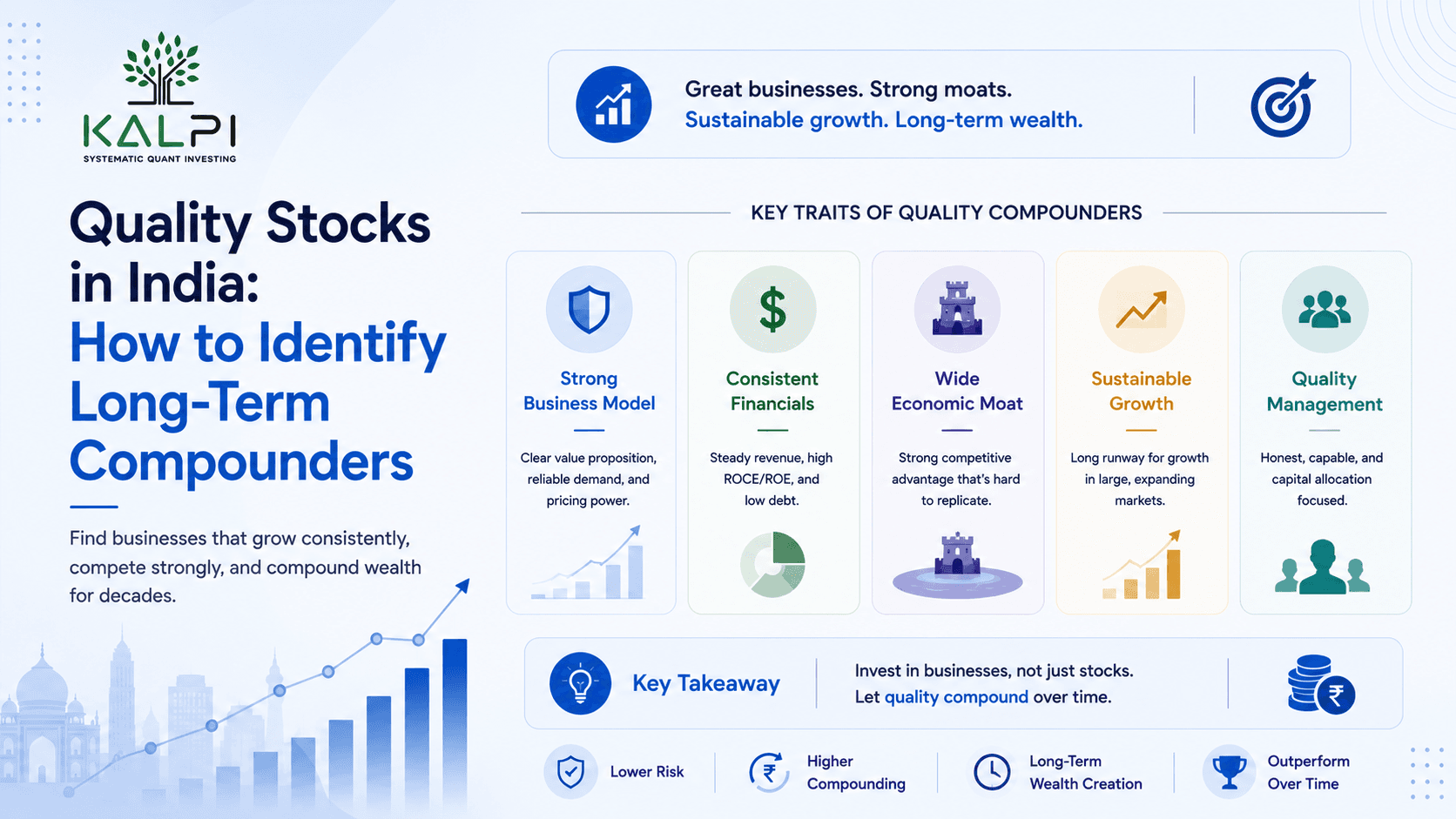
Quality stocks are companies that hold up well across different market conditions because their fundamentals are genuinely strong. These companies usually show:
- Consistent revenue and profit growth
- Strong balance sheets
- Low or manageable debt
- High return on capital
- Capable management teams
- A durable edge over competitors
A rising share price doesn’t automatically make something a quality stock. Business quality shows up over years, not in a few good weeks.
A stock can attract attention because its price jumped, but if profits aren’t growing at a similar pace, that jump probably won’t last. This is why investors hunting for the best quality stocks in India pay more attention to the business itself than to how the price has moved recently.
Why Quality Stocks Matter for Long-Term Investors
The real advantage of a quality company is that it keeps growing, year after year. A strong business grows profits, expands into new areas, and builds more value for shareholders over time.
Compounding kicks in when a company takes its earnings and reinvests them well. A company might use its profits to:
- Expand production capacity
- Enter new markets
- Improve its technology
- Build stronger customer relationships
Do this consistently over several years, and you get a cycle where growth feeds more growth. That’s exactly how some companies that looked fairly ordinary early on eventually became market leaders.
Spotting these businesses early takes patience and real research though, not just a quick look at the stock chart.
Quality Stocks vs Cheap Stocks
A lot of beginners assume a stock with a low price or low valuation is automatically a good buy. That’s not always true.
A stock can look cheap because the business is genuinely struggling. On the other hand, a strong company might trade at a higher valuation simply because investors expect it to keep growing.
| Cheap Stock | Quality Stock |
| May have a low valuation | May trade at a higher valuation |
| Could be facing business problems | Usually has stronger fundamentals |
| Future growth may be uncertain | Growth is often more consistent |
| Requires deeper analysis | Focuses on long-term business strength |
None of this means valuation doesn’t matter. Even the best companies can turn into poor investments if you pay too much for them.
The better approach is finding strong businesses trading at a reasonable price, not the cheapest stock on the screen and not the most expensive one either.
Key Characteristics of Long-Term Compounders
Finding compounder stocks in India means looking at several things together, not just one number.
1. Consistent Earnings Growth
A quality company should show steady profit growth over several years, not just one strong quarter. One good year proves very little. Look for companies that keep growing through different kinds of market conditions, not just the easy ones.
2. Strong Return on Equity (ROE)
ROE tells you how well a company uses shareholder money to generate profit. Companies that consistently post a high ROE are usually running efficient, well-managed businesses.
But don’t look at ROE alone. Check debt levels too, because heavy borrowing can sometimes make ROE look better than the business actually is.
3. Strong Balance Sheet
A company carrying too much debt can struggle badly during tough economic periods. Quality companies usually strike a healthy balance between growth and financial stability.
A strong balance sheet gives a business room to survive downturns and grab new opportunities when they show up.
How to Identify Quality Stocks in India
Finding quality stocks isn’t about chasing trends or leaning on one financial ratio. It means understanding the full picture of a business.
A common mistake is picking a stock just because it’s popular or because the price has been climbing recently. Long-term compounders are usually spotted by studying the strength of the business behind the stock, not the noise around it.
1. A Strong Business Model
A quality company usually operates in a space with long-term demand and real growth potential. It understands its customers, offers strong products or services, and can compete well.
A business with a trusted brand, loyal customers and a solid market position usually has an edge over its competitors. This edge is often called a competitive moat, and a strong moat helps a company protect its market share even as competition heats up.
2. Consistent Profit Growth
Revenue growth alone doesn’t tell the full story. A company can grow its sales and still struggle to turn a profit.
Quality companies usually show steady improvement across revenue, profits, cash flow and margins together. It’s worth checking whether a company has managed to grow across different market conditions, not just when things were easy. A business that only performs well in good times isn’t always a dependable long-term bet.
3. Efficient Management
Management quality plays a bigger role than most beginners realise. A good team focuses on sustainable growth instead of chasing short-term numbers to look good for a quarter.
Worth checking:
- How the company uses its profits
- Whether it’s transparent with shareholders
- How it treats shareholders
- Whether its business decisions actually make sense
A strong business with weak management can still destroy shareholder value. Good leadership, on the other hand, can help an already good company grow even further.
4. Healthy Cash Flow
Profit on paper doesn’t always mean real money is coming into the business. Cash flow shows whether a company is actually generating money from its operations.
Companies with strong cash generation have more room to expand, pay down debt, and get through tough economic periods. That’s why investors looking at quality 30 compounder stocks in India tend to study cash flow alongside profit numbers, not instead of them.

A rule-based screen filtering on operating cash flow, debt-to-equity and sales growth, then ranking by earnings and profit growth, the kind of systematic check that helps separate genuine quality from a stock that’s simply had a good run.
Quality Stocks and Valuation: A Balance Investors Need
A common mistake is assuming a great company is always a great investment. It isn’t. Even the best businesses can become expensive if you pay too much for them.
Think about buying that same premium perfume again. Get it during a sale and you’re getting real value. Pay three times the price for the identical bottle a week later, and the perfume hasn’t changed, but what you’re getting for your money has.
Stocks work the same way. A high-quality company bought at an unrealistic valuation can still deliver poor returns if future growth doesn’t live up to what was already priced in. That’s why it helps to focus on both business quality and a reasonable valuation, not just one or the other.
Common Mistakes While Choosing Quality Stocks
Even investors who understand the idea of quality still trip up in a few common ways.
Buying Only Famous Companies
A well-known brand doesn’t automatically mean a good investment. It’s worth checking the actual financial performance instead of buying something just because everyone’s talking about it.
Ignoring Valuation
A genuinely great company can still turn into a poor investment if you buy it at an extremely high price. Valuation is really just a check on whether you’re paying a fair amount for the growth you’re expecting.
Focusing Only on Past Returns
A stock that did well in the past won’t necessarily keep doing well. Worth asking whether the company’s growth story still holds up today, not just whether it looked good a few years back.
Ignoring Risk
Even quality companies aren’t immune to trouble. Competition, regulation, new technology or shifting customer preferences can all affect future growth. A good investor weighs both the opportunity and the risk, not just the upside.
Quality Stocks vs Growth Stocks
These two get mixed up often. They can overlap, but they’re not the same thing.
| Quality Stocks | Growth Stocks |
| Focus on business strength and stability | Focus on future expansion potential |
| Usually have consistent performance | May have faster but uncertain growth |
| Often have strong financials | May require higher risk tolerance |
| Suitable for long-term investors | Can experience higher volatility |
Some companies manage to be both high-quality and high-growth at once, but each one is worth evaluating on its own rather than assuming the label fits.
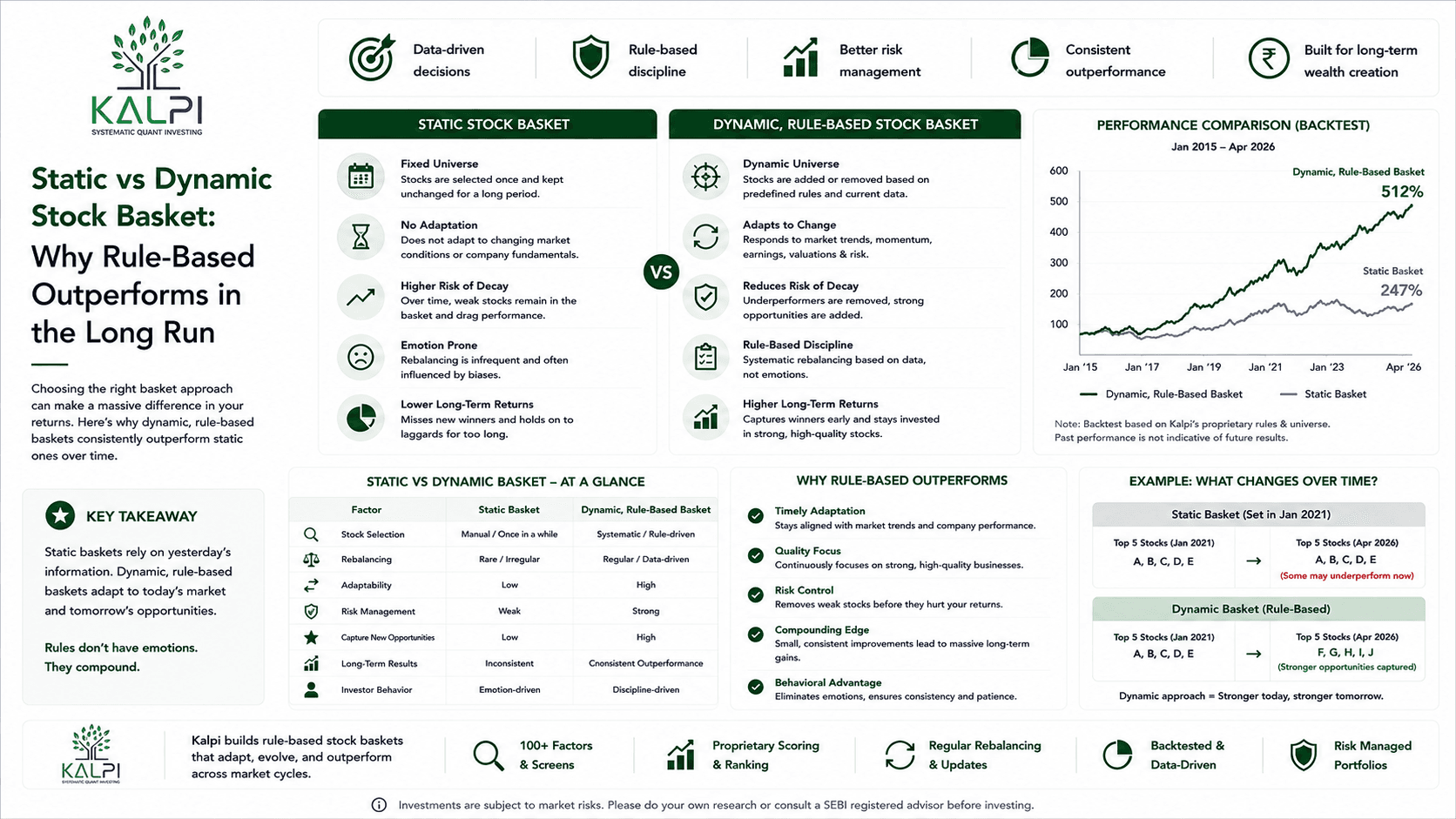
How Rule-Based Investing Helps Identify Quality Companies
Picking quality stocks gets harder when emotions get involved. It’s easy to buy something because it’s trending, sell out of panic during a correction, or overlook warning signs simply because you like the brand.
A rule-based approach cuts down on these emotional slip-ups. Instead of going with a gut feeling, you evaluate every company against the same predefined criteria, things like profitability, financial strength, valuation, growth consistency and momentum.
This gives you a disciplined process where every stock gets judged by the same yardstick. No system removes investment risk completely, but a systematic approach helps you make more balanced decisions instead of reactive ones.

Comparing metrics like dividend yield across a basket of stocks side by side makes it easier to spot which companies are actually consistent, rather than judging each one in isolation.
Can Quality Stocks Underperform?
Plenty of beginners assume that once they’ve bought a quality company, good returns are almost guaranteed. That’s not how markets actually work.
Even the strongest businesses go through rough patches. Economic slowdowns, rising competition, shifting customer preferences or challenges specific to an industry can all weigh on performance for a while.
There are also times when the business itself is doing fine, but the stock price doesn’t move. This usually happens when expectations were set too high. If a company was expected to grow fast but delivers only average results, the price can still fall even though the underlying business remains solid.
This is why experienced investors pay more attention to the business than to a few months of price movement. Quality investing is a long game, and judging a company on short-term price action rarely tells you the full story.
Should You Buy Quality Stocks at Any Price?
No. A great business doesn’t automatically become a great investment if you overpay for it.
Back to the perfume example. Buy it on sale and you’re getting solid value. Buy the exact same bottle a week later at triple the price, and the product hasn’t changed, but what you got for your money has.
Stocks behave the same way. A high-quality company bought at an unrealistic valuation can deliver weak returns because much of its future growth is already baked into the price. Experienced investors try to balance two things at once: buying a strong business, and paying a reasonable price for it. Both matter equally.
Why Patience Matters
Quality companies rarely turn into wealth creators overnight. Most of them spend years quietly improving their products, expanding operations and earning customer trust before the results become obvious.
Companies like Asian Paints, Titan and Infosys didn’t become market leaders in a year or two. Their success came from steadily growing the business over a long stretch of time.
Investors who stayed invested through different market cycles have generally done far better than those trying to time every short-term move. Patience doesn’t sound exciting, but it’s been one of the biggest drivers of long-term wealth creation.
Final Thoughts
Finding quality stocks in India isn’t about picking the cheapest stock on the screen or following whatever company is popular right now.
It’s about identifying businesses with strong fundamentals, capable management, healthy financials, and the ability to grow steadily over many years.
No single ratio can tell you a company is a quality stock on its own. It takes understanding the business, checking its financial strength, seeing whether the valuation is reasonable, and thinking honestly about its long-term growth potential.
A disciplined, rule-based approach makes this process more consistent by evaluating every company against the same objective criteria instead of emotion or market hype.
There’s no perfect stock, and there never will be. The goal is simpler: find a strong business, buy it at a sensible price, and give it enough time to actually grow.
Investors who stay patient, stay disciplined, and focus on long-term business performance give themselves a much better shot at building lasting wealth.
Frequently Asked Questions
1. What are quality stocks in India?
Quality stocks are companies with strong financials, consistent earnings growth, capable management and a durable edge over competitors. These businesses are generally considered well suited for long-term investing.
2. How can I identify quality stocks?
Look at revenue growth, profit growth, return on equity, cash flow, debt levels, management quality and overall business fundamentals, instead of relying only on how the share price has moved recently.
3. Are quality stocks always expensive?
No. Some quality companies trade at premium valuations, but others become reasonably priced during market corrections or periods of temporary weakness.
4. What are compounder stocks in India?
Compounder stocks are companies that consistently grow their earnings over many years, letting investors’ wealth grow alongside them through the power of compounding.
5. Can rule-based investing help identify quality stocks?
Yes. Rule-based investing evaluates companies using predefined factors like profitability, financial strength, valuation and growth consistency, which creates a disciplined process and reduces emotional decision making.