

An honest, practical comparison no jargon, no fluff.
Here’s a situation most Indian investors know a little too well.
You save up some money, decide you should probably start investing properly, open Google, and type out something like “best way to invest in stocks in India.”
Forty-five minutes later, you’ve got fifteen tabs open. Everyone online sounds confident. One YouTube creator says mutual funds are outdated. Another insists PMS is where “serious wealth” gets built. Someone on Twitter is going on about factor investing.
And somehow, you’re more confused than when you started.
PMS sounds expensive, and a bit intimidating if we’re honest.
Mutual funds sound safe but also kind of boring.
Stock baskets and Smallcase-type platforms sound interesting, though most people aren’t entirely sure how they actually work under the hood.
This article attempts to sort that out. Not with textbook definitions or finance jargon just a practical look at what each option actually is, who it’s built for, what it costs, where it works well, and where it quietly falls apart.
By the end, you should have a decent sense of which path fits your situation, instead of just picking whichever one sounded most impressive in a reel.
1. What Is PMS?
PMS stands for Portfolio Management Service.
The simplest way to think about it: you’re hiring a professional to manage your stock portfolio directly. Not a pooled fund, not a SIP product your own portfolio.
You deposit money with a SEBI-registered portfolio manager, and they build and manage a portfolio on your behalf. They decide what stocks to buy, how big each position should be, when to rebalance, and when to exit.
One thing that sets this apart from mutual funds the stocks sit in your own demat account. You can actually see what’s being bought and sold, in real time, instead of waiting for a disclosure.
PMS portfolios also tend to be more concentrated, usually somewhere around 15–25 stocks rather than the much wider spread you’d see in a typical diversified fund.
A concentrated portfolio looks brilliant when the calls work. When they don’t, things unravel much faster.
The other thing people notice fairly quickly is the fee structure. Most PMS providers charge a fixed management fee, plus a percentage of profits above a certain hurdle rate. Over long periods, those fees compound quietly in the background easy to overlook in year one, harder to ignore by year ten.
The bigger issue, though, is accessibility. SEBI mandates a minimum investment of Rs 50 lakhs for PMS. That alone takes most retail investors out of the picture immediately.
And honestly, PMS was never really designed for someone investing their first few lakhs. It’s a wealth-management product for people who already have substantial capital and would rather have someone else make the portfolio calls professionally.
2. What Are Mutual Funds?
Mutual funds are probably the most familiar investing product for most Indians your parents likely have a few, your colleagues talk about their SIPs, it’s just part of the furniture.
You invest money into a fund. That money gets pooled together with money from thousands of other investors. A fund manager then takes that combined pool and invests it into stocks, bonds, or a mix of both.
You’re not picking the stocks. You’re picking the manager, and trusting their process.
The biggest reason mutual funds caught on is simple they remove decision fatigue. You can start with Rs 500 SIPs, set up automatic monthly investing, get instant diversification, and barely have to think about it after that.
For a lot of people, that simplicity is genuinely valuable.
A boring SIP that survives ten years quietly often beats a complicated strategy somebody abandons after one bad year. That part doesn’t really get talked about online it’s not exciting enough for a thumbnail.
Mutual funds are also heavily regulated by SEBI, which gives investors a reasonable layer of protection.
But there are tradeoffs. You have no real control over stock selection, sector exposure, portfolio changes, or rebalancing decisions all of that happens behind the scenes.
Most investors also don’t realise they’re usually seeing portfolio disclosures with a delay. And many actively managed funds end up staying fairly close to their benchmark anyway, because fund managers are managing career risk alongside investment risk.
Which means sometimes you’re paying active-management fees for returns that look surprisingly close to the index.
3. What Are Stock Baskets?
Stock baskets are newer in India, though the underlying idea isn’t complicated at all.
Instead of buying one stock, or a pooled mutual fund, you buy a curated group of stocks together as one basket.
Think of it like ordering a thali. You get a combination designed to work well together, instead of picking every dish separately. The difference here is you can still see every ingredient individually, and if you want, remove or adjust things yourself.
Platforms like Smallcase made this model popular in India by offering ready-made baskets built around sectors, themes, factors, or strategies.
Kalpi pushes this a bit further by letting investors create their own rule-based baskets using filters like momentum, ROE, revenue growth, volatility, or factor ranking and then backtest those rules on historical NSE data before putting in real money.

A sample backtest dashboard showing CAGR, volatility, Sharpe and Sortino ratios against a benchmark.
One reason stock baskets appeal to people is transparency the stocks sit directly in your demat account, so you know exactly what you own. Sounds basic, but psychologically, it changes how people engage with their investments.
Minimum investment is also far lower than PMS. You can begin with a few thousand rupees, depending on how the basket is structured.
And unlike mutual funds, you still retain meaningful control over rebalancing, exits, stock-level visibility, and customisation.
4. This Is Usually Where Opinions Start Separating
Definitions are one thing. The practical differences show up somewhere else entirely control, flexibility, transparency, fees, and how involved you actually want to be.
That’s usually where investors start forming strong opinions.
4.1 Minimum Investment
This is the first major filter, really.
PMS requires Rs 50 lakhs minimum. That’s a regulatory floor, not a marketing line.
Mutual funds sit at the opposite end you can start SIPs with Rs 500.
Stock baskets fall somewhere in between. Some curated baskets may need Rs 5,000, Rs 10,000, or Rs 20,000+ depending on the stocks involved. Kalpi-style rule-based baskets are more flexible since the allocation depends on your own portfolio size and how the strategy is structured.
4.2 Who Actually Controls The Portfolio?
With mutual funds, the fund manager controls everything.
With PMS, the portfolio manager controls decisions within a defined strategy mandate.
With stock baskets, control opens up quite a bit you can use ready-made baskets, customise existing ones, or build your own system from scratch.
Roughly, the spectrum looks like this:
Mutual Funds → PMS → Rule-Based Stock Baskets
Going from least control to the most.
4.3 Transparency
PMS and stock baskets both do well here, because holdings sit directly inside your demat account you can see your positions clearly, any time.
Mutual funds disclose holdings periodically, so visibility comes with a lag.
That may not bother a passive investor much. But for someone trying to actually understand how their portfolio behaves day to day, transparency changes the experience quite a bit.

A monthly returns timeline comparing portfolio performance against the benchmark over several years.
4.4 Customisation
This is where mutual funds fall behind fairly quickly.
You can’t tell a mutual fund to avoid tobacco companies, increase banking exposure, or reduce small-cap weight. It just doesn’t work that way.
PMS allows some customisation, depending on the manager and mandate.
Rule-based baskets give you far more room to move. On Kalpi, for instance, investors can define their stock universe, apply filters, set ranking logic, choose rebalancing schedules, and backtest strategies on historical data no coding required.
Which honestly matters, because most people interested in investing aren’t trying to become quant engineers. They just want a bit more say in what they own.
4.5 Liquidity and Flexibility
Mutual funds are fairly liquid, outside of lock-in products like ELSS.
PMS exits can take a little longer depending on how the portfolio is structured.
Stock baskets behave like direct equity holdings, because that’s exactly what they are. If the market’s open, you can exit. Simple as that.
5. The Full Comparison Table
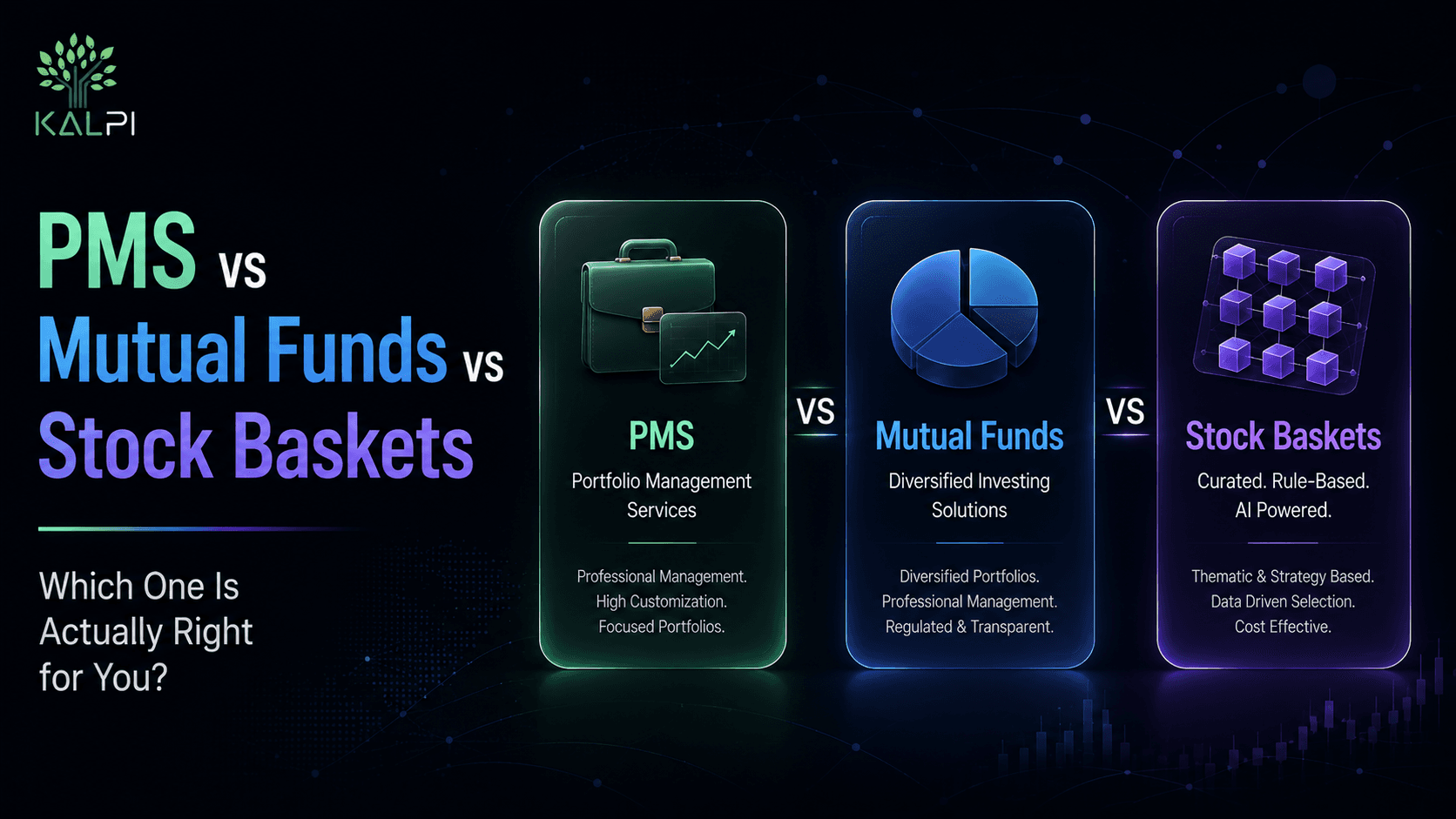
| Parameter | PMS | Mutual Fund | Stock Basket (Rule-Based) |
|---|---|---|---|
| Minimum Investment | Rs 50 Lakhs | Rs 500 SIP | Rs 5,000+ |
| Portfolio Ownership | Your demat account | Fund units | Your demat account |
| Transparency | High | Moderate | High |
| Customisation | Limited | None | Full |
| Professional Management | Yes | Yes | Rule-based / DIY |
| Fees | 1–2.5% + profit share | Expense ratio | Platform subscription |
| Liquidity | Moderate | High | High |
| Control | Low | None | High |
| Backtesting | No | No | Yes |
| Beginner Friendly | No | Yes | Moderate |
6. Cost And Fees
Fees matter more than most people think, mainly because they compound silently for years you don’t feel it happening, but it adds up.
PMS is usually the most expensive of the three. Typical charges include annual management fees, profit sharing, and transaction costs. Over long periods, this becomes a substantial chunk.
Mutual funds are cheaper comparatively, though expense ratios still chip away at returns daily through NAV adjustments. Many investors barely notice this because the deduction is invisible it’s just baked into the number you see.
Rule-based basket platforms work a bit differently. Kalpi, for example, charges a platform subscription fee rather than taking a cut of your profits. You still pay normal brokerage and taxes like any direct equity investor no performance fee, no profit-sharing structure.
At larger portfolio sizes, that difference becomes meaningful surprisingly quickly.
7. Risk And Return
All three carry market risk. None of them eliminate volatility that’s just not how equity works.
The difference is in how that risk is structured.
PMS portfolios tend to be concentrated, which creates potential for strong outperformance but also sharper drawdowns when things go wrong.
Mutual funds smooth out volatility through diversification, though sometimes that diversification gets so broad that returns start resembling the benchmark index anyway.
Rule-based stock baskets approach this differently. Instead of relying entirely on a manager’s instinct, risk management can be built into the strategy itself through factor filters, volatility screens, rebalancing logic, and exit conditions.
And before putting in real money, strategies can actually be tested against periods like the COVID crash, the 2018 correction, or the 2022 volatility phase.
Once people have already seen how ugly a strategy looked during bad periods, future corrections stop feeling quite as shocking.
8. Taxation Briefly
For Indian equity investing, the basics are the same across the board: LTCG above Rs 1 lakh is taxed at 10%, and STCG at 15%. That broadly applies across PMS, direct equity baskets, and equity mutual funds.
The operational difference is control.
With mutual funds, internal portfolio churn happens regardless of what you personally want the fund manager rebalances on their own schedule. With stock baskets, rebalancing schedules are visible and tied to the strategy, which makes tax behaviour a lot easier to anticipate.
9. Which Option Makes Sense For Beginners?
Direct answer: mutual funds remain the easiest starting point for complete beginners.
Low minimums, automatic diversification, very little decision-making required. That simplicity genuinely helps a lot of people stay invested consistently which, over a decade, matters more than almost anything else.
Stock baskets become more useful once someone wants transparency, more control, direct equity ownership, or a better understanding of how a strategy actually behaves. Pre-built rule-based baskets are usually the easiest way in.
PMS is rarely suitable for beginners and not just because of the Rs 50 lakh requirement. Evaluating PMS managers properly requires actual investing experience, which most beginners simply haven’t had yet.
10. Who Should Choose What?
| Your Situation | Best Match |
|---|---|
| Starting with small capital | Mutual Funds |
| Want more portfolio control | Rule-Based Stock Baskets |
| Interested in testing strategies | Kalpi |
| Rs 50L+ portfolio | PMS |
| Prefer fully passive investing | Index Funds |
| Interested in factor investing | Kalpi / Smallcase-style baskets |
11. PMS vs Smallcase The Comparison People Usually Reach Eventually
Once investors move past the beginner stage, the comparison often shifts. It stops being “mutual funds vs stocks” and becomes “PMS vs Smallcase-type investing” instead.
That shift makes sense both offer direct equity visibility, basket-style investing, and a more portfolio-level way of thinking.
But there’s still a meaningful gap between them.
Smallcase mainly offers curated baskets built by research analysts. You browse, you subscribe, and that’s largely it.
Kalpi moves a step further into strategy creation itself. You’re not just selecting baskets you’re building systems: choosing your universe, defining filters, ranking factors, and testing the rules historically before committing money.
That tends to appeal to investors who want transparency and structure, without needing crores of rupees to get PMS-level access.
12. Final Thoughts
There’s no universally “best” option here. The right choice depends on your capital, how involved you want to be, your comfort with volatility, and honestly how interested you actually are in investing as a thing in itself.
Mutual funds make sense for people who want simplicity and consistency without active involvement.
PMS makes sense for high-net-worth investors who are comfortable handing decisions over to a manager.
Rule-based stock baskets make the most sense for investors who want transparency, direct ownership, systematic investing, and more control without needing institutional-scale capital to get there.
And the shift toward systematic investing isn’t just a passing trend. It reflects something real: most investing mistakes are emotional before they’re analytical.
- People panic.
- They override their own plans.
- They chase momentum a bit too late.
- They sell during ugly phases.
Most people only discover their real risk tolerance after watching a portfolio fall for three straight months.
A clear framework reduces that damage not eliminates it, but reduces it.
You don’t need to become a finance expert to invest systematically. You just need a set of rules, reasonable expectations, and the discipline not to abandon the process every time the market gets noisy.
If you want to see what rule-based portfolios actually look like on historical market data before investing, you can explore Kalpi’s research platform
Frequently Asked Questions
What is the minimum investment required for PMS in India?
Rs 50 lakhs. SEBI mandates this minimum across all PMS providers.
Is a stock basket the same as a mutual fund?
No. In mutual funds, you own fund units. In stock baskets, the stocks are held directly inside your demat account and that one difference changes transparency, flexibility, and control quite a bit.
What is the difference between PMS and Smallcase?
PMS involves professional portfolio management services with a Rs 50 lakh minimum. Smallcase-style platforms offer curated direct-equity baskets at much lower entry sizes. The investor retains ownership in both cases, but the control structure is quite different.
Are rule-based stock baskets safer than normal investing?
Not automatically they still carry full equity market risk. The advantage is that risk management rules can be set in advance, rather than relying entirely on how someone feels in the middle of a volatile week.
Can beginners create stock baskets without coding?
Yes. Most modern platforms are visual now, so coding usually isn’t necessary.