

Last Updated: July 2026
Think about your Instagram feed from a few years ago. The creators you followed, the trends you watched, the content that showed up every day, most of it has changed completely. Someone who used to be everywhere on your feed may have disappeared, while a creator you had never heard of is suddenly one of the biggest names online.
That does not mean the older creator failed. Audiences changed, interests moved on, and the algorithm started favouring content that matched newer trends.
The stock market works in a surprisingly similar way.
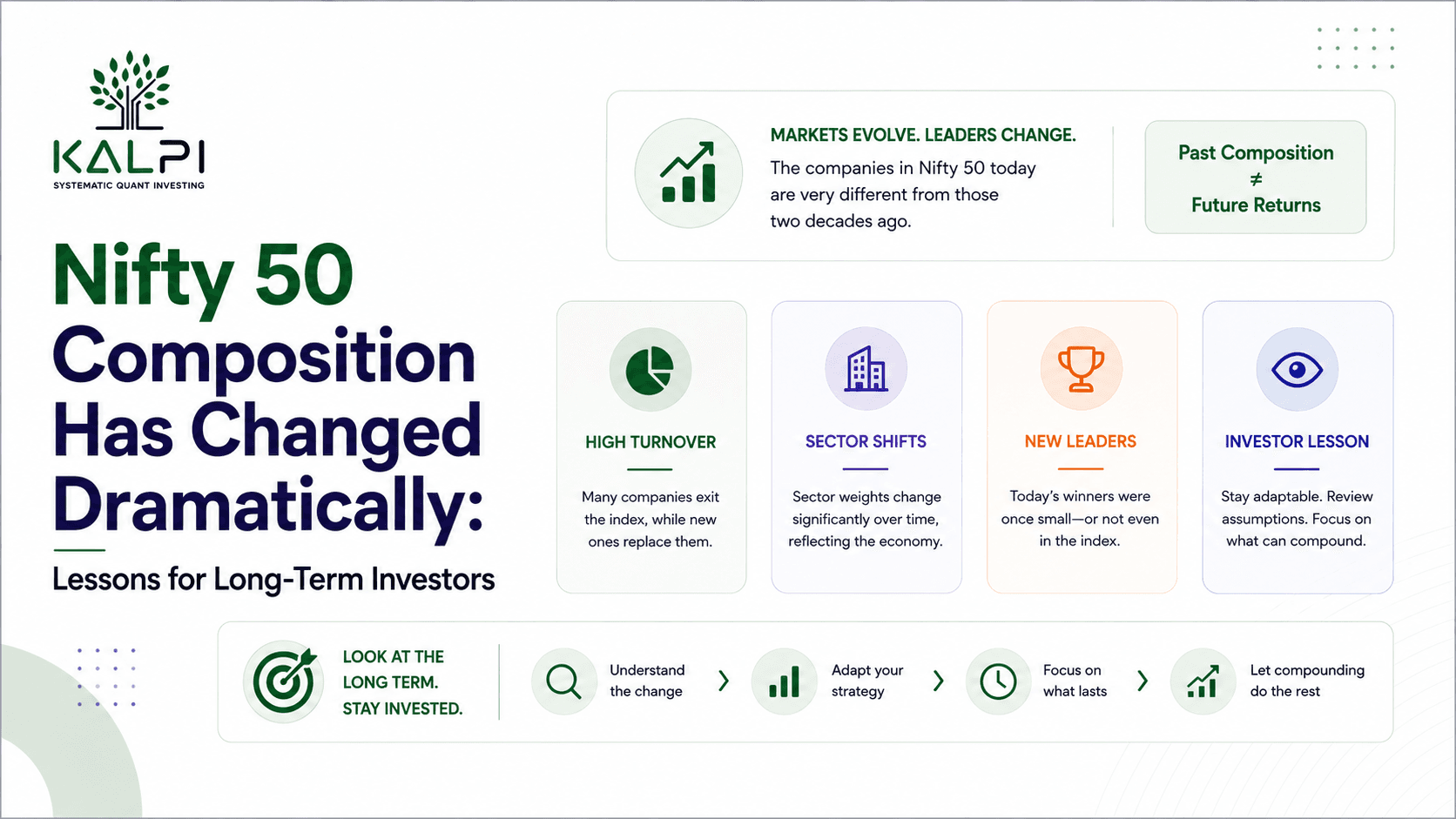
Nifty 50 composition change refers to the regular reshuffling of companies in India’s benchmark index, driven by shifts in market capitalisation, liquidity, and business performance. Companies enter when they grow stronger and exit when they fall behind. Understanding this helps long-term investors avoid assuming that today’s market leaders will automatically stay on top forever.
What Is Nifty 50 Composition Change?
The Nifty 50 tracks 50 large, actively traded companies on the National Stock Exchange. But these companies are not permanent members. The index is reviewed periodically to make sure it still represents the most relevant businesses in India’s market.
A company usually earns a place in the index when it shows strong growth in market value, high trading activity, steady investor interest, and a solid position within its sector.
A company tends to drop out when its market value falls behind peers, its business performance weakens, or another company simply becomes a stronger representative of that part of the market.
None of this means an exiting company is automatically a bad business. Sometimes the market has just moved forward, and newer companies have become more relevant. The index exists to reflect the current market, not the market as it looked years ago.
In practice, index providers review the Nifty 50 on a set schedule, typically twice a year, looking at average market capitalisation and trading volumes over a preceding period. This is a mechanical, rules-based process rather than a judgement call about which company deserves to stay. That is part of what makes the index a useful mirror of the market rather than an opinion about individual businesses.

Tracking live P/E ratio, returns and market breadth across Nifty 50, Midcap, Smallcap and Microcap makes it easier to see how different segments of the market move at different speeds.
Nifty 50 vs 20 Years Ago: How India’s Market Leaders Changed
Comparing Nifty 50 vs 20 years ago shows one clear pattern, market leadership keeps changing. Two decades back, sectors like energy, metals, engineering, and traditional manufacturing had a much bigger presence among India’s largest listed companies.
Today, financial services, information technology, consumer businesses, and healthcare occupy a much larger share of the index. This shift happened because the Indian economy itself changed. Digital adoption, rising consumer spending, and wider access to financial services opened up space for entirely new categories of large companies.
For investors, the lesson is simple. Past performance can tell you what worked earlier, but it does not guarantee that the same companies, or even the same sectors, will lead the market going forward.
Some of the largest companies from twenty years ago are still around today, and a few remain genuinely important businesses. But their weight within the index, and the story behind their growth, looks very different now. A company that once led because of scale in a capital-heavy industry is a different kind of leader than one that leads today because of a scalable, asset-light business model. The comparison is less about winners and losers, and more about how the entire basis of leadership has shifted.
Nifty 50 Then vs Today
| Factor | Nifty 50 Around 20 Years Ago | Nifty 50 Today |
|---|---|---|
| Major sectors | Energy, metals, manufacturing and traditional industries | Banking, IT, consumer, healthcare and financial services |
| Main growth drivers | Infrastructure expansion and industrial growth | Technology, services, consumption and financial growth |
| Business models | More asset-heavy companies | More scalable, service-oriented businesses |
| Investor lesson | Old market leaders can lose their position | Investors need to track changing market trends |

An equal weight version of the Nifty 50 strips out the influence of a handful of dominant large caps, giving a clearer read on how the broader index has actually moved over time.
Why Market Leaders Change: Understanding Nifty Rotation
Many investors assume that finding a strong company and holding it forever is enough to build wealth. Long-term investing is a genuinely powerful approach, but businesses themselves change, and that is easy to forget.
A company that looks unstoppable today can run into trouble later because of new competitors, changing customer behaviour, technology disruption, economic cycles, or regulatory shifts. The Nifty 50 adjusts for exactly this reason, replacing companies that no longer represent the current market with ones that have grown stronger.
This does not mean investors should constantly reshuffle their own portfolios. Frequent trading creates its own costs and problems. The real lesson is that long-term investing needs patience along with periodic review. Holding a stock for years only works as long as the underlying business keeps creating value.
This constant shift in market leadership from one sector or group of companies to another is often called Nifty rotation. India’s market has gone through several such phases, where sectors that once dominated gradually gave up ground to newer industries. A decade ago it might have been infrastructure and capital goods pulling the index higher. More recently it has been private banks, IT services, and consumer facing businesses taking that role.
Nifty rotation is not something investors need to predict with precision. Trying to time exactly when one sector will overtake another is close to impossible even for professional fund managers. What rotation really teaches is more useful than any prediction, it is a reminder that businesses need to keep adapting to stay ahead, and that no sector gets a permanent seat at the top of the index.
Why Blind Buy and Hold Doesn’t Always Work
Buying strong companies and holding them for years has helped many investors build real wealth. Great businesses have rewarded patient shareholders for decades. The problem starts when buy and hold turns into a rule to never look at the investment again.
A company that was excellent 15 or 20 years ago may be facing very different challenges today. Markets shift, competitors get stronger, technology moves fast, and customer preferences change. A strong brand, a profitable history, and a large market presence still do not guarantee that a business will adapt well to what comes next.
A company operating in a sector hit by new technology, tighter regulation, or fresh competition can lose its edge over time, while another business from a growing industry quietly becomes the next market leader. This is part of why the Nifty 50 keeps adjusting itself, adding companies that better represent where the economy is heading.
To be clear, this is not an argument against long-term investing.
Blind buy and hold, where an investor stops checking on a business entirely, is what creates problems. Reviewing a holding occasionally to confirm the original investment reason still makes sense is simply good practice, not market timing.
The goal is not to trade in and out of stocks based on every news headline. The goal is to give good businesses enough time to compound, while still checking every so often that the original reason you invested in them has not quietly stopped being true.
Index Investing vs Individual Stock Investing
Many investors compare a Nifty 50 index fund with buying individual stocks directly, but there is an important difference between the two. When you invest in an index fund, your portfolio automatically follows the changes the index makes. Companies that no longer meet the criteria get removed, and new ones enter, without you having to do anything.
An individual stock investor does not get this built-in adjustment. If you bought a company years ago and never revisited it, you could still be holding a business that has lost the growth potential it once had.
| Index Investing | Individual Stock Investing |
|---|---|
| Portfolio automatically adjusts with index changes | Investor has to review companies manually |
| New market leaders are added over time | Old holdings can remain even after business conditions change |
| Requires trust in index methodology | Requires continuous company analysis |
This is not a case for abandoning individual stocks altogether. It is a reminder that picking stocks directly comes with an extra responsibility that index investing quietly takes care of for you. Investors who prefer individual stocks simply need to be more deliberate about revisiting their choices.
A Practical Portfolio Review Framework
Understanding how the Nifty 50 evolves can sharpen the way you think about your own holdings. Many beginners focus only on finding the next big stock, but knowing when an old investment idea has stopped working is just as valuable a skill. Both take the same underlying habit, paying attention to what a business actually looks like today, not what it looked like when you first bought it.
Instead of holding every investment forever without a second look, you can run through a short, honest checklist once or twice a year. None of these questions require predicting the future. They just require an honest look at where the business stands today.
1. Check business quality
Is the company still financially strong and competitive within its space, or has that edge started slipping?
2. Understand industry change
Is the sector still growing, or is it slowing down and facing disruption from newer models or technology?
3. Analyse performance
Look at revenue growth, profitability, and overall financial health rather than just the stock price chart.
4. Track competition
Are newer entrants gaining ground in a way that could chip away at the company’s position over the next few years?
5. Revisit your original reason
Ask honestly whether the reason you bought the stock in the first place still holds true today.
This is not about reacting to every quarterly result or short-term dip. It is about building a habit of checking, once or twice a year, whether a business still deserves its place in your portfolio.

Watching how dividend yield moves alongside price over time gives investors another data point to judge whether a holding’s valuation still matches its underlying fundamentals.
Common Mistakes Investors Make While Following Market Leaders
A few habits show up again and again among investors who get caught off guard when a long-held stock stops performing.
- Holding past winners without rechecking fundamentals, since a stock that delivered strong returns earlier may not repeat that performance if the underlying business has quietly weakened.
- Ignoring sector rotation, which can mean missing how leadership is gradually shifting from one part of the market to another until the gap becomes hard to ignore.
- Assuming large companies cannot lose their position, when size offers real advantages in access to capital and talent, but never guarantees permanence in a competitive market.
- Making decisions based only on recent returns, instead of also weighing valuation, business quality, and whether the growth story still has room to run.
None of these mistakes are unique to inexperienced investors. Even seasoned ones fall into the trap of anchoring to a stock’s past glory rather than its present condition.
The cost of these mistakes rarely shows up immediately. A stock that has quietly lost its edge can still drift sideways or even rise for a while on old momentum, which makes it easy to keep believing the original story is still intact. The damage tends to surface only when a real test comes, a downturn, a strong new competitor, or a shift in what customers want, and by then the gap between perception and reality has usually grown quite wide.
Final Thoughts
The Nifty 50’s journey over the last two decades shows that market leadership is never permanent. The companies that mattered most twenty years ago are not the same ones shaping the index today, and that is not a sign of failure. It is simply how a growing economy works.
For investors, the real takeaway is to avoid treating today’s market leaders as guaranteed winners forever. A company remains a good investment as long as its business keeps growing and adapting, but long-term investing also asks you to keep learning and occasionally reviewing your own decisions.
Markets change. Businesses change. What investors need is not blind attachment to old winners, but a simple process to check whether their reasons for holding a stock still make sense today.
Whether you invest through an index fund or pick stocks directly, the underlying lesson stays the same. Businesses rise because they create value, and they stay on top only for as long as they keep creating it.
Frequently Asked Questions
What is Nifty 50 composition change?
Nifty 50 composition change refers to companies entering and leaving the index based on factors such as market capitalisation, liquidity, and how well they represent the current market.
How is Nifty 50 different from 20 years ago?
Comparing Nifty 50 vs 20 years ago shows a clear shift away from energy, metals, and manufacturing toward banking, technology, consumer businesses, and financial services.
What does Nifty rotation mean?
Nifty rotation describes the change in market leadership as different sectors and companies perform better during different phases of the economic cycle.
Why doesn’t buy and hold always work?
Buy and hold can stop working when investors hold a company for years without ever checking whether its business quality, competitive position, or growth potential has changed.
Should investors change their portfolio whenever the Nifty 50 changes?
Not necessarily. Index changes do not require you to act, but they are a useful reminder to check whether your own investment assumptions are still valid.