

Last Updated: July 2026
Someone walks up to you the evening before an important exam and quietly slips you tomorrow’s question paper.
You study only those questions. The next day, you score almost full marks.
Now imagine telling everyone your result came purely from intelligence and hard work.
It looks impressive on paper. But it was never a fair test, because you already knew what was coming.
Look-ahead bias in backtesting works in almost the same way. Some backtesting tools unknowingly let today’s strategy use information that would only become available in the future. The strategy then appears to deliver outstanding historical returns, not because it is genuinely better, but because it had an advantage no real investor could have had at the time.
On paper, the numbers look extraordinary. In the real market, the same strategy often disappoints, because future information is never available while you’re actually making decisions.
This is what a look-ahead bias backtest does. It’s one of the biggest reasons backtest accuracy can be misleading, especially when investors trust a biased backtest without checking whether the data genuinely reflects what was known at that point in time.
This piece walks through what look-ahead bias really means, why it creeps in, how point-in-time data helps prevent it, and why retail investing tools can accidentally produce results that look better than they should.
What Is Look-Ahead Bias in Backtesting?
Backtesting lets investors test a strategy against historical market data. Instead of risking real money right away, they ask a simple question: if I had followed this strategy in the past, using only the information available at that time, how would it have performed?
Done correctly, backtesting is genuinely useful for evaluating an investment idea. But its reliability rests on one rule that’s easy to state and surprisingly easy to break.
Every decision in the test must use only the information that was actually available on that specific date.
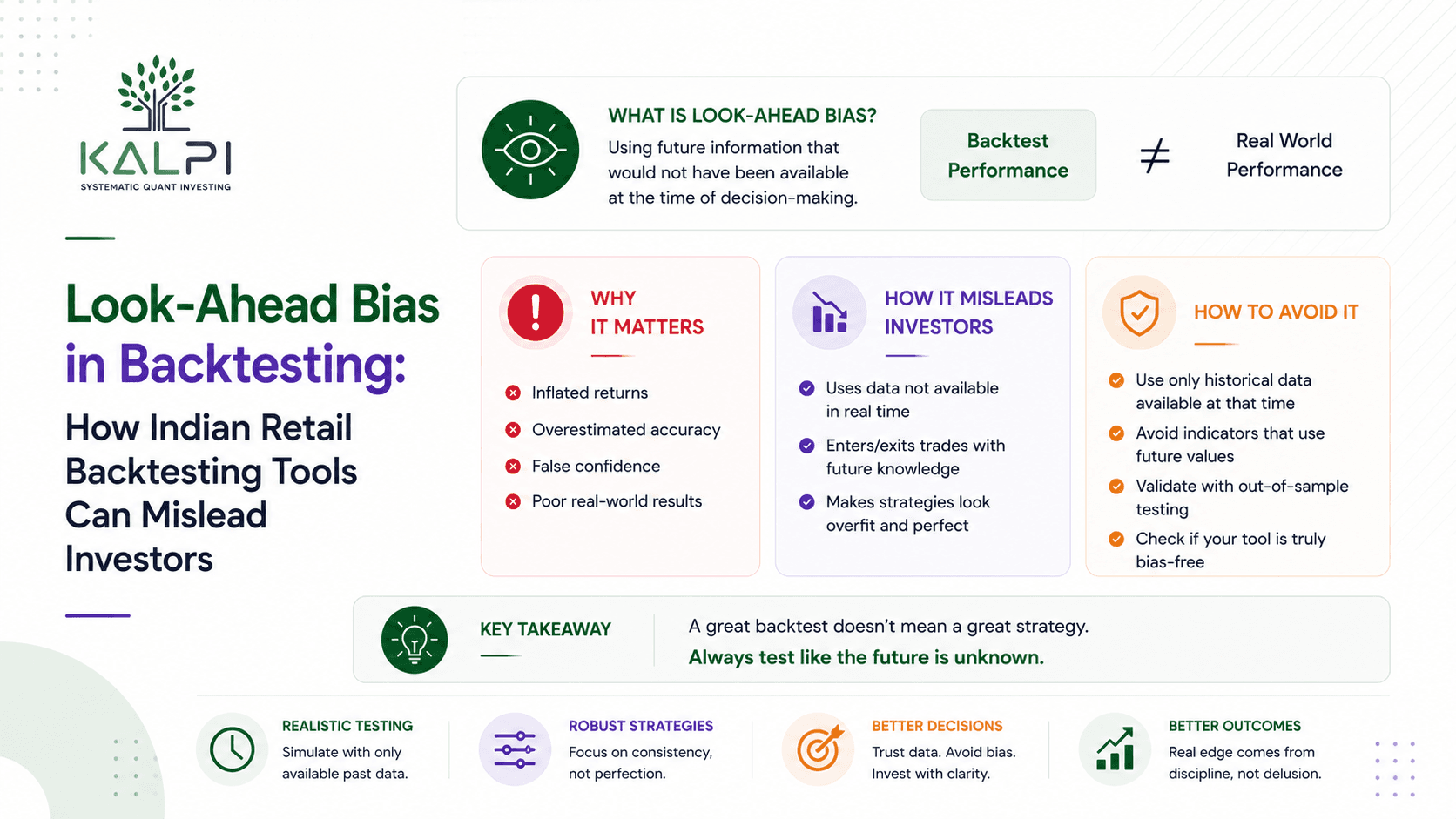
Look-ahead bias shows up when a backtest quietly pulls in information from the future while pretending to make a decision in the past. It can seem like a small technical slip, yet it’s often enough to make an average strategy look far better than it really is.
A biased backtest creates an illusion of skill. It makes a strategy look more accurate than anything achievable in live investing, simply because the test already knew the answer before the question was asked.
Professional investors take point-in-time data seriously for exactly this reason. Every historical decision in a proper backtest should rely only on information that genuinely existed at that moment, not on data that surfaced days, weeks or months later.

A Simple Example
Say you are backtesting a strategy on 1 April 2024, and one of your rules says: buy companies whose annual profit has increased by at least 20%.
Here is the catch. Many companies had not yet published their annual results by 1 April. Those numbers only became public a few weeks later.
If your backtest still uses those figures while making a decision dated 1 April, it is cheating without anyone realising it. The test already knew which companies would report strong earnings in the future, something no investor could have known on the actual date.
That one mistake alone can inflate historical returns dramatically, while making the strategy almost impossible to replicate once real money and real time constraints are involved.
Why This Happens More Often Than People Think
Beginners often assume look-ahead bias only happens because of a coding error somewhere. In practice, it is usually simpler than that.
Most investors download historical datasets without checking when each piece of information actually became available. Financial statements, index changes, analyst ratings and corporate announcements all get released on different dates, and few people cross-check this before running a test.
If a backtest treats every dataset as though it always existed, ignoring these timelines, the results end up biased. The strategy can look remarkably consistent on paper, but that consistency is built on information real investors simply did not have at the time.
Backtest accuracy depends on more than clean charts or a well-organised spreadsheet. It also depends on using the right version of the data, tied to the right point in time.
What Is Point-in-Time Data?
One of the more reliable ways to avoid look-ahead bias is using point-in-time data.
Think of it as travelling back to a specific date and seeing only what investors genuinely had access to on that day. Nothing from the future gets to sneak in.
If a company’s quarterly results were announced on 15 July, a backtest running on 10 July should not be able to see those numbers. The same rule applies to earnings reports, index rebalancing, stock classifications and other market information.
Point-in-time data fixes this by making sure your backtest only sees information that would actually have existed on that date. The results may look a little less spectacular than a biased test, but they are far more trustworthy, because they reflect decisions an investor could realistically have made in real time.
Why It Matters for Rule-Based Investing
Rule-based investing depends on consistency. Every buy or sell decision follows a predefined set of rules instead of emotion.
But even the best rules become unreliable if the data underneath them is flawed.
Picture spending weeks building a strategy, testing it across hundreds of stocks, and finally landing on something that appears to beat the market.
Then you discover the outperformance came from future information leaking into the backtest. The rules were never the problem. The data was.
Experienced investors pay as much attention to data quality as they do to the strategy itself. A simple strategy tested on reliable point-in-time data is usually worth far more than a sophisticated model tested on a biased backtest.
How Indian Retail Backtesting Tools Can Get It Wrong
Most retail backtesting platforms exist to make strategy testing more accessible, and that’s a genuinely good thing. It means more investors can explore systematic investing without needing a background in coding or quantitative finance.
The trouble starts when investors assume every backtest result is automatically accurate.
A strategy might show impressive returns, but the real question is whether the test used information that was genuinely available at the time being tested.
Indian retail backtesting tools can sometimes produce misleading results if data handling is not accurate. Some platforms use the latest financial data while analysing years of historical performance. Others update company classifications, index membership or financial ratios without accounting for the exact date that information became public.
This doesn’t mean every platform gets it wrong. It means the data preparation behind a backtest deserves scrutiny before you trust the output.
Before trusting any backtest, it helps to ask one direct question: did this strategy know something on that date that a real investor could not have known? If the answer is yes, the results probably don’t represent real market conditions.
How to Spot a Biased Backtest
You do not need to be a data scientist to catch the warning signs. A few simple checks can reveal whether a strategy is leaning on unrealistic assumptions.
| Warning Sign | Why It Deserves Attention |
|---|---|
| Extremely high returns with very small losses | Real markets usually include difficult periods and unexpected drawdowns |
| Strong performance in every market condition | Most genuine strategies struggle during certain phases |
| Financial data used before its announcement date | This is a direct example of look-ahead bias |
| Historical index changes not adjusted properly | A company should only appear in an index after it officially joins it |
| No clear explanation of data sources | Without transparency, judging backtest accuracy becomes difficult |
None of these signs alone proves a strategy is flawed. But when a few of them show up together, the testing process deserves a closer look before real money gets involved.
Best Practices for More Accurate Backtesting
Improving backtest accuracy is not always about building a more complex strategy. Often, the biggest gains come from tightening the testing method itself.
- Use point-in-time data wherever possible
- Check the exact publication dates of financial statements, earnings reports and company announcements
- Test the strategy across different market cycles instead of one favourable stretch
- Avoid rewriting the rules every time a result looks disappointing
- Compare expected backtest performance against realistic market conditions
A realistic backtest can produce lower returns than an unrealistic one. That is fine. Realistic results are worth more, because they represent what an investor could actually have achieved.

Biased Backtest vs Reliable Backtest
| Feature | Biased Backtest | Reliable Backtest |
|---|---|---|
| Data Used | May include future information | Uses only information available at that point in time |
| Results | Often look unusually attractive | Usually appear more realistic |
| Investor Confidence | Can create false confidence | Builds practical expectations |
| Decision Making | Based on distorted historical results | Based on realistic testing conditions |
| Long-Term Value | Weak foundation for investing | Better support for disciplined strategies |
Final Thoughts
A backtest should help you understand how a strategy might have performed in the past. It should never create the illusion of a perfect system.
Even a small amount of future information leaking into a historical test can turn an average strategy into something that looks exceptional on a chart.
Backtesting itself isn’t the problem. The real challenge is making sure the testing process reflects what investors actually knew at the time, not what we know now with hindsight.
A strategy that looks average after honest testing is usually worth more than one that looks perfect because the test was unrealistic to begin with.
No backtest can predict the future with certainty. What a properly designed one can give you is something more useful than impressive numbers: confidence that your strategy has actually been tested under conditions you could have lived through. That’s the only foundation disciplined, rule-based investing can be built on.
Frequently Asked Questions
What is look-ahead bias in a backtest?
Look-ahead bias occurs when a backtest uses information that was not available on the date being tested. This can make historical performance appear better than what investors could realistically have achieved.
Why is point-in-time data important in backtesting?
Point-in-time data ensures a backtest only uses information available at that specific moment in history, which improves backtest accuracy and produces more realistic results.
Can Indian retail backtesting tools have look-ahead bias?
Yes, it is possible. Some tools may unintentionally use updated financial data, revised company information or current classifications while testing historical strategies. It helps to understand how a platform handles past data before relying on it.
Does a high-return backtest always mean the strategy is good?
No. Extremely high returns with very low risk can sometimes point to a biased backtest. It is worth examining the data source, methodology and assumptions behind the results before trusting them.
How can investors avoid look-ahead bias?
Using point-in-time data, checking information release dates, testing strategies across different market environments and sticking to a consistent backtesting process all help reduce look-ahead bias.