

Last Updated: July 2026
Imagine you’re shopping for a new laptop.
You’ve probably done this yourself. Before spending your money, you compare different models, check the processor, battery life, RAM, reviews and price. Only after weighing all the options do you decide which laptop offers the best value for your needs.
Investing works in much the same way.
Finding a good company isn’t difficult anymore. The internet is full of stock ideas, screeners and recommendations. The real challenge is deciding which stocks deserve a place in your portfolio and how those stocks should work together.
That is exactly why investors are paying more attention to portfolio construction India instead of simply chasing the next trending stock.
In 2026, two approaches have become increasingly popular. Some investors prefer stock screeners that help them discover companies based on financial filters. Others are choosing curated stock baskets that are already built around a clear investment strategy.
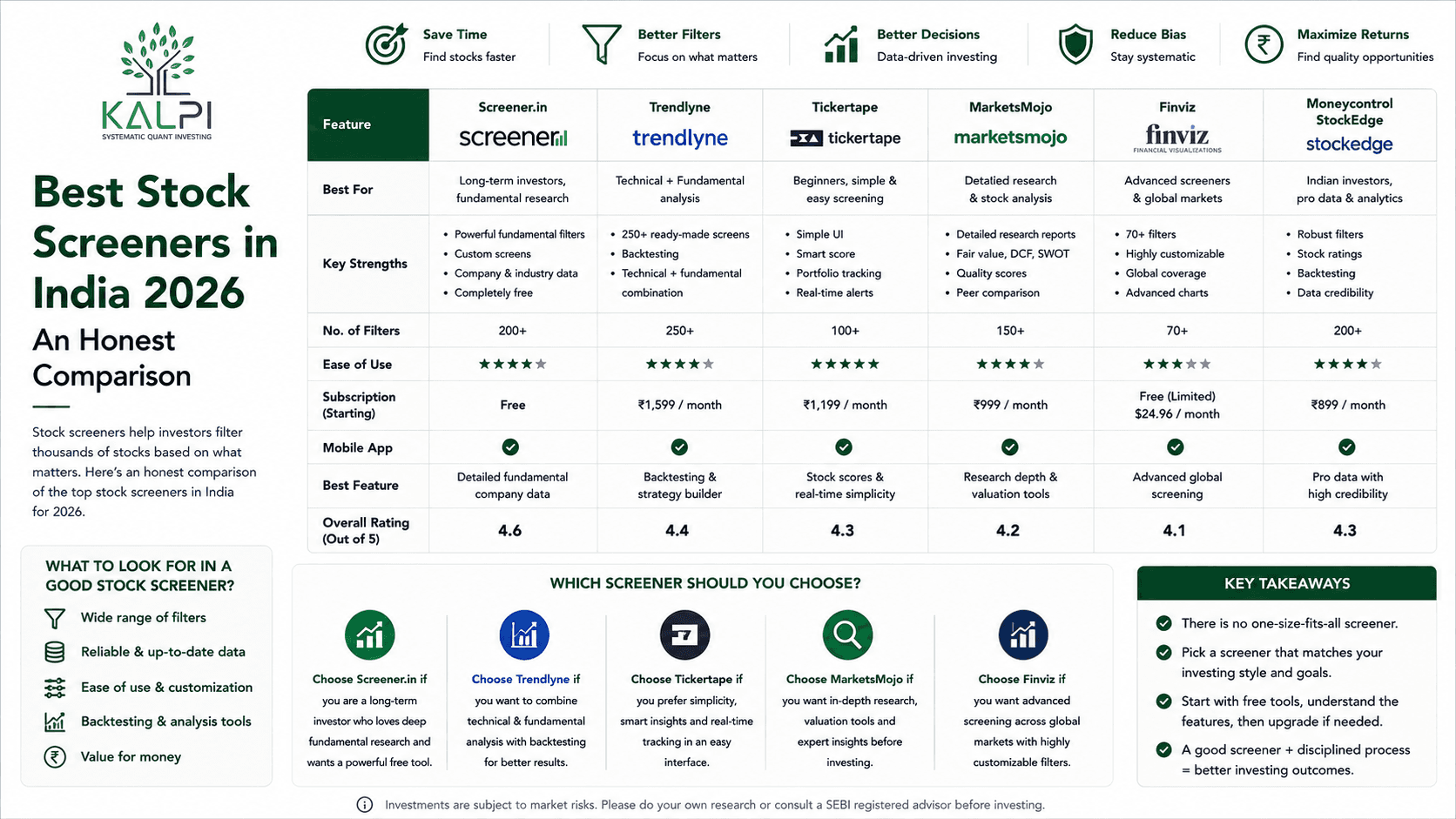
If you have searched for the best stock screener in Indian stocks, you have probably come across platforms like Screener.in. At the same time, platforms like Kalpi are introducing ready-made stock baskets designed around themes, factors and long-term investing strategies.
Both approaches can be useful, but they solve different problems. The right choice depends less on which platform is better and more on how you prefer to invest.
In this guide, we will compare Kalpi vs Screener, understand where each one fits into the investment process, and see how both can support better portfolio construction India, smarter diversification stocks, and a well balanced multi basket portfolio.
What Is Driving This Shift?
A few years ago, many retail investors focused on one question.
“Which stock should I buy?”
Today, the conversation is changing.
“How should I build my portfolio?”
That is an important difference.
Even an excellent company can become a poor investment if too much money is invested in one stock or one sector.
Imagine building a cricket team.
A squad made entirely of batsmen may look impressive, but without bowlers, wicketkeepers and all rounders, the team becomes unbalanced.
Investing works the same way.
Owning good stocks matters.
Owning the right combination of stocks matters even more.
This growing awareness is one of the biggest reasons why portfolio construction has become just as important as stock selection.
What Is a Stock Screener?
Imagine opening a list of more than 5,000 listed companies on the Indian stock market.
Analysing every company manually would take weeks.
A stock screener reduces that work to a few seconds.
It allows investors to filter companies using financial conditions that match their investment style.
For example, an investor might search for companies with:
- P/E ratio below 20
- Return on Equity above 18%
- Debt to Equity below 0.5
- Consistent profit growth
- Market capitalisation above ₹5,000 crore
Within seconds, the screener displays companies that satisfy those filters.
This makes stock screeners one of the most useful research tools available to retail investors.
However, a screener answers only one question.
“Which companies meet my criteria?”
It does not answer another equally important question.
“How should these companies fit together inside my portfolio?”
That decision still depends on the investor.
What Is a Stock Basket?
A stock basket takes a different approach.
Instead of giving you hundreds of companies to analyse, it offers a carefully selected group of stocks built around a specific investment strategy.
For example, one basket may focus on:
- High quality businesses
- Value investing
- Dividend paying companies
- Momentum investing
- AI and technology
- Banking leaders
Instead of selecting individual stocks yourself, you are investing in a predefined strategy.
Think about cooking dinner.
Buying vegetables, spices and ingredients separately is similar to using a stock screener.
Buying a ready to cook meal kit with measured ingredients is similar to investing through a stock basket.
Both methods can produce a good result.
The difference lies in how much work you want to do yourself.
Table 1: Stock Screener vs Stock Basket
| Feature | Stock Screener | Stock Basket |
|---|---|---|
| Primary Purpose | Find companies using filters | Invest through a predefined strategy |
| Research Required | High | Lower |
| Portfolio Construction | Manual | Structured |
| Time Needed | More | Less |
| Best For | DIY investors | Investors looking for guided investing |
Kalpi vs Screener: Understanding the Real Difference
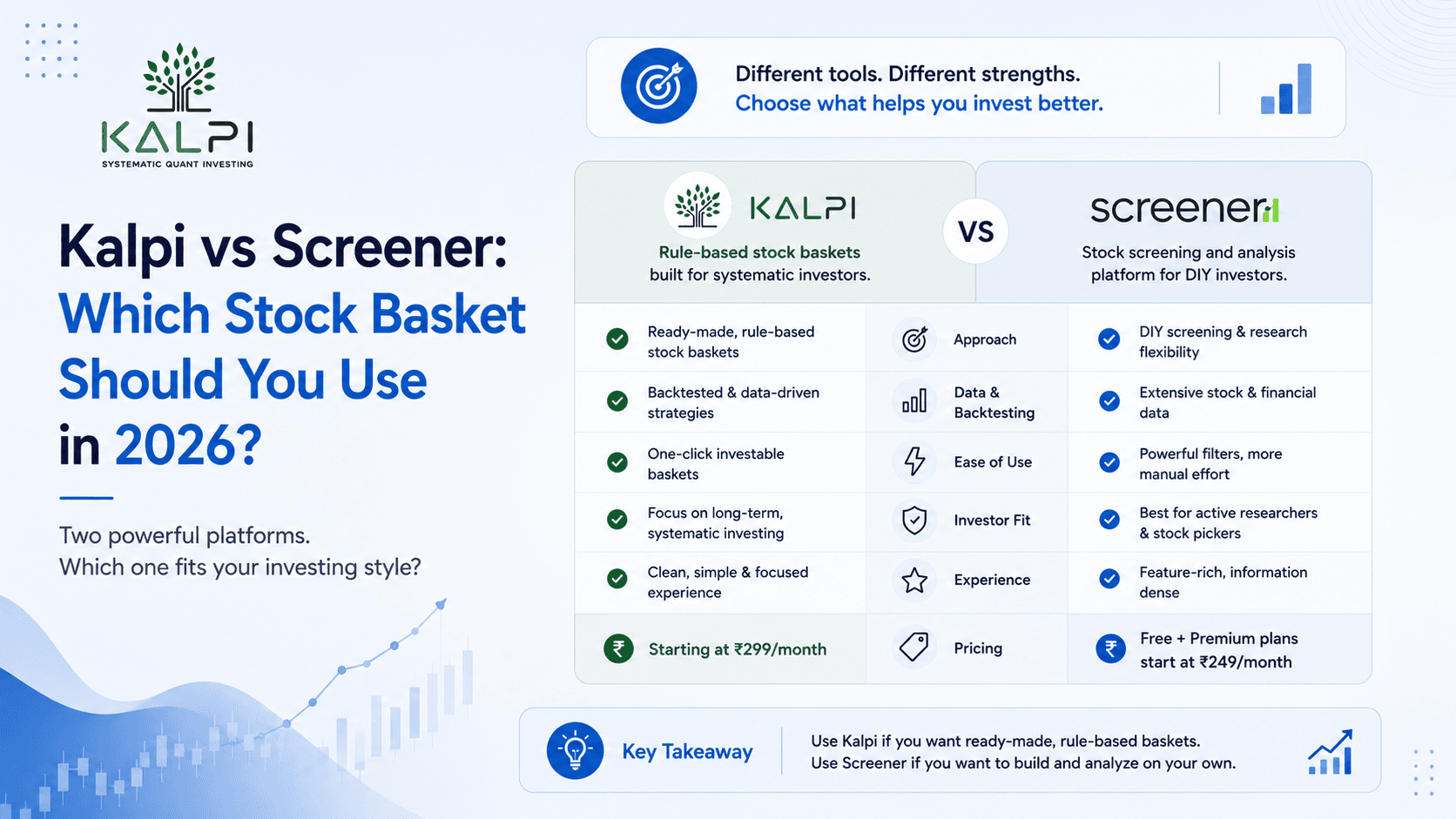
At first glance, Kalpi and Screener appear to compete with each other.
In reality, they serve different purposes.
Screener helps investors discover opportunities.
Kalpi helps investors implement those opportunities inside a portfolio.
That is a very important distinction.
Suppose you search for companies with:
- Low debt
- High ROE
- Strong earnings growth
A stock screener may return fifty companies.
Now another challenge begins.
Which ten should you buy?
How much money should each receive?
Should they all belong to the same sector?
How often should the portfolio be rebalanced?
A stock screener leaves those decisions to you.
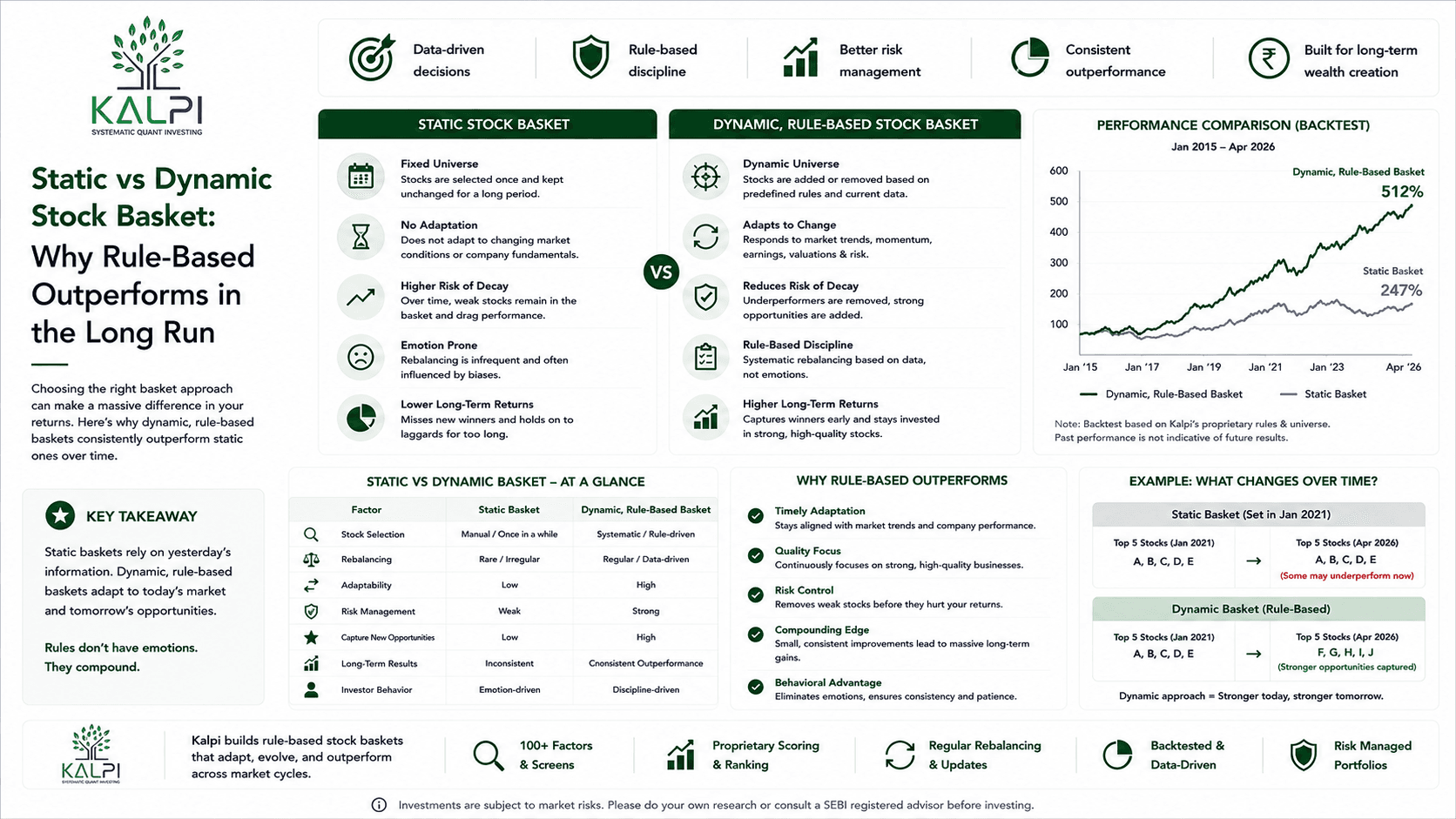
A stock basket tries to solve them by following predefined selection rules, allocation methods and investment themes.
Neither approach is inherently better.
Which one makes more sense depends on how you invest.
One helps you identify potential investments.
The other helps you build a portfolio around them.
Table 2: Which One Fits Your Investing Style?
| If your goal is to | Better Choice |
|---|---|
| Research companies yourself | Screener |
| Save research time | Kalpi |
| Build your own portfolio | Screener |
| Invest through ready made strategies | Kalpi |
| Learn stock analysis | Screener |
| Follow a structured investing approach | Kalpi |
Why Portfolio Construction Matters More Than Ever
Many investors unknowingly build portfolios with hidden concentration risk.
For example, someone may own:
- HDFC Bank
- ICICI Bank
- SBI
- Axis Bank
- Kotak Mahindra Bank
At first glance, five different stocks appear diversified.
In reality, almost the entire portfolio depends on one sector.
If banking stocks struggle, every holding could decline together.
This is why experienced investors focus on diversification stocks instead of simply increasing the number of companies they own.
Diversification is not about owning more stocks.
It is about owning businesses that behave differently under different market conditions.
A thoughtfully constructed portfolio aims to reduce unnecessary risk while still creating long term growth opportunities.
This shift is changing how many retail investors build portfolios today. Instead of relying on a single tool, they are combining research platforms with curated stock baskets to create a balanced multi basket portfolio.
In the next section, we will compare Kalpi and Screener in greater detail, explore how each one contributes to portfolio construction, and help you decide which approach best matches your investing style.
How Kalpi and Screener Fit into Portfolio Construction
Choosing between Kalpi and Screener is not really about finding a winner.
It is about understanding where each platform fits into your investing journey.
Think about planning a road trip.
You first decide where you want to go, then choose the route that gets you there. The destination stays the same, but the path depends on your preference.
Investing works in a similar way.
A stock screener helps you discover companies that meet your financial criteria.
A stock basket helps you invest through a predefined strategy where the portfolio has already been structured around a particular objective.

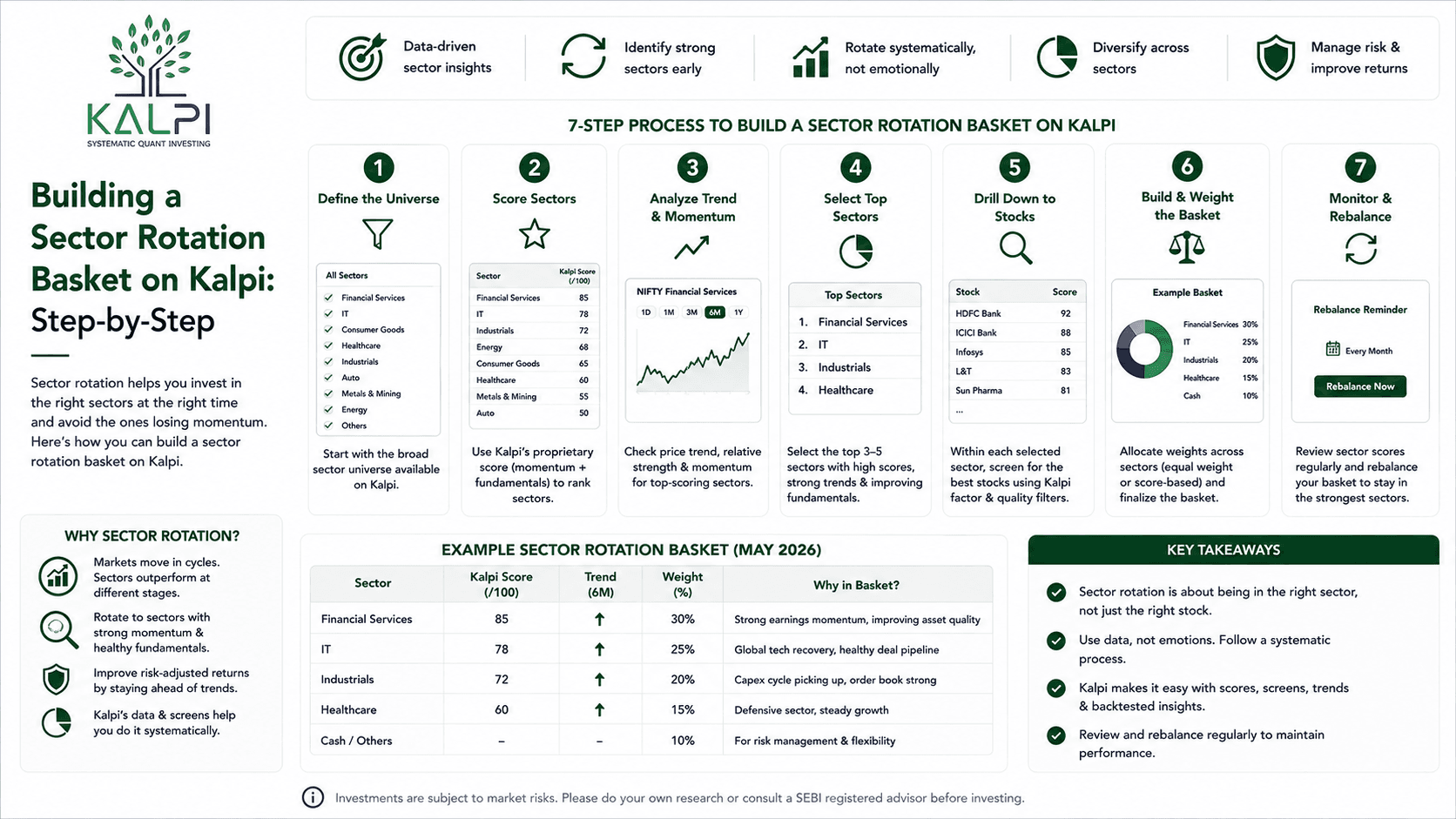
A rule based strategy on Kalpi: universe, filters, ranking and weighting are all defined upfront, so the portfolio follows a fixed process instead of ad hoc stock picks.
Both approaches have value.
The difference lies in how involved you want to be.
If you enjoy analysing annual reports, comparing financial ratios and selecting stocks yourself, a screener gives you complete flexibility.
If you would rather spend less time researching individual companies and prefer investing through a structured approach, curated stock baskets can be a practical alternative.
Neither method is right for everyone.
The better choice depends on how you prefer to invest.
Building a Multi Basket Portfolio
One trend that is becoming increasingly popular is building a multi basket portfolio.
Instead of relying on a single investment theme, investors combine different baskets that complement each other.
For example, a portfolio may include:
| Basket Type | Purpose |
|---|---|
| Quality Stocks | Long term stability |
| Value Stocks | Attractive valuations |
| Growth Stocks | Capital appreciation |
| Dividend Basket | Regular income |
| Technology Basket | Exposure to future growth |
Each basket plays a different role.
If one investment theme underperforms for a while, another may provide stability or continue generating returns.
This approach does not remove market risk.
However, it reduces dependence on a single investment strategy.
That is one reason many investors today focus on portfolio construction India instead of simply buying stocks one after another.
Diversification Means More Than Owning Many Stocks
Many beginners believe diversification simply means owning a larger number of companies.
That is only partly true.
Imagine owning ten different banking stocks.
Although you own ten companies, almost your entire portfolio still depends on one sector.
If banking faces a difficult period, most of those stocks could decline together.
True diversification comes from spreading investments across different industries, business models and investment styles.
That is why experienced investors pay attention to diversification stocks, not just the number of holdings.
A balanced portfolio may include companies from banking, healthcare, consumer goods, manufacturing, technology and infrastructure.
The objective is not to predict which sector will perform best.
The objective is to reduce unnecessary concentration risk while giving your portfolio multiple opportunities to grow over time.
Should You Choose Kalpi or Screener?
The answer depends entirely on your investing style.
If you enjoy researching businesses and making every investment decision yourself, Screener offers tremendous flexibility.
You decide the filters.
You analyse the companies.
You build the portfolio.
Many experienced investors prefer this level of control.
Kalpi follows a different approach.
Instead of beginning with financial filters, it begins with an investment strategy.
The stock selection and portfolio construction are already organised around a specific objective.
That can be particularly useful for investors who want a structured starting point without spending hours analysing hundreds of listed companies.

Once a basket is built, every holding shows its ideal weight against the actual weight, so drift is visible at a glance instead of buried in a spreadsheet.
Neither platform replaces good investing habits.
They simply make different parts of the investment process easier.
Table 3: Kalpi vs Screener at a Glance
| Feature | Kalpi | Screener |
|---|---|---|
| Primary Focus | Curated stock baskets | Stock research and screening |
| Suitable For | Guided investing | Self directed investing |
| Portfolio Construction | Structured | Manual |
| Stock Selection | Basket based | Investor chooses |
| Research Time | Lower | Higher |
| Best For | Investors seeking ready made strategies | Investors who enjoy detailed analysis |
Can You Use Both Together?
Absolutely.
In fact, many experienced investors do exactly that.
They do not see Kalpi and Screener as competing platforms.
Instead, they use each one for a different purpose.
A common approach looks like this:
- Use Screener to discover companies that match your financial criteria.
- Study those businesses before making any investment decision.
- Compare your findings with curated stock baskets available on Kalpi.
- Build a portfolio that matches your financial goals and risk tolerance.
- Review your allocation periodically instead of reacting to short term market movements.
Using both tools together allows investors to combine independent research with structured portfolio construction.
Rather than replacing each other, the two approaches can complement one another.
Common Mistakes Investors Should Avoid
Regardless of which platform you use, avoiding a few common mistakes can improve your investing experience.
Some of the most common mistakes include:
- Buying stocks simply because they appear in a screener.
- Investing in a basket without understanding its investment objective.
- Putting too much money into one sector or one investment theme.
- Ignoring portfolio reviews for long periods.
- Chasing recent winners instead of following a long term investment plan.
No investment platform can guarantee returns.
Research tools and stock baskets are designed to support better decisions, but disciplined investing still matters far more than the platform itself.
Final Thoughts
The discussion around Kalpi vs Screener is not really about deciding which platform is superior.
It is about choosing the right tool for the right purpose.
If your goal is researching companies and performing your own financial analysis, a screener remains one of the best stock screeners in Indian stocks.
If your priority is investing through a structured strategy with better portfolio organisation, curated stock baskets offer a practical alternative.
Many investors eventually discover that they do not have to choose one over the other.
They use screeners for research and stock baskets for portfolio construction.
No platform can replace patience, research and discipline.
The right tool can certainly make investing easier, but long term success still depends on the quality of your decisions, sensible diversification and the consistency with which you follow your investment plan.
Frequently Asked Questions
What is the best stock screener in Indian stocks?
Many investors use platforms like Screener.in because they provide detailed financial filters, company data and fundamental research tools.
What is a multi basket portfolio?
A multi basket portfolio combines different stock baskets based on separate investment strategies, helping investors diversify across themes and sectors.
Is Kalpi better than Screener?
Not necessarily. Kalpi focuses on curated stock baskets, while Screener focuses on stock discovery and financial research. The better choice depends on your investing style.
Why is portfolio construction important?
Good portfolio construction helps reduce concentration risk and creates a balanced investment portfolio that aligns with long term financial goals.
Can beginners use both Kalpi and Screener?
Yes. Beginners can invest through curated stock baskets while gradually learning stock analysis using a screener. Many investors eventually combine both approaches.