

PORTFOLIO RISK
Last Updated: July 2026
| IN SHORT Portfolio concentration risk starts when one stock, one sector, or one investment idea begins taking up more space in your portfolio than you originally intended. A portfolio can hold many stocks and still be risky if most of the money depends on a small part of the market. Reviewing your holdings regularly can help you spot these risks before they become a problem. |
The Hidden Risk Most Investors Ignore
Many investors spend a lot of time looking for the next multibagger.
Very few ask another question:
What happens if my biggest investment goes wrong?
The answer often tells you more about your portfolio than its returns.
A portfolio can perform well for years and still become riskier than you realise. One stock may quietly become too large. One sector may slowly start dominating your investments.
This is called portfolio concentration risk.
The problem is that concentration usually does not happen overnight.
It builds slowly.
A stock performs well.
You buy more.
Its price rises further.
Sometimes you do not even notice the risk because making money feels comfortable.
Before you realise it, a large part of your portfolio depends on one investment.
Think About Your Medicine Box
Open the medicine box at home.
You will probably find different tablets inside. Something for a headache, something for a fever, and maybe medicines that you hope you never have to use.
Nobody keeps only one type of tablet and expects it to solve every problem.
Investing works in a similar way.
If all your money sits in one stock or one sector, you are depending on one solution for every market situation.
When that investment struggles, your entire portfolio can feel the pain.
A balanced portfolio is a bit like a well-stocked medicine box. Different investments can help you deal with different market conditions.
No strategy can remove risk completely, but spreading your money across different areas means one bad decision is less likely to hurt your entire portfolio.
What Is Portfolio Concentration Risk?
Portfolio concentration risk occurs when a large portion of your investments depends on a small number of holdings.
For example:
- One stock makes up 40 percent of your portfolio.
- Most of your money is invested in technology companies.
- Almost all your investments are invested in banking stocks.
- The majority of your portfolio is invested in small-cap companies.
At first glance, the portfolio may look diversified because it contains several stocks.
But if most of your money depends on one stock or one sector, the risk is still concentrated.
Why Do Investors End Up With Concentrated Portfolios?
Most investors do not intentionally create concentrated portfolios.
It usually happens because of simple habits.
Winning Stocks Become Bigger
A stock performs well and naturally takes up more space in the portfolio.
Familiarity Creates Comfort
People often invest more money in sectors they understand well.
Past Success Creates Confidence
A sector that has delivered strong returns for years starts feeling safer than it actually is.
Portfolio Reviews Become Less Frequent
Many investors track returns every day but rarely review allocation.
Why Concentration Risk Matters
Most people enjoy talking about returns. Very few enjoy talking about risk until something goes wrong.
Losses can take a long time to recover from.
Suppose your portfolio falls by 50 percent.
You now need a gain of 100 percent just to get back to your starting point.
This is why protecting your portfolio from large losses matters.
A concentrated portfolio can deliver strong returns during good times.
The challenge appears when things stop going according to plan.
Different Types of Concentration Risk
1. Stock Concentration Risk
This happens when one company becomes a very large part of your portfolio.
If that company faces problems, your entire portfolio can suffer.
2. Sector Concentration Risk

This happens when most of your investments belong to one industry.
Examples include:
- Banking
- Information Technology
- Pharmaceuticals
- Energy
- Consumer Goods
This is called sector concentration risk.
No sector stays on top forever. Different industries go through good and difficult periods. Relying too much on one industry can increase your overall risk.
3. Market-Cap Concentration Risk
Some investors prefer only small-cap stocks.
Others invest only in large-cap companies.
Every market segment behaves differently.
Depending entirely on one segment can make your portfolio more vulnerable.
How Do You Know If Your Portfolio Is Too Concentrated?
Ask yourself a few simple questions.
Does one stock account for a large share of my portfolio?
Does one sector dominate my investments?
Would one bad quarter from a company significantly affect my portfolio?
Am I investing only in businesses that I already know?
If your answer is yes to several of these questions, your portfolio may be more concentrated than you realise.
What Happens When Concentration Risk Goes Wrong?
Many investors believe concentration is not a problem because their portfolio has performed well in the past.
The problem is that markets can change quickly.
A company can face new competition.
A sector can go through a difficult period.
Government policies can change.
Consumer behaviour can change.
When too much of your portfolio depends on one area, these events can affect your overall returns more than expected.
Sometimes the problem is not owning a bad stock.
It is simply owning too much of a good one.
Many successful companies have gone through periods of weak performance. Investors who depended too heavily on those companies often found themselves facing losses that took years to recover from.
This is why understanding concentration risk matters.
How a Portfolio Analyzer Can Help
Many investors think they understand their portfolio very well.
Then they actually look at the numbers.
Sometimes they discover that one stock represents 35 percent of their investments.
Sometimes more than half of the portfolio belongs to one sector.
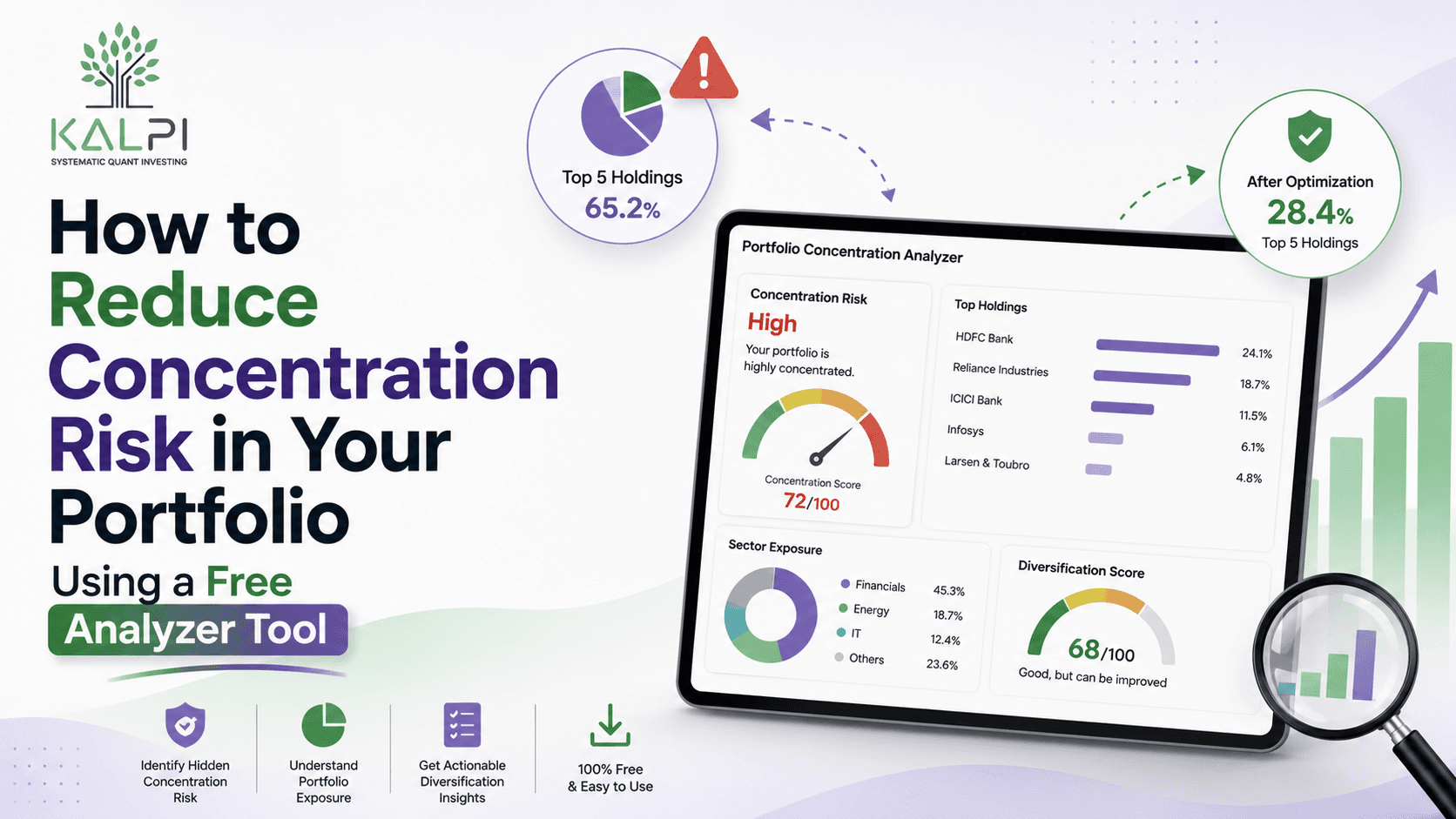
A good portfolio analyzer India tool can help answer questions such as:
- Which stocks have the highest weight?
- Which sectors dominate the portfolio?
- How diversified is the portfolio?
- Am I taking more risk than I realise?
Many investors are surprised when they finally see their portfolio broken down into percentages.
What Should a Free Portfolio Analyzer Show?
| Feature | Why It Matters |
|---|---|
| Stock Allocation | Helps identify whether one stock has become too large |
| Sector Allocation | Helps identify sector concentration risk |
| Market-Cap Breakdown | Shows exposure to large-cap, mid-cap, and small-cap stocks |
| Portfolio Summary | Gives an overall picture of diversification |
A free portfolio analyzer is not meant to predict future returns.
Its purpose is to help investors understand where their risks are coming from.

How portfolio risk breaks down when you look closely at it.
~ above is Kalpi Image
How to Reduce Portfolio Concentration Risk
Review Your Portfolio Regularly
Many investors check prices every day but review allocation only once or twice a year.
A periodic review can reveal risks that slowly build over time.
Avoid Depending Too Much on One Stock
There is no perfect percentage that works for everyone.
The real question is simple:
If this one company struggles, how much damage will it do to my portfolio?
Spread Investments Across Different Sectors
Different industries perform differently at different times.
A balanced portfolio usually has exposure to multiple sectors.
Diversify Across Market Segments
Large-cap, mid-cap, and small-cap companies all behave differently.
Exposure across different market segments can reduce dependence on one area of the market.
Rebalance When Necessary
Sometimes a stock performs so well that it becomes much larger than you originally intended.
Reviewing and rebalancing your portfolio from time to time can help maintain your desired allocation.

Risk sources change every year. No single one stays on top for long.
How Often Should You Review and Rebalance Your Portfolio?
There is no perfect rule.
Checking your portfolio every day can lead to unnecessary decisions.
Ignoring it for years can create hidden risks.
Many long-term investors prefer reviewing their portfolios every few months or after major market movements.
The goal is not to make constant changes.
The goal is to understand whether your portfolio still matches your original investment plan.
Sometimes you may discover that one sector has become too large.
Sometimes you may realise that one stock now represents a much bigger percentage of your investments than you intended.
A simple review can help identify these issues before they become serious problems.
Does Diversification Mean Buying More Stocks?
Not necessarily.
Buying twenty banking stocks does not automatically make your portfolio diversified.
Ten stocks can still leave you exposed to one big risk if they all move for the same reason.
Diversification is about reducing dependence on one outcome.
Common Mistakes Investors Make
| Mistake | Possible Result |
|---|---|
| Investing heavily in one favourite stock | Portfolio becomes dependent on one company |
| Buying only one sector | Higher sector concentration risk |
| Ignoring portfolio reviews | Hidden risks continue to grow |
| Chasing recent winners | Portfolio becomes unbalanced |
Concentration risk usually creeps in quietly.
You often notice it only after one stock or one sector has become too important.
Should You Completely Avoid Concentrated Portfolios?
Not necessarily.
Some investors prefer concentrated portfolios because they strongly believe in a few businesses.
There is nothing wrong with that approach.
The important thing is understanding the risks that come with it.
A concentrated portfolio can create excellent gains.
It can also create large losses.
Knowing that trade-off helps investors make informed decisions.
Final Thoughts
Many investors spend a lot of time searching for the next winning stock.
Far fewer spend time asking a simple question:
What happens if my biggest investment goes wrong?
Understanding portfolio concentration risk is not about becoming overly cautious.
It is about understanding where your portfolio depends too heavily on one stock, one sector, or one idea.
A regular review and the use of a free portfolio analyzer can help investors understand their portfolios more clearly and make better decisions over time.
Sometimes the biggest risk is not the investment you chose.
It is how much of it you own.
Frequently Asked Questions
1. What is portfolio concentration risk?
Portfolio concentration risk occurs when too much of your money is invested in a small number of stocks, sectors, or themes. Because a large portion of the portfolio depends on only a few investments, poor performance in one area can significantly affect overall returns.
2. What is sector concentration risk?
Sector concentration risk happens when a large part of your money is invested in one industry, such as banking or technology. If that sector goes through a difficult period, your overall portfolio may also suffer.
3. Why should investors use a portfolio analyzer?
A portfolio analyzer helps investors understand how their money is actually distributed. It can show stock allocation, sector exposure, market-cap breakdown, and areas where risk may be higher than expected. Sometimes a simple analysis reveals concentration that investors did not even realise existed.
4. Is owning more stocks always safer?
No. If most of those stocks belong to the same sector or follow the same theme, the portfolio can still be highly concentrated.
5. How often should I review my portfolio?
There is no fixed rule. Many investors prefer reviewing their portfolios every few months or after major market changes. The purpose is not to make frequent changes but to make sure the portfolio still matches their original plan.