

Last Updated: July 2026
Say you are house hunting.
Before you even think of signing anything, two things run through your mind. Is the house actually worth buying? Solid construction, a decent location, something that holds its value ten years down the line. And second, is this the right time to buy it? If the seller is asking way above the going rate, you would probably wait it out rather than rush in.
Many investors unknowingly follow only half of this process when picking stocks.
Some spend hours going through balance sheets and quarterly results but pay almost no attention to how the market is actually pricing the stock. Others sit glued to charts, chasing breakouts, without ever checking whether the company behind the ticker is any good.
Both approaches leave an important gap.
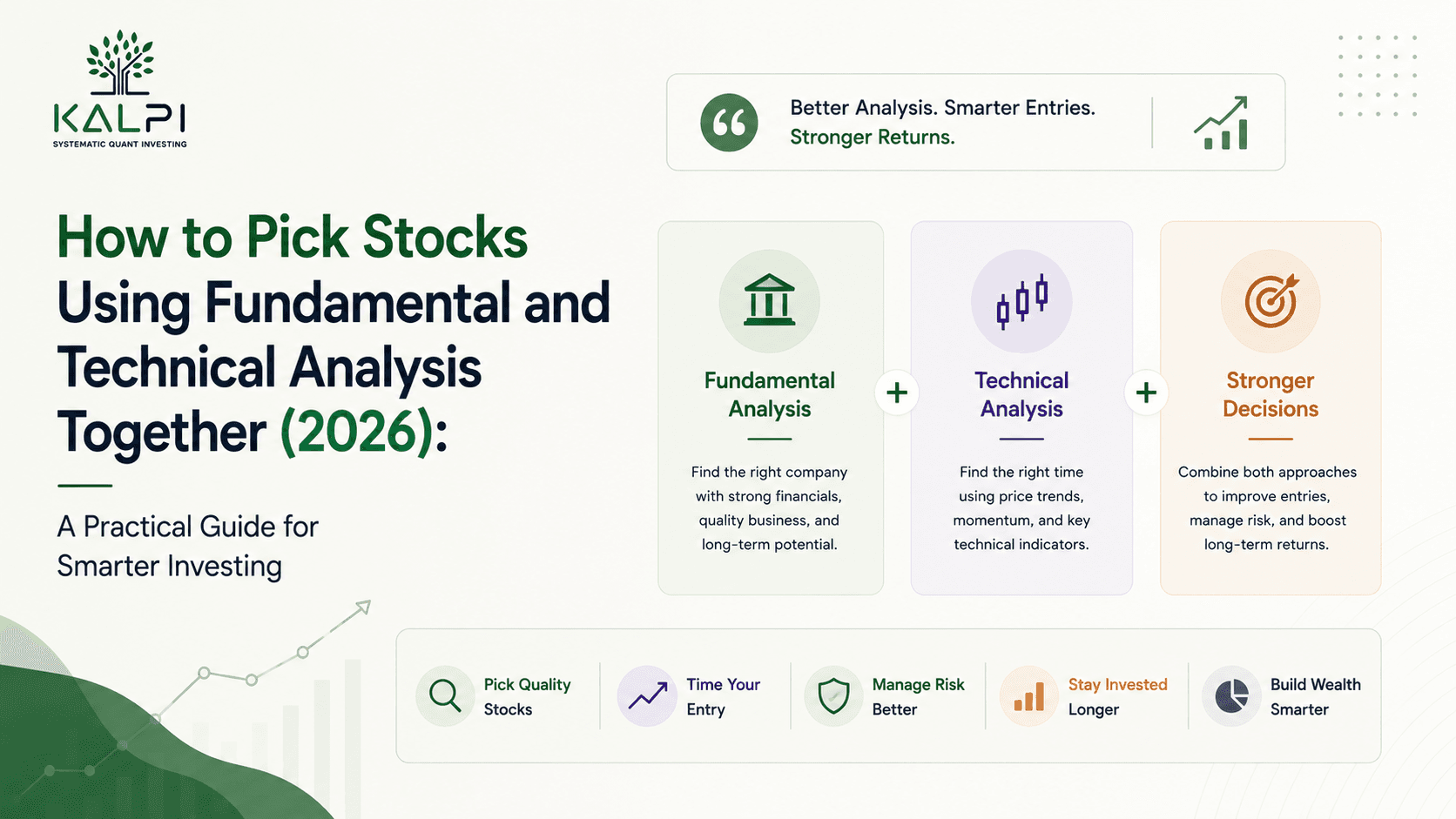
Fundamental analysis answers one question: is this company worth owning?
Technical analysis answers a different one: is this a sensible time to buy it?
Neither replaces the other. Strong businesses are easier to find through fundamentals, and technical analysis is what helps you time the entry and manage the risk once you have found one. The fundamental versus technical analysis debate has been going on for decades, but framing it as a contest misses the point. The real question is how the two work together.
This guide walks through both approaches, where each one holds up and where it does not, and how combining them into a hybrid stock analysis process can lead to sharper, calmer decisions.
What Is Fundamental Analysis?
Fundamental analysis looks at the business itself, not the stock price on your screen.
You dig into things like:
- Revenue growth
- Profitability
- Earnings consistency
- Debt levels
- Cash flow
- Competitive position
- Management quality
- Valuation
The goal is straightforward. You are trying to work out whether a business has the financial muscle to keep creating value for years, not just this quarter.
Say two companies sit in the same industry. An investor doing fundamental work will line up their earnings growth, debt levels and return on equity side by side before deciding which one looks like the stronger business.
This is usually the preferred lens for long-term investors, since business performance tends to matter far more than a stock’s mood on any given day.
What Is Technical Analysis?
Technical analysis studies how a stock actually trades in the market.
Rather than reading financial statements, it looks at:
- Price trends
- Trading volume
- Support and resistance levels
- Moving averages
- Momentum indicators
- Chart patterns
It is not trying to judge whether a company is good or bad. It is trying to read how buyers and sellers are behaving right now.
A fundamentally sound company can still go through a rough patch because of sentiment that has nothing to do with its earnings. Technical analysis is what helps you spot these stretches and find a better window to step in.
Why Investors Keep Comparing the Two
The fundamental versus technical analysis argument refuses to die because both camps have a point.
Some investors are convinced the financials tell you everything you need to know. Others believe the chart has already priced in every scrap of information available. In reality, both perspectives have their strengths.
A financially strong company bought at the wrong price can still disappoint you. A stock riding strong momentum can just as easily stumble if the business underneath keeps deteriorating.
So plenty of experienced investors have quietly moved to a combined fundamental-technical approach, instead of betting everything on just one method. The better question was never which method wins. It is how the two can work together to sharpen your decisions.

Fundamental Analysis vs Technical Analysis
With both approaches on the table, it helps to line them up directly.
Fundamental analysis helps you decide which business deserves your money, while technical analysis helps you decide when the market offers a better opportunity to buy it. Neither one is trying to do the other’s job.
Think about buying vegetables at your regular market stall.
You know that one particular shop always has good onions, garlic and tomatoes. The quality never really changes, so you trust it. But if prices suddenly spike because supply has dried up for a few days, you might just wait it out instead of buying that day.
The vegetables have not changed. Only the timing has.
Investing runs on the same logic. A company can be excellent on every count and still not be worth buying today, if today happens to be a bad entry point. Equally, a stock with strong chart momentum is not automatically worth owning if the business behind it is quietly falling apart.
A Simple Comparison
| Factor | Fundamental Analysis | Technical Analysis |
|---|---|---|
| Main Focus | Business quality | Price movement |
| Primary Question | Is this company worth investing in? | Is this a good time to invest? |
| Time Horizon | Usually long term | Short to medium term |
| Data Used | Financial statements, earnings, cash flow, valuation | Charts, trends, volume and indicators |
| Best For | Long-term investors | Active traders and investors improving entry timing |
| Main Strength | Identifies strong businesses | Helps improve buying and selling decisions |
The two methods are answering different questions, which is exactly why they complement each other instead of competing.
Why Many Investors Combine Both
Say you have shortlisted five companies after digging through their financials. All five have healthy profits, manageable debt and steady earnings growth.
Now comes the harder part: which one do you buy first?
Say two banks on your list look almost identical on paper. Both have strong return on equity, healthy asset quality and steady loan growth. But one stock has just started showing fresh buying interest on the chart, while the other is still sliding lower with no sign of support. Fundamentals alone cannot tell you which one to pick first. This is exactly where technical analysis steps in, helping you lean towards the bank showing early strength rather than the one still stuck in a falling trend.
This is where technical analysis become useful. Rather than putting money into all five stocks at once, you can study their price trends, support levels and overall momentum to spot which one offers a better entry right now.
Fundamentals narrow the list. Technical analysis sharpens the timing. Put together, that is a far more structured process than picking a stock because it looked good on either count alone.
Where Fundamental Analysis Performs Better
Fundamental analysis proves its worth when the goal is long-term wealth creation, not a quick trade. It helps you find businesses capable of growing for years, instead of chasing whatever happens to be moving this week. This approach tends to suit investors who:
- Build long-term portfolios.
- Invest gradually through SIPs or regular purchases.
- Care most about business quality.
- Prefer holding through different market cycles.
For this kind of investor, short-term volatility usually matters far less than whether the company can keep growing its earnings.
Where Technical Analysis Adds Value
Timing is where technical analysis really comes into its own.
It does not ask whether a company is fundamentally sound. It asks how buyers and sellers are behaving at this exact moment, and that can help you:
- Avoid buying into periods of unusually weak momentum.
- Spot stronger entry opportunities.
- Manage risk with clear exit levels.
- Read overall market sentiment.
Even committed long-term investors often lean on a few simple technical tools to time their entry, rather than buying the moment they find a company they like.
Is One Better Than the Other?
This is usually where beginners get stuck, and the honest answer is that neither one wins outright.
A fundamentally strong company bought at an unreasonable valuation can still hand you disappointing returns. A stock with impressive momentum can just as easily stall if its underlying business keeps weakening.
Rather than arguing over fundamental versus technical analysis, it helps to be clear about what each one actually contributes. One tells you whether the business is worth owning. The other tells you whether now is a sensible time to own it. A combined fundamental-technical approach has caught on with retail investors for exactly this reason. It gives them a steadier process instead of a one-sided bet.
Common Mistakes Investors Make
Learning both approaches is the easy part. Trouble starts when investors lean entirely on one and ignore the other completely, which usually ends in decisions backed by strong numbers but terrible timing, or good-looking charts sitting on top of weak businesses.
Ignoring Business Quality
Plenty of beginners buy a stock purely because the chart looks strong, or because someone online called it the next multibagger.
A rising chart can signal genuine momentum, but if earnings are weakening, debt is climbing or profits have turned inconsistent, that momentum rarely lasts. Price movement needs a solid business standing behind it.
Ignoring Price Action
The opposite mistake is buying a fundamentally excellent company without checking how the market is actually behaving around it.
Picture buying the best quality rice for your kitchen. The rice itself might be excellent, but if you end up paying almost double because of a temporary shortage, that is still not a smart purchase.
Investing works the same way. A great company can turn into a poor investment simply because you bought it at the wrong price or during an unfavourable phase in the market.
Trying to Predict Every Market Move
Neither fundamental analysis nor technical analysis can forecast the future with total accuracy, and that was never really the point.
Their job is not to remove uncertainty. It is to improve the quality of your decisions by giving you better information to work with.
Using Too Many Indicators
Plenty of beginners assume that stacking on more indicators automatically sharpens their accuracy.
In practice, too much information usually creates noise rather than clarity. A handful of indicators, used consistently, tends to work better than jumping between a dozen different tools every few weeks.
Changing Strategy Too Often
Every market cycle feels different while you are living through it.
Some investors keep dropping one strategy for another every few months because something else appears to be working better right now. Consistency with one well-tested process usually beats chasing whatever happens to be popular this quarter.

A Simple Framework You Can Follow
None of this needs to be complicated if you are just getting started.
Think of it as running your ideas through two filters. The first filter removes weak businesses. The second filter helps you sidestep poor entry points. What is left is a much shorter list of companies that actually deserve your attention.
Step 1. Identify industries likely to benefit from long-term trends.
Step 2. Within those industries, shortlist fundamentally strong companies by checking revenue growth, profitability, cash flow and manageable debt.
Step 3. Compare valuations and drop companies that look significantly overvalued.
Step 4. Study the charts of what remains. Look for healthy trends, meaningful support levels and improving momentum before you commit.
Step 5. Build your position gradually instead of putting the entire amount in during a single transaction.
This kind of top-down stock picking blends business quality with sensible entry timing, and it does not need to be any more complicated than that.
Who Should Consider This Hybrid Approach?
Combining both methods tends to suit investors who:
- Prefer long-term wealth creation.
- Want to cut down on emotional decision-making.
- Like understanding a business before putting money into it.
- Want better timing on their entries.
- Prefer following a structured process rather than gut feel.
Pure traders may stick mainly to technical analysis. Deep value investors may lean almost entirely on fundamentals. Most retail investors, though, gain the most by understanding both sides and using them together rather than picking a camp.
Successful stock picking rarely comes down to choosing one tool over the other. Fundamentals usually do the heavy lifting early, when you are narrowing down which businesses deserve a place in your portfolio. Technical analysis then takes over closer to the actual buying decision, helping you time that entry with a bit more confidence. Used at the right stage, each tool ends up doing exactly what it is best at.
Final Thoughts
The fundamental versus technical analysis debate often gets framed as a choice you are forced to make. It is not.
Fundamental analysis tells you whether a company deserves your money. Technical analysis tells you whether the market is currently offering you a sensible way in. One is about the business. The other is about behaviour. Together, they build a process that holds up far better than either one alone.
Markets will never hand you certainty, and no method removes risk completely. But when a genuinely strong business is paired with sensible timing, investing stops feeling like a gamble and starts feeling like a process you can actually trust.
That is the real payoff. Not predicting every move the market makes, but building a habit disciplined enough to survive the ones you cannot predict.
Frequently Asked Questions
What is the difference between fundamental and technical analysis?
Fundamental analysis looks at a company’s financial health, earnings, management and valuation. Technical analysis studies price charts, trends and trading volume to spot possible entry and exit points.
Which is better for beginners?
Starting with basic fundamental analysis and then gradually adding simple technical tools usually gives you a more balanced foundation.
Can both methods be used together?
Yes. Many investors shortlist fundamentally strong companies first, then use technical analysis to find a better window to actually buy them.
Is technical analysis useful for long-term investors?
Yes. Even long-term investors often check charts to improve entry timing and steer clear of buying during weak market phases.
Does combining both methods guarantee better returns?
No approach guarantees returns. Combining both simply helps you make better-informed decisions by weighing business quality alongside market behaviour.