

Most investors in India start with one or two stocks, watch them go up and down, and never really know why. There is no system, no logic just a tip from a friend or something they saw on Twitter at 11pm. That works fine when markets are going up. When they fall, it gets expensive fast.
A stock basket changes that. You build a system, follow it, and stop making decisions based on how you feel that morning. The rules decide not the news, not the noise, not your gut.
Key Takeaways
- A stock basket is a group of stocks built around a clear strategy not a feeling
- You control everything which stocks get in, how much, when it gets reviewed
- Test on real historical data before putting a single rupee in
- Not passive investing you set rules and rebalance on a schedule
- Beginners: start simple. Equal weight, 15 to 20 stocks, Nifty 50
- This is a system. It rewards patience not people looking for shortcuts
1. What Is a Stock Basket?
Think of it like your grocery cart, except instead of milk and bread, you are picking companies. A stock basket is a group of stocks built around a specific strategy. You invest in all of them together, like a mini portfolio that you built and you control.
Unlike a mutual fund, the stocks sit directly in your Demat account. You know exactly what you own and why. No black box. No fund manager making calls you never see. No opacity.
2. Why This Is Catching On in India
India crossed 16 crore active Demat accounts in 2025. A large chunk of those are first-generation investors people who are sharp, read a lot, but have no one guiding them. They don’t want to hand 1.5% every year to a mutual fund for mediocre returns. They want to build something themselves and actually understand what they are holding.
The other shift is access. Five years ago, testing a strategy properly was expensive and out of reach for most retail investors. That has changed. Now anyone can run a multi-year backtest on a real strategy in minutes. That changes everything.
Direct stock ownership means no hidden fees, full transparency on every position, and the ability to exit any single stock without unwinding the whole portfolio. Mutual funds cannot offer that. Stock baskets can.
3. Step-by-Step: Building Your Stock Basket
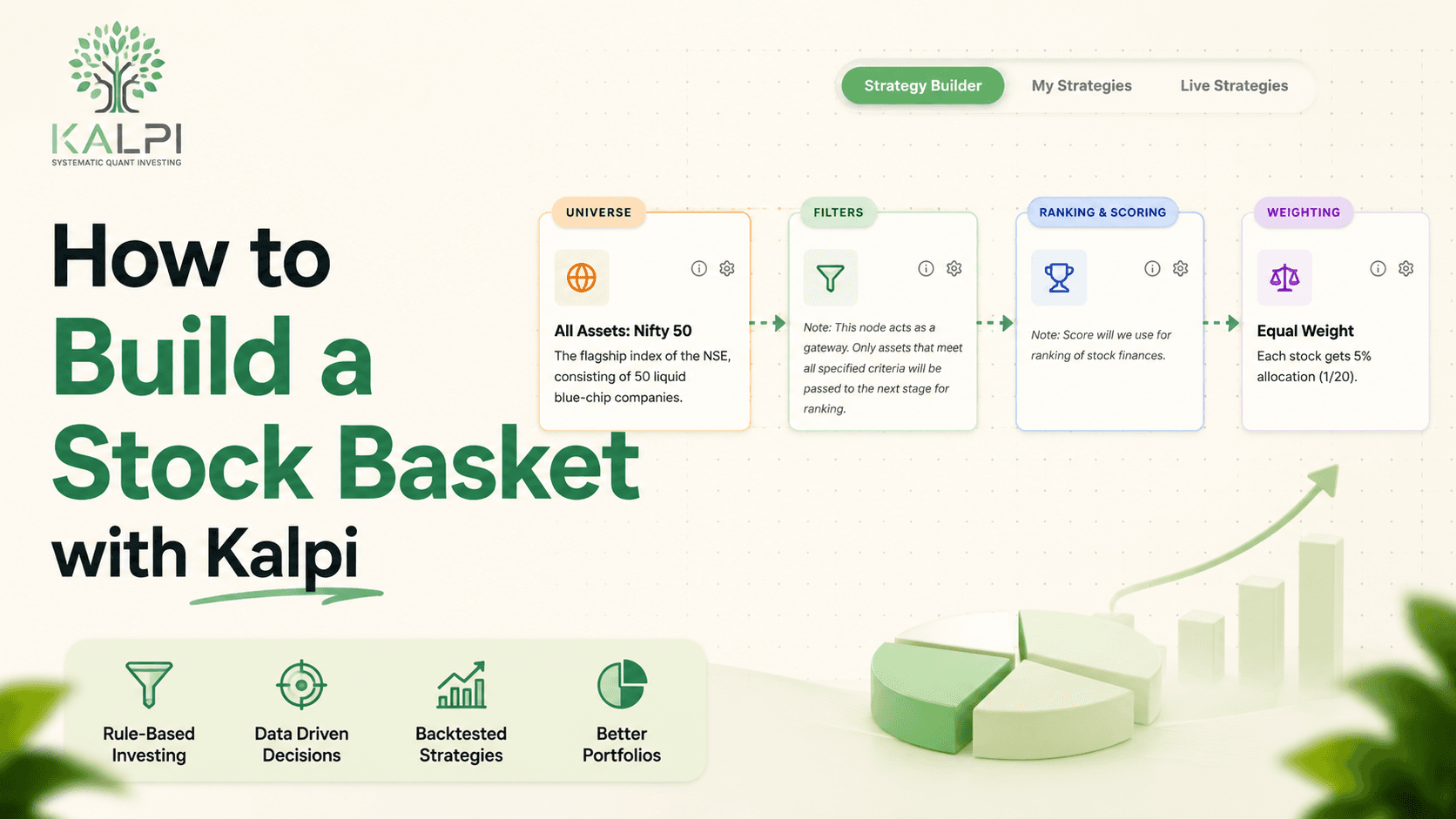
Think of it as a funnel. Hundreds of stocks go in at the top. Only the ones that survive every filter and rank high enough come out into your basket. Four stages. Each one has a clear job.
| Step 1 | Define Your Universe | Pick your starting pool Nifty 50, 200, or 500. Start with Nifty 50 if you want stability. |
| Step 2 | Apply Filters | Set rules: revenue growth, debt-to-equity, ROE, momentum. Stocks that don’t clear every bar get rejected. |
| Step 3 | Rank and Score | From filtered list, rank by strength ROE, earnings growth, momentum. Top scorers make the cut. |
| Step 4 | Set Weightage | Equal weight is cleanest to start 20 stocks = 5% each. Add complexity only when ready. |

Strategy Builder Universe → Filters → Ranking & Scoring → Weighting
4. Picking the Right Stocks
Stop thinking about it stock by stock. Think criteria first. Once your filter rules are set, the scanning happens automatically. These are the metrics that actually matter:
- Revenue and profit growth: Three years of consistent 15%+ growth. One good year means nothing.
- Debt-to-equity: Below 1x for most sectors. Banking and infrastructure naturally carry more debt apply sector logic, not blanket rules.
- Return on Equity: Above 15% means the company is putting your money to work properly. Below 10% needs a reason.
- Price momentum: Stocks trending upward over 6 to 12 months tend to keep going. Ignore it and you leave returns on the table.
- Sector mix: Don’t stuff 70% into IT because it ran last year. Mix banking, FMCG, pharma, industrials. That is actual diversification.
- Liquidity: Thinly traded stocks look fine going in. Getting out when you actually need to is a different story.
5. Example Stock Baskets
Three starting points depending on where you are. These are illustrative not investment advice.
| Feature | Beginner | Balanced | Aggressive |
|---|---|---|---|
| Universe | Nifty 50 | Nifty 200 | Nifty 500 |
| No. of Stocks | 15–20 | 20–30 | 25–40 |
| Key Filter | High ROE, Low Debt | Earnings Growth + Momentum | High Momentum + Small Cap |
| Weighting | Equal Weight | Market Cap Weighted | Score-Based |
| Rebalance | Quarterly | Monthly | Monthly |
| Risk Level | Low–Medium | Medium | Medium–High |
| Best For | First-time investors | Working professionals | Active traders |

Backtesting Dashboard Monthly Returns vs Benchmark (Apr 2017 – Apr 2026)
6. Rebalancing What It Actually Means
Most articles tell you to rebalance quarterly and move on. Nobody explains what actually happens when you do.
When you rebalance, the strategy re-runs from scratch. Your filter and ranking rules scan the universe again. Stocks that no longer qualify get removed. New ones that now qualify get added. Positions that have grown too large get trimmed back to their target weight. Positions that have shrunk get topped up.
This means you will sometimes be selling stocks that are doing well and buying ones that have underperformed recently. That feels wrong. It is not. That is literally how you buy low and sell high systematically without needing to predict anything.
On the tax side, every sale triggers either short-term or long-term capital gains. If you are rebalancing monthly, most gains will be short-term and taxed at 20%. Quarterly rebalancing gives more positions time to cross the 12-month mark for the lower 12.5% LTCG rate.
7. Stock Basket vs Other Options
| Stock Basket | Mutual Fund | PMS | Direct Stocks | |
|---|---|---|---|---|
| Control | Full | None | Partial | Full |
| Transparency | Complete | Monthly NAV | Partial | Complete |
| Cost | Low (brokerage only) | 0.5–2% per year | 2–3% + profit share | Low (brokerage only) |
| Min Amount | ~Rs 50,000 | Rs 500 | Rs 50 Lakh | Any |
| Effort | Medium (setup + rebalance) | Very Low | Low | High |
| Best For | DIY systematic investors | Beginners wanting zero effort | HNIs | Active traders |
8. Mistakes That Will Cost You
- Over-concentration: Putting 60–70% into 2 or 3 stocks defeats the entire purpose.
- Ignoring rebalancing: A basket built in January drifts badly by June. Set a schedule. Follow it.
- Chasing last year’s winners: A stock that returned 80% last year can return -30% this year.
- Over-filtering: Too many filters, too few stocks pass. You end up with a wish list, not a basket.
- Skipping the backtest: Never go live without running your strategy on historical data first.
- Forgetting tax: Every rebalance triggers capital gains. Monthly rebalancing adds up fast.
9. When a Stock Basket Won’t Work for You
This is worth being honest about. A stock basket is not for everyone.
- You want to put Rs 5,000 in and check it once a year a SIP in an index fund will serve you better.
- You cannot handle seeing individual stocks down 20–30% without panicking and selling.
- You are looking for a shortcut to quick returns this is a 2 to 3 year minimum game.
- You do not have the time to rebalance even quarterly a basket needs maintenance.
If any of those describe you right now that is fine. Come back when the situation changes. The market will still be here.
10. How Kalpi Helps
If you have spent time picking stocks randomly and it has not worked, Kalpi is worth a look. The platform was built for investors who want a proper system not another app to track prices on.
The Strategy Builder puts the entire four-step process on one screen. Universe, filters, ranking, weighting all visual, no coding, no spreadsheets. When you are done building, you hit backtest and the platform runs your strategy against data going back to 2017.
The backtest output is not just a return number. You see the average monthly return against the benchmark, the win rate month by month, the best month, and the worst month. For the Nifty 50 equal-weight strategy: average return +2.12% vs benchmark +1.01%, win rate 62.4%, best month +25.51%, worst month -24.13%.
For beginners, Kalpi also has template strategies you can clone and study before building your own, and that is really the core idea behind a good stock basket strategy. Not predicting which stock will become the next multibagger, but building a portfolio with a clear framework that can survive different market conditions without depending on emotions or random tips.
Explore Stock Basket Strategies in India on Kalpi.
Frequently Asked Questions
What is the minimum amount to start?
Practically, somewhere between Rs 50,000 and Rs 1,00,000 for a 20-stock Nifty 50 basket. You need enough to buy at least one share of each stock. Kalpi shows you the exact capital required before anything goes live.
Is this the same as a mutual fund?
No. Mutual fund units sit with the fund house. With a basket, individual stocks are in your Demat account. You own them directly, you control the rules, and there is no annual management fee eating into your returns.
How often should I rebalance?
Quarterly is a good starting point for most people. Monthly works if you are comfortable with higher transaction costs and mostly short-term capital gains tax. Figure out your tax situation first, then set your schedule.
Can a complete beginner do this?
Yes start with a template on Kalpi, run the backtest, understand what the basket is doing before going live. Most people figure it out faster than they expect.
How reliable is backtesting?
It is the best tool available for validating a strategy before risking real money. But it is based on historical data markets change, and past performance is not a promise of future returns.
What is the difference between this and smallcase?
Smallcase gives you someone else’s basket. Kalpi lets you build your own your filters, your ranking, your rules. You are not buying someone else’s conviction. You are running your own strategy.
What happens to my stocks if Kalpi shuts down?
Your stocks are always in your own Demat account not held by Kalpi. If anything were to happen to the platform, your holdings are completely unaffected.