

Last Updated: July 2026
Walk into any fruit market and you will notice something. One shop sells only bananas. Another sells only apples. A third keeps every fruit you can think of.
Now imagine buying fruit for the whole week. Would you fill your bag with only bananas? Probably not.
Bananas are nutritious, cheap and easy to find, but eating the same fruit every single day is rarely the smartest choice. Most people naturally pick a mix, because if one fruit runs out, turns expensive or is not fresh that week, the others still carry the basket.
Building an investment portfolio works the same way.
A single high-dividend stock can generate decent income for a while, but relying on just one company also raises your risk. If that company cuts its dividend or runs into business trouble, your income can drop overnight.
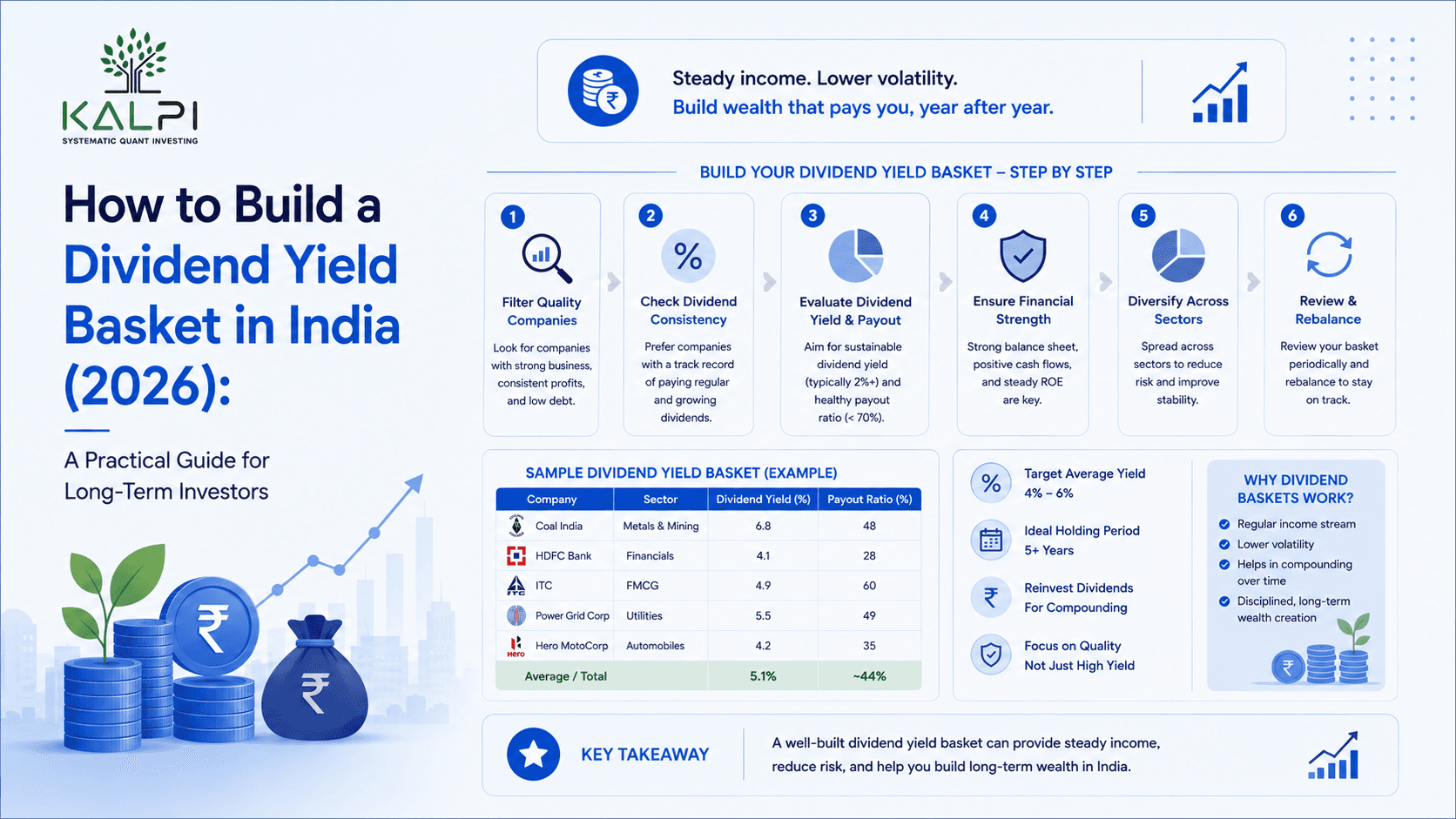
A dividend yield basket takes a more balanced route. Instead of betting on one company, you hold multiple dividend-paying stocks spread across different sectors. The idea is to build a portfolio that pays out fairly steady income without leaning too hard on any single business.
This is exactly why long-term investors usually prefer building a high dividend yield stock India portfolio rather than chasing whichever stock happens to offer the highest payout this month.
In this guide, we will look at what a dividend yield basket actually is, how to build one step by step, what to check before picking stocks, and the mistakes investors tend to make along the way.
What Is a Dividend Yield Basket?
A dividend yield basket is simply a group of dividend-paying stocks chosen to generate regular income while keeping your money spread out sensibly.
Instead of putting your entire investment into one company, you split it across several businesses that have a track record of paying dividends consistently.
For instance, your basket could include names from banking, energy, IT, FMCG and utilities. These sectors tend to move differently across market cycles, so if one sector has a rough year, the rest of your basket can help cushion the impact.
The goal here is not simply to chase the highest dividend number you can find. It is to pick businesses that have the financial strength to keep paying dividends for years, not just this year.
Understanding Dividend Yield
Dividend yield tells you how much a company pays out in dividends each year compared to its current share price.
The formula is straightforward:
Dividend Yield = (Annual Dividend per Share ÷ Current Share Price) × 100
A higher yield does not automatically mean a better stock.
Sometimes a yield looks unusually attractive simply because the share price has fallen sharply. In cases like this, the high number is often a warning sign of business trouble rather than a bargain waiting to be picked up.
This is why experienced investors rarely shortlist stocks on yield alone. They also look at business quality, earnings stability, cash flow, and how consistent the company has been with its dividend payments over the years.
Why Do Investors Build Dividend Yield Baskets?
A well-diversified dividend basket offers a few real advantages:
- Creates a steady stream of passive income
- Reduces how dependent you are on any single company
- Lowers overall portfolio risk through diversification
- Lets you benefit from long-term compounding when dividends are reinvested
- Builds a disciplined, long-term investing habit
If you prefer steady cash flow over constantly trading in and out of stocks, dividend investing can become a solid part of your overall portfolio strategy.

Should You Reinvest Your Dividends?
Once your dividend basket starts paying out regularly, you will face another decision: spend the income or reinvest it?
There is no single right answer here. It depends on what you are trying to achieve.
If you are retired or looking for regular cash flow, using the dividends as extra income makes complete sense. But if you are still in the wealth-building phase, reinvesting those dividends can meaningfully grow your portfolio over time.
Think of it like planting a mango seed.
You could eat every mango the tree gives you each year, or you could plant a few of those seeds and grow more trees. It takes patience, but a few years down the line, you end up with a much bigger orchard than if you had just eaten everything.
Dividend reinvestment works on the same principle. Instead of withdrawing every payout, many investors use that money to buy more shares. Those new shares go on to generate dividends of their own, and over the years, this compounding effect can add up significantly.
Risks You Should Know
Dividend investing is often seen as less volatile than growth investing, but that does not make it risk-free. Knowing the risks upfront helps you set realistic expectations.
A few things worth keeping in mind:
- Companies can reduce or stop paying dividends during tough business conditions
- A high dividend yield sometimes just reflects a falling share price, not strength
- Inflation can quietly erode the purchasing power of your dividend income over time
- Putting too much money in one sector raises your portfolio risk
- Even strong, well-run dividend companies go through periods of market volatility
A dividend basket needs periodic attention. It is not something you build once and completely forget about.
How Often Should You Review Your Dividend Basket?
Building the basket is only step one. Companies change, industries evolve, and market conditions never stay the same for too long.
That does not mean checking your portfolio every day. For most long-term investors, reviewing the basket once or twice a year is usually enough.
During each review, ask yourself a few simple questions:
- Is the company still financially healthy?
- Has it kept up consistent dividend payments?
- Has the business model changed in any meaningful way?
- Has one stock grown too large compared to the rest of the basket?
- Does the basket still match your investment goals?
Small, occasional adjustments usually work better than frequent buying and selling.

Who Should Consider a Dividend Yield Basket?
A dividend-focused portfolio tends to suit investors who:
- Prefer regular income from their investments
- Want to reduce dependence on any single company
- Are building long-term wealth through disciplined investing
- Appreciate stable, mature businesses over high-flying ones
- Plan to reinvest dividends for compounding benefits
On the other hand, investors chasing rapid capital appreciation may prefer putting a larger share of their portfolio into growth-oriented companies instead.
Neither approach is better on its own. Many experienced investors actually combine both, holding a mix of growth stocks and dividend stocks India offers to build a more balanced portfolio.
Dividend Investing vs Growth Investing: A Quick Comparison
| Factor | Dividend Investing | Growth Investing |
|---|---|---|
| Primary goal | Regular income | Capital appreciation |
| Volatility | Generally lower | Generally higher |
| Typical companies | Mature, stable businesses | Expanding, reinvestment-heavy businesses |
| Cash flow | Regular payouts | Little to no payouts |
| Best suited for | Income-focused, long-term investors | Investors comfortable with higher risk |
Final Thoughts
A dividend yield basket is not about finding whichever company offers the biggest payout today.
It is about building a portfolio of quality businesses with the financial strength to reward shareholders consistently, year after year.
When you are shortlisting high dividend yield stocks India has to offer, look past the headline yield number. Business quality, cash flow, sector diversification and dividend consistency matter far more than a single percentage figure.
Whether your goal is earning regular passive income or steadily building long-term wealth, a carefully constructed dividend yield basket can become a genuinely valuable part of your overall investment strategy.
Like most things in investing, the real edge comes from patience and discipline. Staying invested through different market cycles tends to work better than constantly chasing whichever stock currently has the highest yield.
Frequently Asked Questions
What is a dividend yield basket?
A dividend yield basket is a portfolio of dividend-paying stocks chosen to generate regular income while staying diversified across different sectors.
How many stocks should a dividend basket contain?
There is no fixed rule. Many investors hold somewhere between 10 and 20 quality companies, which gives reasonable diversification without making the portfolio too hard to track.
Should I only buy the highest dividend-paying stocks?
Not really. A very high dividend yield can sometimes signal financial stress rather than opportunity. It helps to also check business quality, earnings, cash flow and dividend history before investing.
How often should I review my dividend basket?
For most long-term investors, reviewing the portfolio once or twice a year is usually enough, unless there is a major change in a company’s fundamentals.
Are dividend stocks suitable for beginners?
Yes. Many beginners start with dividend-paying companies since they tend to be established businesses with relatively stable earnings. That said, every stock still deserves proper research before you invest.