

If you’re searching for how to backtest a stock strategy in India, or looking for a free backtesting tool India investors can actually use, this guide walks through it slowly portfolio testing, momentum strategies, and what the numbers actually mean once you stop staring only at the returns column.
Most people think they have a strategy. Usually they just have recent market memories.
Around early 2024, almost everyone suddenly looked like a market expert.
Railway stocks were flying. PSU stocks kept moving up. Every second finance reel had “next multibagger” written somewhere in the thumbnail.
Aman got pulled into it too.
He bought a few stocks after watching YouTube videos and reading Twitter threads from people who sounded extremely confident. For a while, it even worked. His portfolio kept going up, which made him believe he’d finally cracked how the market works.
Then came a correction.
Not even a massive crash. Just a rough few months.
Suddenly those same stocks were down 20–30%, finance creators went quiet, and Aman sat there refreshing his portfolio every hour, trying to decide whether to sell or just hold on and hope.
Funny how “long-term conviction” gets much quieter once stocks stop rising every week.
That’s usually where people realise something uncomfortable.
Most retail investors are not really following a strategy.
They’re following excitement.
And those are very different things once markets turn ugly.
So what exactly is backtesting?
Sounds technical at first. The idea itself is pretty simple though.
You take an investing strategy and test how it would have behaved using old market data. That’s really it.
Say your rules look something like this:
- pick Nifty 500 companies
- revenue growth above 15%
- high ROE
- strong momentum
- rebalance every quarter
A backtesting tool checks:
- which stocks matched historically
- how the portfolio performed
- how badly it fell during corrections
- whether recoveries were fast or painfully slow
- and whether the strategy stayed consistent over time
The uncomfortable part is this once markets get stressful, most people discover they never really had a system.
Think of two students preparing for a maths exam. One just keeps reading formulas and hopes the difficult questions don’t show up. The other actually sits down and solves old papers.
That second student already knows where the silly mistakes happen, which chapters get hard under pressure, and how timing feels once the clock starts running.
Backtesting works the same way. You’re not trying to predict the future perfectly. You’re trying to understand what happens if markets suddenly turn messy for a few months.
Why more Indian investors are learning backtesting now
A few years ago, hardly anyone outside finance Twitter discussed portfolio testing seriously.
Now even beginners search things like free backtesting tool India, backtest momentum strategy, stock strategy testing, or portfolio analysis tools.
Mostly because investors have seen what emotional investing looks like during panic markets. The COVID crash. The small-cap frenzy. Influencer stock pumps, then sharp corrections right after.
A lot of retail investors slowly realised they were making decisions based on headlines, Telegram tips, excitement, and the fear of missing out.
That works surprisingly well during easy bull markets.
The confusion starts the moment markets stop cooperating.
What should you actually check while backtesting?
Most beginners only look at returns. That’s normally the first mistake.
A strategy showing 42% returns sounds brilliant until you realise it also crashed 55% during one bad phase. Context changes everything.
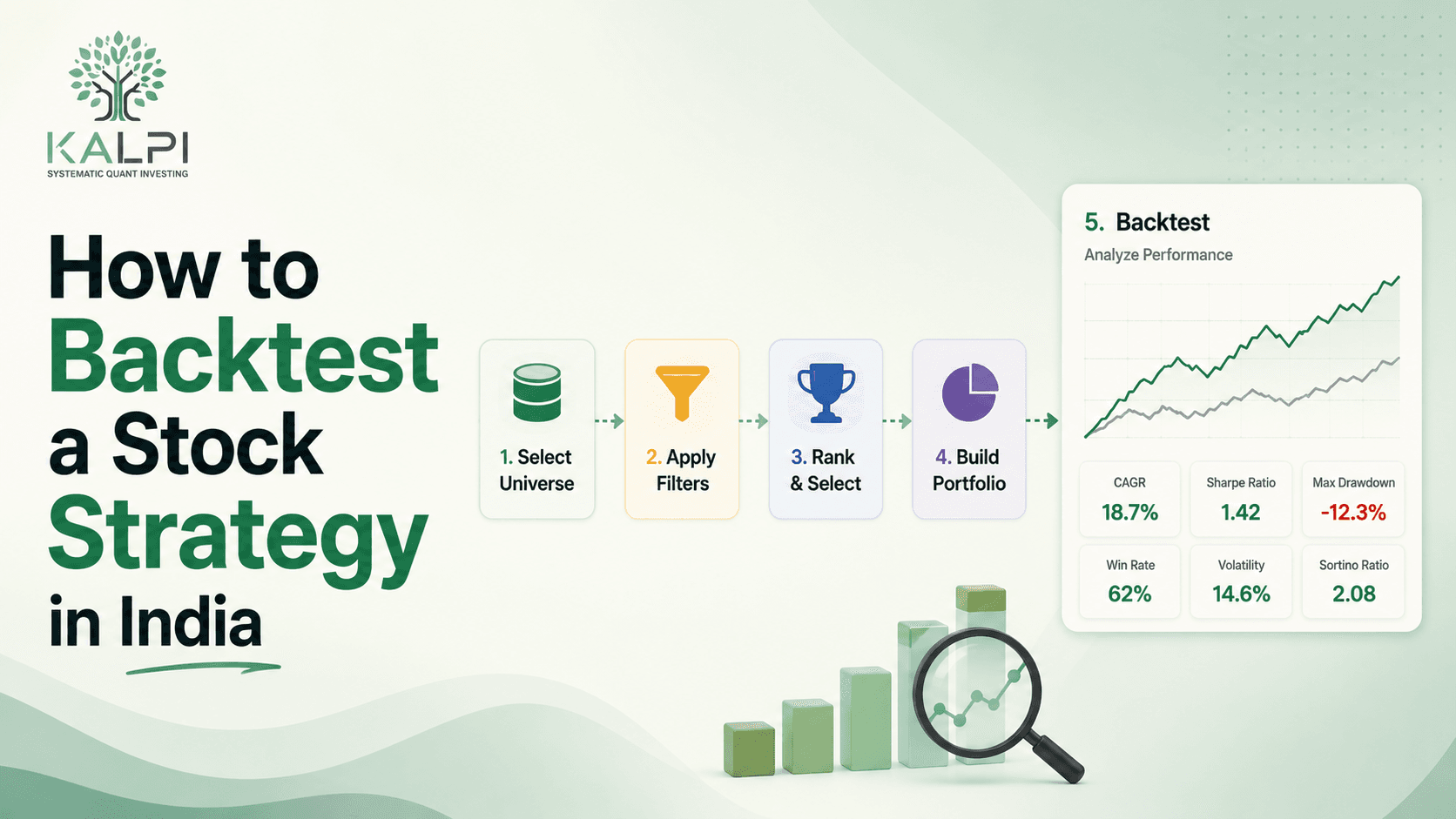
| Metric | What It Actually Means |
| CAGR | Average yearly portfolio growth |
| Max Drawdown | Largest portfolio fall |
| Sharpe Ratio | Return earned compared to risk taken |
| Volatility | How unstable returns were |
| Win Rate | How often the strategy stayed positive |
| Rebalancing Frequency | How often holdings change |
A strategy is only useful if a normal human being can realistically keep following it when markets turn ugly.
That part rarely gets discussed online.
Why many stock screeners still miss the bigger problem
Most stock screeners today can filter companies fairly quickly PE ratio, ROE, momentum, debt, earnings growth, market cap, all of it.
Filtering stocks isn’t difficult anymore.
The harder question is: how would this portfolio actually behave during completely different market conditions?
That’s where many investors realise stock selection and portfolio construction are two entirely different skills. A strategy can look incredible during a bull run and still fall apart once volatility shows up properly.
How a simple backtest usually works
Suppose somebody wants to test a momentum strategy. The rules might look like:
- top momentum stocks from Nifty 500
- ROE above 18%
- equal weight allocation
- quarterly rebalancing
The platform basically goes backwards in time and asks: which stocks qualified back then? When would they enter the portfolio, and when would they leave? How deep would drawdowns get, and did the strategy recover afterwards?
For most investors, that matters more than the headline CAGR screenshot a portfolio surviving the difficult phases tells you far more than one that only worked while markets were comfortable.
Backtesting tools used to feel impossible for normal investors
Earlier, most portfolio-testing software felt like engineering tools pretending to be finance platforms. Too many spreadsheets, too many formulas, too much setup before you even understood what was happening.
That’s changed quite a bit now.
Many modern platforms let investors manually create portfolios, upload CSV files, compare historical performance, test allocation weights, and analyse factor exposure.

Even beginners with zero coding knowledge can poke around and figure out what’s happening underneath.
| Feature | Why It Helps |
| Manual Portfolio Setup | Test custom stock combinations |
| CSV Upload | Useful for existing portfolios |
| Allocation Analysis | Shows concentration risk |
| Historical Simulation | Helps evaluate consistency |
| Factor Attribution | Explains what drove returns |

If you already track portfolio returns in Excel or Google Sheets, most tools now let you upload that directly instead of rebuilding everything by hand.
At least now you’re not buying stocks just because somebody sounded confident in a five-minute reel.
Most people think the biggest benefit is better returns. It probably isn’t.
The underrated benefit is emotional preparation.
When you already know your strategy once fell 28%, stayed flat for months, and recovered slowly afterwards real market volatility stops feeling shocking.
Without that context, every correction starts feeling like the market is permanently broken. Sounds dramatic, but during crashes that’s genuinely how a lot of retail investors think.
Where beginners quietly destroy their own strategies
A lot of people accidentally turn backtesting into a game. They keep tweaking filters until historical returns start looking unbelievable.
Add one filter. Remove one losing stock. Change one rule slightly.
Eventually, the strategy starts looking magical.
And those are usually the exact strategies that collapse once live markets start behaving differently because the portfolio was designed too perfectly around the past.
Good backtesting isn’t about building fantasy portfolios. It’s about building something realistic enough that a normal investor can stick with for years.
A strategy only works if humans can actually follow it
A strategy with slightly lower returns but a steadier experience is often more useful in real life.
Because during crashes, people don’t behave like spreadsheets.
They panic. Pause SIPs midway. Sell strong businesses at terrible prices. Then quietly re-enter once markets have already recovered.
You start paying attention to things people usually ignore during bull runs drawdown depth, recovery time, consistency, and whether the strategy still makes emotional sense once the excitement disappears.
Most investors aren’t really failing because information was unavailable. They struggle because they never built a framework for the difficult markets.
Explore portfolio and momentum backtesting strategies
Most investors today can screen stocks reasonably well. The harder part is understanding whether a strategy can actually survive different market conditions over time.
You can explore different Backtest Stock Portfolio & Momentum Strategies and compare how factor-based portfolios behaved across bull markets, crashes, and recovery periods.
Final thoughts
So yes, beginners should probably learn backtesting fairly early.
Not because it predicts the future. It doesn’t.
But it changes how you think about investing. You stop treating stocks like lottery tickets and start paying attention to risk, consistency, patience, and how a portfolio actually behaves during the uncomfortable phases.
And over long periods, that mindset matters a lot more than finding one lucky stock tip.
Frequently Asked Questions
Is backtesting useful for beginners?
Yes. Probably more useful than most beginners realise.
Can I backtest Indian portfolios for free?
Yes, though free versions are usually limited basic strategy testing tends to be free, deeper analytics and comparisons often sit behind a paid plan.
Does backtesting guarantee future returns?
No.
And anyone promising guaranteed returns from a backtest is either inexperienced or selling something too aggressively.
Historical testing only shows how a strategy behaved under old market conditions. Markets constantly change what worked between 2018 and 2024 might behave completely differently over the next few years.
What is the biggest mistake people make while backtesting?
Over-optimisation. People keep adjusting filters until historical returns start looking unrealistically good and those strategies often fail later because they were built too perfectly around past data instead of durable investing logic.
Why are momentum strategy backtests becoming more popular in India?
Retail investors are slowly shifting toward systematic approaches instead of random stock picking. Momentum also looks easier to understand visually than a lot of finance concepts, even though it can still see sharp drawdowns during volatile periods.