

Last Updated: July 2026
Introduction
Picture two friends starting similar businesses with the same amount of capital. Both end up earning ₹20 lakh in annual profit. On paper, they look equally successful. The difference shows up in how each business got there.
The first business ran mostly on borrowed money, so a chunk of its earnings goes straight into loan interest every month. The second kept debt to a minimum, which means most of its profit stays inside the business and can go toward expansion, new products, or dividends. Given a choice, most people would call the second one the safer bet.
Investors think about companies the same way. It’s rarely just “how much profit did they make.” The real questions are usually “how efficiently are they using shareholder money” and “how much debt are they carrying to get there.” That combination is why High ROE Low Debted Stocks India shows up so often in investor searches.
A high Return on Equity can point to a company generating solid profits from shareholders’ capital, and low debt tends to ease the pressure when business conditions turn choppy. But neither number tells the full story on its own. A company can post an impressive ROE purely because it borrowed heavily, while another with barely any debt might be struggling to grow profits at all. Knowing how these two numbers interact matters more than knowing either one in isolation.
What Does High ROE Mean?
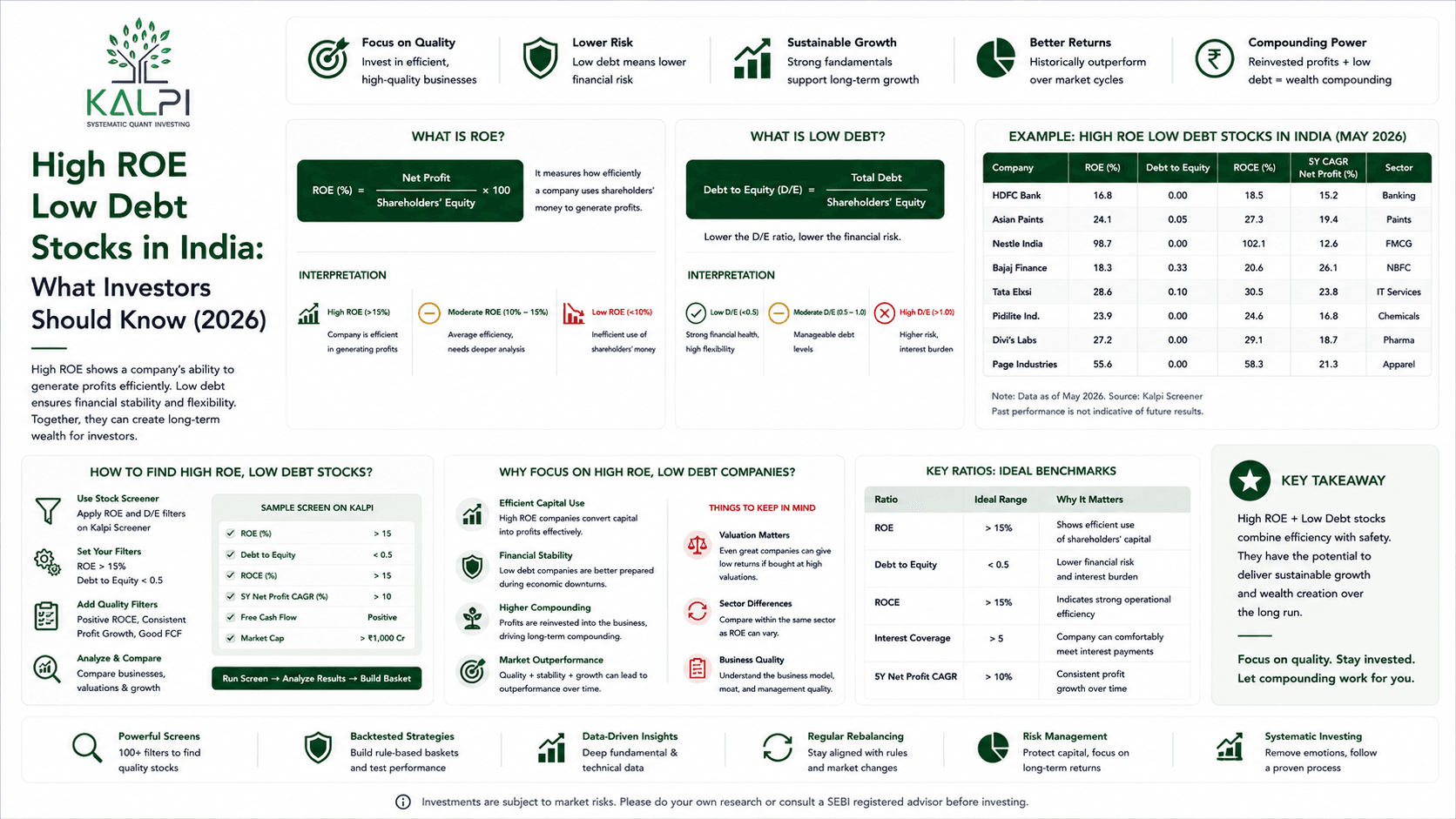
Return on Equity measures how efficiently a company converts shareholders’ money into profit. Put simply: for every ₹100 an investor puts in, how much profit does the company generate from it?
A higher ROE usually signals that management is deploying capital well and running a disciplined, profitable operation. Take two companies in the same industry:
| Company | Return on Equity (ROE) |
|---|---|
| Company A | 12% |
| Company B | 22% |
Assuming similar operations and risk levels, Company B is squeezing more profit out of the same shareholder capital. That doesn’t automatically make it the better investment — it just tells you the company is currently using capital more efficiently than its peer. This is a big part of why ROE gets so much attention when investors screen for Quality Stocks India.
Why Does Low Debt Matter?
Debt itself isn’t a red flag. Plenty of healthy companies borrow to build factories, expand production, or fund growth. The trouble starts when borrowing gets out of hand — more debt means more fixed interest payments, and those don’t go away just because sales slow down for a quarter or two.
Companies carrying relatively low debt usually have more room to breathe. They can chase growth opportunities, ride out a rough patch, or adapt to shifting market conditions without their interest bill eating into what’s left. That said, some sectors genuinely need more leverage than others. Infrastructure, utilities, and heavy manufacturing routinely carry higher debt simply because of how capital-intensive their projects are. So debt is best judged against industry norms rather than one fixed number applied across the board.

A Kalpi fundamentals comparison showing P/E, P/B, and dividend yield measured against the benchmark — the kind of side-by-side check investors use before judging valuation or debt-driven ratios in isolation.
Why Investors Look at ROE and Debt Together
A single ratio rarely tells the whole story. A company can show a high ROE largely because it borrowed heavily — more debt shrinks shareholder equity, which can flatter the ROE figure without reflecting genuine operational strength. On the flip side, a business with very low debt might still generate mediocre returns if it isn’t putting its capital to good use.
This is why experienced investors read ROE and debt together instead of picking one and ignoring the other. Companies that investors typically bucket as Strong Stocks rarely earn that label from a single metric — it’s usually a mix of profitability, debt discipline, cash flow, and consistent earnings growth that gets them there. The same logic applies when identifying Best Fundamentally Stocks, where all of these factors get weighed together rather than in isolation.
How to Identify High ROE Low Debt Stocks in India
Spotting financially strong companies isn’t about fixating on one number. It usually comes down to studying a handful of factors together to understand whether a business has consistent profitability, a stable balance sheet, and genuine room to grow.
Consistent ROE Over Multiple Years
A single strong year doesn’t say much on its own — it could be a one-off asset sale, a temporary tax benefit, or a shift in capital structure rather than real operational improvement. What matters more is whether a company has kept its ROE healthy across several years and different market cycles. A business that holds up across both good and bad years usually tells you more than one that spikes briefly and fades.
Understanding Debt Levels
When screening for Low Debted High ROE Stocks, it helps to look beyond whether a company has debt and ask whether that debt is actually manageable. Two companies can carry similar debt loads and be in completely different financial positions — one with steady cash flows can service higher debt comfortably, while another with unpredictable earnings might struggle even at lower borrowing levels.
A few metrics help here:
| Metric | What It Indicates |
|---|---|
| Debt-to-Equity Ratio | Compares company debt against shareholders’ equity |
| Interest Coverage Ratio | Shows how comfortably a company can meet its interest payments |
| Cash Flow from Operations | Reflects whether the business is generating real, usable cash |
Checking Earnings Growth
High ROE today doesn’t guarantee much if profits aren’t growing. A genuinely strong business usually shows steady revenue growth, improving margins, efficient capital use, and healthy cash generation working together — not just one good year of returns.
Looking at Business Quality
Ratios are a useful starting point, but they can’t substitute for understanding the business itself. Companies that fall into the Best Fundamentally Stocks category tend to share a strong competitive position, experienced management, a durable business model, and the ability to adapt when their industry shifts. A company with a recognisable brand and loyal customers is often better placed to sustain profitability than one riding a temporary market trend.
High ROE Does Not Always Mean a Good Stock
It’s easy to assume every high-ROE company is automatically a quality pick, but that’s not really true. A high ROE can come from excessive debt, a shrinking equity base, or a short-lived profit spike — and without digging into the reason behind the number, investors risk getting an incomplete picture.
Say a company borrows heavily to fund expansion. If the expansion works out, profits climb and ROE looks attractive on paper. But if conditions turn, that same debt load becomes a burden. This is exactly why ROE needs to be read alongside debt levels, cash flow, business quality, and the broader industry backdrop — not by itself.

CAGR, volatility, and risk-adjusted return comparisons like these on Kalpi help illustrate why return numbers alone — including ROE — need to be read alongside risk and consistency, not in isolation.
What High-Quality Businesses Tend to Have in Common
When investors go looking for Quality Stocks India, they’re usually hunting for signs of financial discipline sustained over time, not just a good quarter.
A few traits tend to show up together in these companies: high ROE reflecting efficient use of capital, manageable debt that keeps financial pressure in check, strong and consistent cash flow, steady growth year over year, and management that makes sound capital allocation decisions. No single trait guarantees a good outcome, but seeing several of them together builds a much stronger case than any one metric alone.
Why Investors Prefer Financially Strong Companies
Markets don’t move in a straight line. During good stretches, plenty of businesses look strong regardless of their balance sheet. It’s the tougher periods that separate financially sound companies from the rest — the ones with manageable debt and efficient operations tend to have more flexibility when conditions get difficult.
This doesn’t mean debt-free companies always win or that any company with debt should be avoided. The right amount of leverage depends on the industry, the business model, and how well management handles it. What actually matters is whether a company is using its capital effectively and whether its financial structure can support growth over the long run.
Common Mistakes While Screening for These Stocks
A few mistakes come up repeatedly when investors search for High ROE Low Debted Stocks India: judging a company on one year’s ROE instead of a longer track record, glossing over the debt picture entirely, comparing businesses across unrelated industries without adjusting for context, chasing stock price momentum instead of business quality, and assuming that strong past performance will simply continue. Avoiding these requires a bit of patience and a willingness to actually dig into the numbers rather than taking a screener’s shortlist at face value.
Limitations of Using ROE and Debt Alone
High ROE and low debt are useful signals, but leaning on just these two numbers can leave gaps in the analysis. A company might post a high ROE because it operates in a strong industry with capable management — or it might hit a similar number by buying back shares and shrinking its equity base, or by taking on more financial risk than is obvious at first glance. The ratio looks the same either way, but the underlying businesses can be very different.
Low debt isn’t automatically a green light either. A company with zero debt but weak revenue growth, shrinking margins, or poor execution can still be a mediocre investment. This is why it’s worth weighing several things together: revenue and profit growth, cash flow generation, competitive positioning, industry conditions, management quality, and valuation.
Why Valuation Still Matters
One thing investors sometimes skip while chasing Quality Stocks India is price. A financially strong company can still be a poor investment if the stock already trades at a valuation that assumes years of flawless execution. High ROE, low debt, and a solid growth history don’t mean much if the market has already priced in all of that future growth and then some. Business quality and stock valuation are two separate questions — understanding both gives a far more complete picture than looking at either alone.
High ROE Low Debt Stocks Across Different Industries
How much weight to give ROE and debt shifts depending on the industry. A software company can comfortably run on low debt since it doesn’t need much physical infrastructure. A manufacturer, on the other hand, might rely on borrowing just to build out capacity. Comparing these two purely on ROE and debt ratios, without adjusting for the industry, doesn’t tell you much — investors generally get better insight by comparing a company against peers running similar business models.
Building a Balanced Approach
Finding Low Debted High ROE Stocks isn’t about hunting for a perfect company that ticks two boxes. These metrics work better as a starting point for deeper research than as a final answer.
A more balanced evaluation usually asks a few things:
- Has the company kept up profitability across several years?
- Is its debt reasonable next to industry peers?
- Are cash flows consistent?
- Does it have a real, durable edge over competitors?
- Is the current price actually reasonable given all of this?
Working through these questions shifts the focus toward business quality instead of short-term price swings.
Final Thoughts
No two investors build portfolios the same way — goals, risk appetite, and time horizons differ from person to person. High ROE and low debt are two traits worth watching because they often point to efficient capital use and a sturdier financial base, but they work best as part of a bigger picture rather than a standalone checklist.
The point of studying High ROE Low Debted Stocks India was never to find a guaranteed winner. It’s about understanding what actually makes a business financially sound, and learning to spot the companies that show real discipline and consistency over time. Pairing that financial analysis with a genuine understanding of the business tends to lead to better decisions than chasing ratios alone.
Frequently Asked Questions
1. What are High ROE Low Debt Stocks?
They’re companies that generate strong returns on shareholders’ capital while keeping debt levels relatively low. Investors typically study both traits together when evaluating financially stable businesses.
2. Is a high ROE always a sign of a good company?
Not always. A high ROE is a positive signal, but it’s worth checking debt levels, cash flow, growth, and overall business quality before drawing conclusions.
3. Are low debt companies always better than companies carrying debt?
Not necessarily. Debt can fuel growth when it’s managed well. What matters is whether the company can comfortably service what it has borrowed.
4. How can investors find fundamentally strong stocks?
By looking at a mix of factors — profitability, debt levels, earnings growth, cash flow, management quality, and where the company sits within its industry — rather than relying on any single number.
5. Should investors only focus on ROE while picking stocks?
No. ROE is just one metric among several. A fuller analysis also weighs valuation, business performance, risk, and future growth potential.