

Last Updated: July 2026
Imagine your phone battery drops from 100% to 50% during the day. Charging it back to 100% isn’t difficult, because you’re simply adding power to what remains. Investing does not work the same way.
When your portfolio loses value, recovering that loss becomes much harder than most investors expect.
Many people assume that if their investment falls by 20%, a 20% gain will bring them back to where they started. Unfortunately, percentages don’t work like that. A 20% loss and a 20% gain are never equal.
This simple mathematical reality explains why recovering from market declines often takes far longer than investors realise. It also shows why protecting your capital matters just as much as growing it.
Understanding drawdown recovery math helps explain the loss versus gain math that catches many investors off guard. Once you get this concept, it becomes much easier to see why losses hurt more, and why experienced investors pay so much attention to managing downside risk instead of chasing the highest possible returns.
In this guide, we will walk through the drawdown recovery math, look closely at loss versus gain math, understand why losses hurt more, and see how asymmetric returns shape long-term wealth creation.
What Is a Drawdown?
A drawdown is the decline in the value of an investment from its highest point to its lowest point before it recovers.
Suppose your portfolio grows from ₹5 lakh to ₹6 lakh. Later, the market falls and your portfolio drops to ₹4.8 lakh. The fall from ₹6 lakh to ₹4.8 lakh is the drawdown.
Notice something important here. The drawdown isn’t measured from your original investment. It is measured from the most recent peak.
This makes drawdowns one of the most useful ways to understand how much risk an investor has actually experienced.
For long-term investors, temporary declines are completely normal. Every market goes through periods of correction. The real challenge isn’t avoiding every drawdown. It’s understanding how much recovery becomes necessary after each one.

Portfolio Health score, showing how risk and returns combine to reveal the real state of a portfolio
Why Losses Hurt More Than They Appear
Many people assume percentages work both ways. If something falls by 30%, they expect a 30% rise to restore it. That’s not how percentage calculations actually work.
Take a simple example. Suppose you invest ₹1,00,000. Your portfolio falls by 20%. Its value becomes ₹80,000.
Now imagine your portfolio gains 20%. Twenty percent of ₹80,000 equals ₹16,000, not ₹20,000. Your portfolio now becomes ₹96,000. You’re still below your original investment.
That’s because gains are calculated on the reduced value after the loss. This is exactly why recovering from losses becomes increasingly difficult as the drawdown grows.
Understanding Drawdown Recovery Math
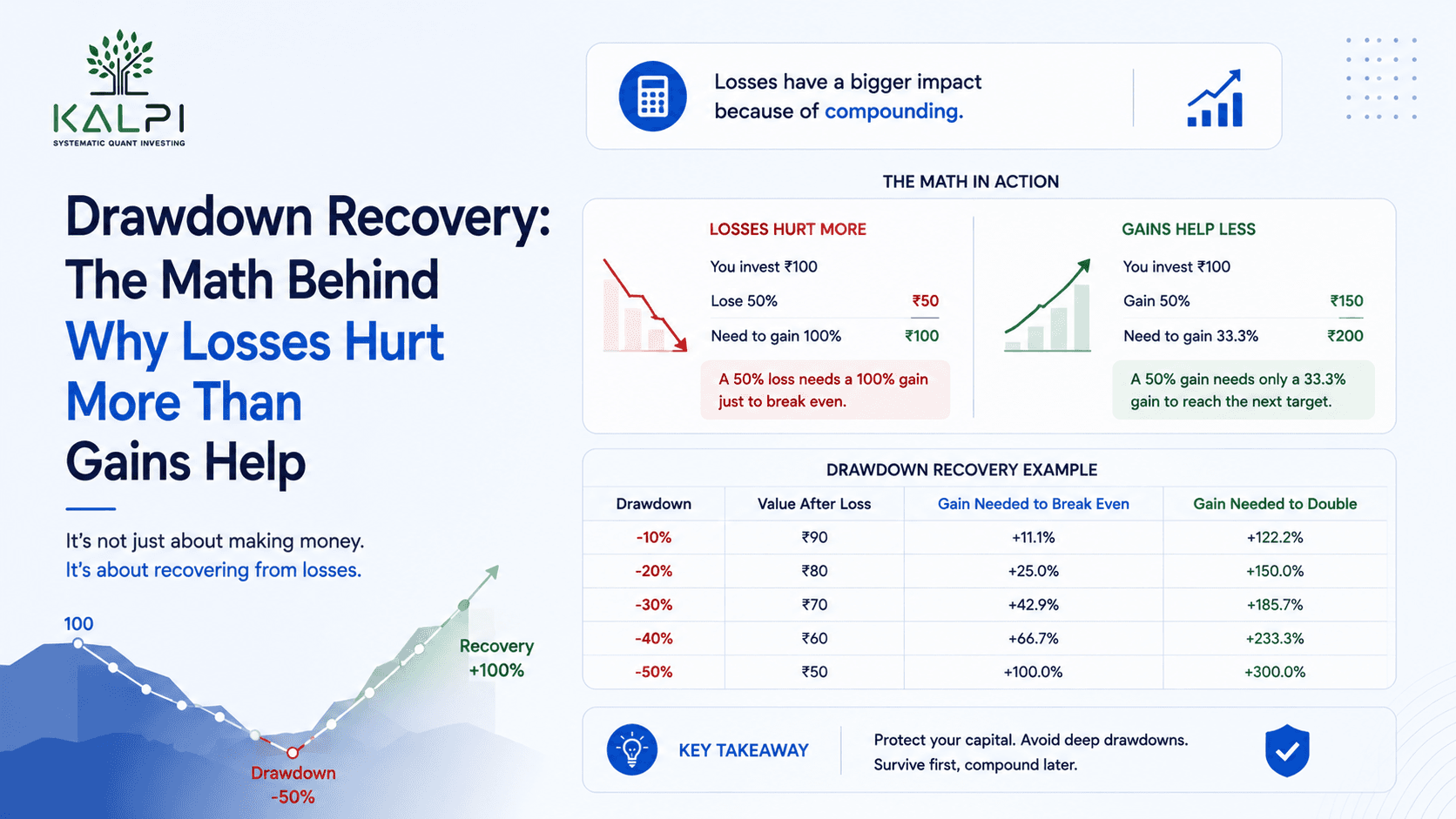
The relationship between losses and recovery isn’t linear. As losses increase, the recovery required grows much faster. The table below makes this clear.
| Portfolio Loss | Gain Needed to Recover |
|---|---|
| 10% | 11.1% |
| 20% | 25% |
| 30% | 42.9% |
| 40% | 66.7% |
| 50% | 100% |
A 50% loss requires a 100% gain just to break even. That surprises many investors the first time they see the numbers.
This mathematics explains why experienced investors spend so much time managing downside risk instead of chasing the highest possible returns.
Why This Happens
Take another example. Suppose your investment is worth ₹10 lakh. The market falls by 50%. Your portfolio is now worth ₹5 lakh.
To go from ₹5 lakh back to ₹10 lakh, your investment has to double. Doubling means earning a 100% return.
The percentage needed to recover becomes larger because every gain is calculated on a smaller base. That’s the heart of drawdown recovery math. The deeper the fall, the steeper the climb back.
The Psychology Behind Drawdowns
Losses affect investors in two different ways. The first is financial. The second is emotional.
When portfolios decline sharply, many investors stop focusing on their long-term goals. Instead, they start worrying about recovering losses as quickly as possible. This often leads to poor decisions.
Some panic and sell during market corrections. Others take excessive risks hoping to recover faster. Ironically, both reactions can make recovery even harder.
Understanding why losses hurt more isn’t only about mathematics. It’s also about recognising how market declines influence investor behaviour. Protecting your emotions can sometimes be just as important as protecting your portfolio.
Returns Are Not Symmetrical
One of the biggest lessons in investing is that gains and losses don’t cancel each other out. They behave differently. This idea is known as asymmetric returns.
| Scenario | Portfolio Value |
|---|---|
| Initial Investment | ₹1,00,000 |
| After 25% Loss | ₹75,000 |
| After 25% Gain | ₹93,750 |
Even after earning the same percentage that you lost, your investment hasn’t fully recovered.
This simple example explains why avoiding large losses is often more valuable than trying to generate extraordinary returns. Successful investing isn’t only about finding winners. It’s also about limiting the size of your setbacks.
In the next section, we’ll look at practical ways investors reduce drawdowns, understand how diversification and asset allocation help during market declines, and see why protecting capital is one of the strongest drivers of long-term wealth creation.
Reducing Drawdowns Without Chasing Returns
Every investor wants higher returns. But experienced investors often focus on something else first. They try to avoid large losses.
That may sound less exciting, but over long investment periods, protecting capital can have a surprisingly powerful effect on overall wealth creation.
This doesn’t mean trying to predict every market correction. It simply means building a portfolio that can withstand periods of volatility without suffering unnecessary damage.
Here are some practical ways investors try to reduce drawdowns.
Diversification
Putting all your money into one company, one sector or one asset class increases risk. Diversification spreads that risk across different investments.
If one part of the portfolio performs poorly, another may provide stability. Diversification doesn’t eliminate losses, but it can reduce the size of drawdowns.
Asset Allocation
Markets don’t move in the same direction at the same time. Equity, debt, gold and other asset classes often behave differently under different economic conditions.
A balanced asset allocation can help reduce overall portfolio volatility. This is one reason financial planners spend so much time discussing asset allocation before recommending individual stocks.
Portfolio Rebalancing
Over time, market movements change your portfolio allocation. Rebalancing helps restore your intended allocation.
It doesn’t guarantee higher returns, but it helps investors control risk and avoid becoming overly dependent on one asset class after a strong rally.
Investing for the Long Term
Short-term market movements can be unpredictable. Long-term investing gives quality businesses more time to recover from temporary setbacks.
History shows that many market corrections eventually pass, but investors who panic during those periods often lock in losses permanently.
Risk Management Is More Powerful Than It Looks
Many investors spend most of their time searching for the next stock that could deliver exceptional returns. Far fewer spend time thinking about risk.
Ironically, managing risk often has a greater impact on long-term wealth than chasing extraordinary gains.
Consider two investors. Both start with ₹10 lakh. Investor A earns 15% every year but suffers a 50% drawdown during a market crash. Investor B earns 12% annually while keeping losses relatively smaller during difficult periods.
Although Investor A enjoyed stronger returns initially, the large drawdown significantly delayed recovery. Investor B spent less time recovering and more time compounding.
That difference may not seem dramatic over one or two years. Over twenty years, it can become substantial.
The lesson isn’t that investors should avoid risk altogether. It’s that unnecessary losses interrupt compounding in ways many people underestimate.
Why This Concept Matters for Every Investor
Whether you invest directly in stocks, mutual funds or ETFs, drawdown recovery math affects your portfolio. It isn’t limited to professional investors.
Every market correction tests both your finances and your emotions. Understanding loss versus gain math helps you set realistic expectations during those periods.
Instead of asking, “When will my portfolio recover?”, ask a more useful question: “How can I reduce the size of future drawdowns?”
That small shift in thinking often leads to better investment decisions. Investors become less interested in chasing short-term performance and more focused on building portfolios that can withstand different market cycles.
Key Lessons to Remember
The mathematics behind investing is simple, but its implications are powerful.
| Lesson | Why It Matters |
|---|---|
| Small losses are easier to recover from | Recovery requires smaller percentage gains |
| Large drawdowns slow wealth creation | More time is spent recovering instead of compounding |
| Risk management supports long-term investing | Protecting capital helps future returns compound |
| Diversification reduces concentration risk | A balanced portfolio is generally more resilient |
| Patience is often more valuable than prediction | Staying invested through market cycles supports long-term goals |
No investor can avoid every market decline. The objective is to avoid losses that permanently damage long-term financial progress.

Annual risk sources across years, showing how the drivers of portfolio volatility shift over time
Final Thoughts
Market declines are an unavoidable part of investing. What separates experienced investors from inexperienced ones is rarely their ability to predict the next correction. It’s their understanding of what happens after a loss.
The drawdown recovery math shows that every percentage decline requires a disproportionately larger gain to recover. That’s exactly why loss versus gain math deserves far more attention than it usually receives.
Successful investing isn’t only about earning higher returns. It’s also about protecting your portfolio during periods when markets become unpredictable.
The smaller the drawdown, the easier the recovery becomes. That means your investments can spend more time compounding instead of trying to recover from previous losses. Over the long run, that difference can have a meaningful impact on wealth creation.
Frequently Asked Questions
What is drawdown recovery?
Drawdown recovery refers to the percentage gain required for an investment to return to its previous peak after experiencing a loss.
Why do losses hurt more than gains help?
Losses reduce the investment base. Future gains are calculated on that smaller amount, which means larger percentage returns are needed to recover.
What is an asymmetric return?
An asymmetric return means that equal percentage gains and losses don’t cancel each other out. For example, a 50% loss requires a 100% gain to recover.
How can investors reduce drawdowns?
Diversification, proper asset allocation, regular portfolio rebalancing and long-term investing can all help reduce the impact of market declines.
Is avoiding losses more important than earning high returns?
Both matter, but protecting capital often improves long-term wealth creation because it allows investments to spend more time compounding instead of recovering from large drawdowns.