

Last Updated: July 2026
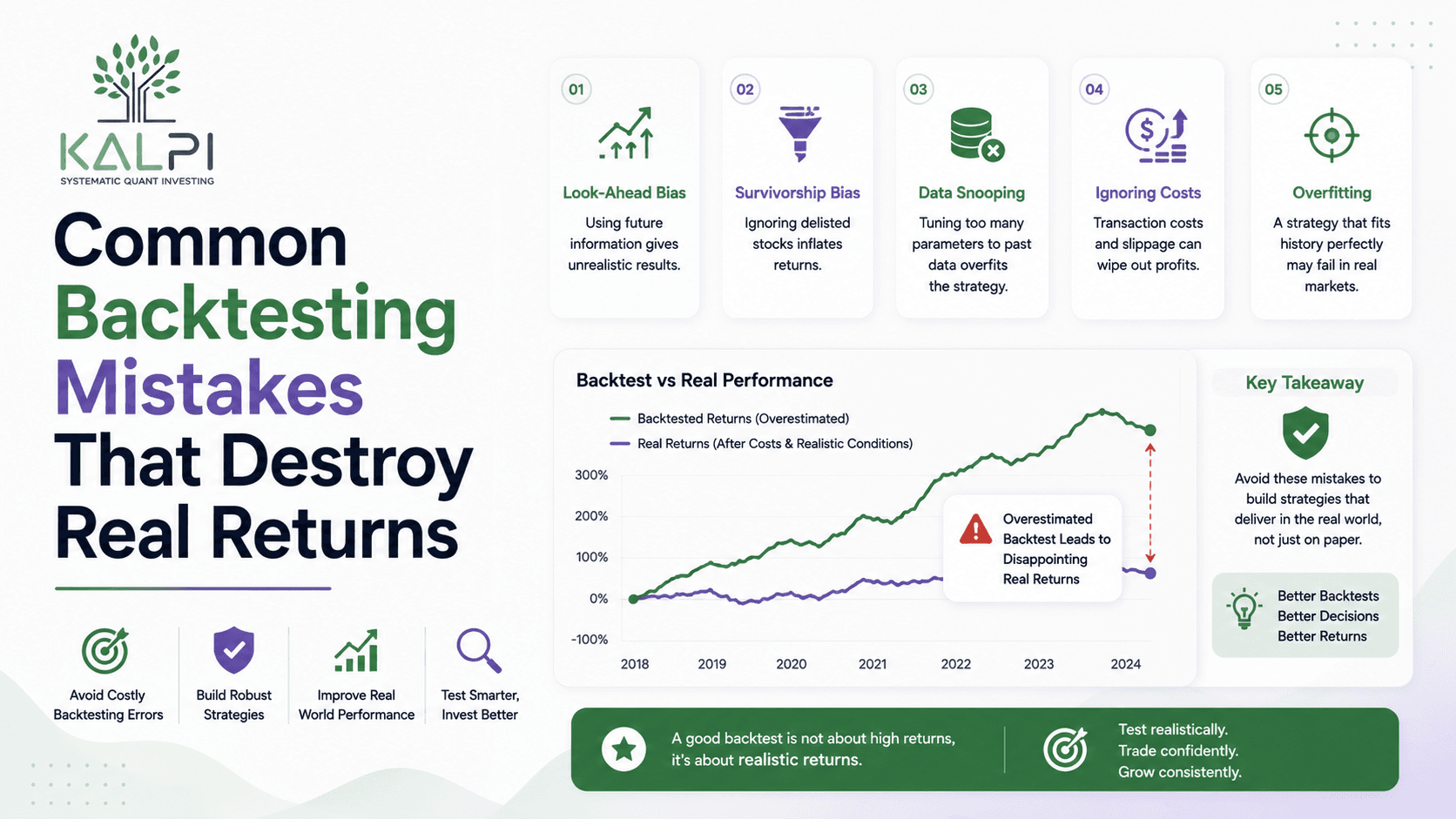
Backtesting helps investors understand how an investment strategy might have performed using historical market data. But even a good strategy can produce misleading results if the testing itself has flaws. Common backtesting mistakes such as survivor bias, look-ahead bias, overfitting, and curve fitting can make a strategy look far stronger than it would actually be in real markets. Get these wrong and a strategy that looks brilliant on paper can lose money the moment you invest real capital.
Why Some Investment Strategies Look Amazing but Fail Later
Imagine buying a pair of running shoes.
You wear them inside the store for a few minutes, walk around comfortably and decide they are perfect. A week later, you take them on a long morning run. Halfway through, your feet begin hurting and you realise the short trial never showed how the shoes would perform in real conditions.
Plenty of strategies look excellent on historical data. Big returns, barely any drawdowns, a curve that just keeps climbing. Then someone actually puts money behind it, and the results rarely match what the backtest promised.
Nine times out of ten, the strategy isn’t the problem. The way it was tested is.
A backtest is only as good as the data, rules and assumptions used to build it. If any one of those is unrealistic, the final result can also become misleading.
What Is Backtesting?
Backtesting is a way of checking how an investment strategy would have performed using historical market data. Instead of investing immediately, investors first apply a set of predefined rules to data from previous years and study the outcome.
For example, an investor may decide to buy companies only when earnings are growing steadily and sell them when that growth begins to slow. Rather than risking money straight away, those rules can first be tested on past market data.
This isn’t about predicting the future with any certainty. It’s about checking whether the process held up reasonably well across different kinds of markets, not just the good ones.
A good backtest can answer questions like:
- How did the strategy perform during bull markets?
- How did it behave during market corrections?
- How often did it generate losses?
- Were the returns consistent over different time periods?
Why Investors Use Backtesting
Nobody wants to invest in a strategy without knowing how it behaved in the past. That’s one reason backtesting has become such a core part of investing.
Markets do not move in a straight line. Some years deliver strong returns. Other years test every investor’s patience. A strategy that performs well during one market phase may struggle during another.
Backtesting lets investors see how the same process would have behaved across different situations, instead of judging it purely on recent performance. But that only works if the testing itself is done properly. Use unrealistic assumptions, incomplete data, or information that wouldn’t actually have been available at the time, and the results stop meaning anything. That’s why experienced investors check the backtest’s data quality before they even look at the returns.

Annual risk sources for a portfolio, broken down by market exposure, factor exposure, and unexplained variance across different years.
A Strong Backtest Is Not Always a Reliable One
Many beginners believe the strategy showing the highest historical return must automatically be the best. That is not always true.
Think about buying a raincoat.
Before paying for it, you decide to test whether it is waterproof. Instead of pouring water over it, you leave it outside on a bright sunny afternoon. By evening, the raincoat is completely dry.
The test was completed. But it never answered the real question.
A strategy can produce outstanding historical returns simply because it was tested under unrealistic conditions. If those conditions do not reflect how markets actually behave, the results create false confidence. Before trusting impressive returns, experienced investors first ask whether the testing itself was fair.
The Biggest Mistake Is Trusting Every Backtest
One of the biggest misunderstandings among new investors is believing that a successful backtest proves a strategy will perform equally well in the future. It does not.
A backtest is simply a tool that helps investors learn from historical data. Economic conditions shift, interest rates move, investor behaviour changes with the mood of the market, which means a strategy that worked well during one period may face very different conditions in the future.
A carefully designed backtest can increase confidence in an investment process. It cannot remove uncertainty.
Why Small Testing Errors Can Create Big Problems
Many backtesting mistakes appear small at first. Some happen because the data is incomplete. Some occur because future information accidentally becomes part of the analysis. Others happen when investors keep changing their strategy until it perfectly matches historical data.
Each one seems minor when you spot it on its own, but put two or three together in the same test and they can quietly rewrite the whole outcome.
A strategy that looks outstanding on paper can perform very differently once it’s live, simply because the original testing had hidden flaws nobody caught in time.
Four Mistakes Every Investor Should Know
Although backtesting errors can appear in many forms, four mistakes are responsible for most misleading results. They are:
- Survivor bias
- Look-ahead bias
- Overfitting
- Curve fitting
Each of these creates a different problem. Some make returns look much higher than they actually were. Some remove losing companies from the analysis. Others quietly use information that investors would never have had access to at the time. Learn to spot all four and it gets a lot easier to tell a genuinely good strategy from one that just got lucky with its testing.
Why Survivor Bias Can Make a Weak Strategy Look Strong
One of the easiest ways to misunderstand a backtest is by looking only at the companies that survived. This mistake is called survivor bias, and it’s more common than most investors realise.
Imagine someone wants to understand how difficult a marathon is. Instead of speaking to everyone who registered, they interview only the runners who crossed the finish line. The people who dropped out because of injuries, exhaustion or poor preparation are completely left out.
Based on those conversations, finishing a marathon would probably seem much easier than it really is.
The same thing can happen during backtesting. Suppose an investor tests a strategy using only companies that are currently part of the Nifty 500. Sounds reasonable enough on the surface, until you notice what’s missing.
The companies that failed, merged, got delisted or shut down over the years are no longer part of today’s index. If those businesses are missing from the historical data, the strategy is being tested on a much stronger group of companies than investors actually had at that time. As a result, the historical returns can look far better than reality.
The strategy isn’t necessarily better than it looks. It’s just been tested on a group of companies that quietly excludes everyone who didn’t make it.
How This Mistake Can Mislead Investors
Markets never stay the same. Some companies turn into industry leaders, others gradually lose customers, struggle financially, or disappear altogether.
When a backtest includes only businesses that survived, investors end up seeing only half the picture.
Think about judging the quality of a school by interviewing only the students who scored above 95 percent. The results would sound impressive. But they would never represent the experience of the entire class.
It’s an incomplete picture dressed up as a complete one.
Using Better Data Makes a Big Difference
Reducing survivor bias starts with using complete historical data. Instead of analysing only the companies that exist today, a proper backtest should include every company that was available during the testing period, even if some of them later disappeared from the market.
This creates a much more realistic picture of how the strategy would actually have performed.
The point isn’t to inflate returns on paper. It’s to find out what the strategy could have genuinely delivered, warts and all.
Lower but believable returns are usually much more valuable than impressive numbers that cannot be repeated in real investing.
What Is Look-Ahead Bias?
Another common backtesting mistake is look-ahead bias. This happens when a strategy accidentally uses information that investors would not have known when making an investment decision.
Imagine watching yesterday’s football match after already knowing the final score. Every pass, every substitution and every tactical decision suddenly looks obvious because you already know how the game ends.
Now imagine making those same decisions while the match is still being played. Suddenly, every decision becomes much more uncertain because you no longer know what happens next.
Backtesting runs into the same problem, just with dates instead of a scoreline. A strategy should only use information that was actually available on that particular day. If future information quietly becomes part of the analysis, the strategy starts making decisions no real investor could have made at the time.
A Simple Example of Look-Ahead Bias
Suppose a company’s quarterly results were officially announced on 25 April. Now imagine a backtest buying that stock on 20 April because those strong earnings are already available in the historical database.
At first glance, everything seems correct. The earnings really did improve. The problem is timing. On 20 April, investors did not know those results. Only after 25 April did that information become public.
By allowing the strategy to act before the announcement, the backtest quietly gives itself knowledge from the future. The strategy starts looking far more successful than any investor could realistically expect.
The strategy appears smarter than it actually is because it’s making decisions using information that didn’t exist at that point in time.
Table 1: Survivor Bias vs Look-Ahead Bias
| Mistake | What Happens | Why It Creates Misleading Results |
|---|---|---|
| Survivor Bias | Failed or delisted companies are removed from historical data. | Historical returns look stronger because weaker businesses are missing from the analysis. |
| Look-Ahead Bias | The strategy uses information that became available later. | Investment decisions become unrealistically accurate because they rely on future information. |
Why These Mistakes Often Go Unnoticed
Neither survivor bias nor look-ahead bias throws up an error message anywhere. The backtest runs fine, the charts look professional, the performance report reads convincingly, and nothing about it looks off unless you already know what to check for.
Most people look at the final returns and stop there, without asking how those numbers were actually generated. It’s worth resisting that urge and checking the historical data and testing process first.
A big number on a chart grabs attention fast. Whether it would survive contact with real money is a different question altogether, and it’s the one most people never bother asking.
Overfitting: When a Strategy Becomes Too Perfect
One of the most misunderstood backtesting mistakes is overfitting. If a strategy keeps showing excellent historical returns, it’s easy to believe it has found the perfect formula.
The problem starts when investors keep changing the rules until the strategy matches historical market data almost perfectly.
Imagine someone is trying to bake a cake. The first attempt is too dry. The second is too sweet. The third is much better. Instead of stopping once they have a reliable recipe, they continue making small changes until the cake turns out perfectly in their own oven.
Later, they share the same recipe with someone else. The result is completely different. The recipe worked perfectly in one kitchen, but it was never tested properly anywhere else.
A strategy that’s been adjusted again and again to match historical data may produce outstanding results during testing. When market conditions change, it often struggles because it has become too dependent on what happened before instead of being flexible enough for what comes next.
What Is Curve Fitting in Investing?
Curve fitting is closely related to overfitting. The difference is small but important.
Curve fitting happens when investors keep modifying a strategy until it follows historical price movements almost perfectly. On paper, the results look outstanding. In real markets, they often disappoint.
Think about drawing a line through several points on a page. A simple line may not touch every point exactly, but it still shows the overall trend. Now imagine bending that line again and again until it touches every single point. It explains the past almost perfectly. But the moment one new point is added, the line no longer works.
Investment strategies behave the same way. Trying to explain every movement in historical data usually creates a strategy that cannot handle future market conditions.
A practical strategy does not need to explain every small movement. It only needs to perform reasonably well across different market environments.
Other Mistakes Investors Often Ignore
Survivor bias, look-ahead bias, and overfitting get most of the attention, and rightly so, but a couple of quieter mistakes can do just as much damage to a backtest.
One common example is ignoring trading costs. Buying and selling shares is rarely free. Brokerage charges, taxes, slippage and other transaction costs reduce actual returns. If these costs are ignored, the strategy may appear much more profitable than it would be in practice.
Another mistake is forgetting about market impact. A strategy that works with a small amount of money may not produce the same results when much larger amounts are invested.
Liquidity also matters. Some companies may not have enough trading volume to allow investors to buy or sell shares at the expected price.
On its own, none of this looks especially serious. Stack two or three of them together in the same backtest, though, and the final numbers stop reflecting anything close to reality.

A backtest is only as reliable as the data feeding it. Clean, well-structured historical data with clear date and return columns is the starting point for any credible test.
Table 2: Common Backtesting Mistakes and Their Impact
| Mistake | What Goes Wrong | Possible Result |
|---|---|---|
| Overfitting | The strategy is adjusted repeatedly to match historical data. | Excellent historical performance but weaker future results. |
| Curve Fitting | The strategy follows past market movements too closely. | Poor adaptability when market conditions change. |
| Ignoring Trading Costs | Brokerage, taxes, slippage and other expenses are excluded. | Actual returns become lower than expected. |
How to Make a Backtest More Reliable
A few simple habits go a long way toward making a backtest more reliable.
- Use complete historical data instead of only successful companies.
- Make sure every investment decision uses information that was actually available at that time.
- Avoid changing the strategy repeatedly just to improve historical returns.
- Include realistic trading costs and taxes wherever possible.
- Test the strategy across different market periods instead of only favourable ones.
- Keep the investment rules simple and easy to understand.
Simple strategies often perform more consistently than complicated ones. If a strategy needs dozens of conditions before making a decision, it may be fitting historical data instead of solving a real investment problem.
It’s also worth testing a strategy on data that wasn’t used while building it, sometimes called out-of-sample testing. If the strategy performs reasonably well during a completely different market period, investors can have greater confidence that the results aren’t based purely on luck.
Final Thoughts
Backtesting is one of the most useful tools available to investors, but only when it’s done carefully. A strategy with impressive historical returns is not automatically a strong investment strategy. The quality of the testing process matters just as much as the final numbers.
Mistakes such as survivor bias, look-ahead bias, overfitting, and curve fitting can all produce results that look much better than what investors are likely to experience in real markets.
Understanding these mistakes does not guarantee investment success. It helps investors look beyond attractive return numbers and understand whether the testing process itself was reliable.
Treat a backtest as one input among several, not the final word, and it earns its place in your research. Trust it blindly and sooner or later you’ll run into the same wall every investor eventually does, the gap between what looked great on paper and what actually happens once real money is on the line.
Frequently Asked Questions
1. What are the most common backtesting mistakes?
Some of the most common backtesting mistakes include survivor bias, look-ahead bias, overfitting, ignoring trading costs and using incomplete historical data.
2. What is survivor bias in backtesting?
Survivor bias happens when historical testing includes only companies that still exist today while ignoring businesses that failed, merged or were delisted.
3. What is look-ahead bias?
Look-ahead bias occurs when a strategy uses information that was not available when the investment decision was actually made.
4. Why is overfitting dangerous?
An overfitted backtest creates a strategy that performs extremely well on historical data but often struggles when market conditions change, because it’s been tailored too closely to past events.
5. Can backtesting predict future returns?
No. Backtesting cannot predict future performance. It helps investors understand how a strategy behaved in the past, but future market conditions may be very different.