


Last Updated: July 2026
If you have been following investing content lately, one term keeps coming up everywhere: algo trading.
Social media is full of claims that algorithms never panic, never get emotional, and can trade while you are asleep. It sounds exciting, especially if you do not have hours to track the market every day.
But before you download the first platform that shows up in your feed, it helps to understand what algo trading actually means and whether it even fits how you invest.
Think of it like buying a scientific calculator for your maths exam. Modern calculators pack in hundreds of functions, yet most students end up using only a handful of them regularly. The calculator is not a bad product. It simply offers more than what most people need.
Algo trading platforms work in a similar way. Some are loaded with advanced tools built for experienced traders. Others keep things simple for people just starting out. The best platform is not the one with the longest feature list. It is the one that matches your knowledge, your goals, and the way you like to trade.
So choosing the best algo trading apps India has to offer is not really about comparing advertisements. It is about finding a platform that helps you trade more efficiently without turning the process into a headache.
In this guide, we compare some of the most popular algo trading platforms available to Indian investors in 2026. Instead of chasing marketing claims, we look at ease of use, features, pricing, flexibility, and who each platform actually suits.
Whether you are completely new to automation or looking for a reliable STRATZY alternative, this guide should help you make a more informed call.
What Is Algo Trading?
Algo trading, short for algorithmic trading, simply means using predefined rules to place trades automatically.
Instead of manually buying or selling every time the market moves, you set up a strategy with specific conditions. For example:
- Buy when Stock A crosses above its 50-day moving average.
- Sell if the price falls by 8%.
- Exit automatically once a predefined target is reached.
Once these rules are set, the software tracks the market and executes trades whenever those conditions are met.
The biggest advantage here is consistency. Unlike us, an algorithm does not get greedy after a winning trade or panic during a sudden correction. It just follows the rules it has been given.
That said, automation cannot fix a weak strategy. If the underlying logic is flawed, the software will simply execute that flawed logic with perfect discipline. Automation improves execution. It does not improve decision-making.
Why Are More Indian Investors Exploring Algo Trading?
Until a few years back, algorithmic trading was mostly the domain of large institutions and professional traders. That is changing fast.
Today, several automated trading India platforms are built specifically for retail investors. Some let you build strategies without writing a single line of code, while others offer ready-made strategies you can test before putting in real money.
A few things have driven this shift:
- Better access to technology
- Faster internet and mobile trading apps
- Easier broker integrations
- Growing awareness through YouTube and investing communities
- More beginner-friendly platforms entering the market
As a result, algorithmic trading is no longer limited to people who know how to code.
Manual Trading vs Algo Trading
Before we get into comparing platforms, it helps to see how automation actually changes the trading process.
| Feature | Manual Trading | Algo Trading |
|---|---|---|
| Trade execution | Done manually | Executed automatically based on predefined rules |
| Emotions | Can influence decisions | Rules stay consistent |
| Speed | Depends on the trader | Usually much faster |
| Time commitment | Needs active monitoring | Needs less day-to-day involvement once set up |
| Best suited for | Investors who want complete control | Investors following systematic strategies |
Neither approach is automatically better. Some experienced investors stick to manual trading because they enjoy reading charts and making every call themselves. Others prefer automation because it removes hesitation and keeps them disciplined.
The right choice really comes down to your personality, your experience, and how you like to invest.
Don’t Believe Every Marketing Claim
A lot of advertisements make algo trading sound effortless. “Set it once and earn while you sleep” is a common pitch.
Reality tends to be more complicated. No trading platform can guarantee profits. Markets keep changing, and even strategies that have been tested thoroughly go through phases of underperformance.
A platform is just a tool. Success still depends on using sensible strategies, managing risk properly, and reviewing performance from time to time.
If a platform promises guaranteed returns simply because it runs on automation, take that claim with a pinch of salt. Reliable platforms focus on helping you execute your strategy efficiently. They do not promise that every strategy will make money.
What Makes a Good Algo Trading Platform?
Picking the right platform is not about finding the one with the most features. For most retail investors, simplicity matters just as much as functionality.
A good platform should make it easier to create, test, and manage strategies without turning the whole process into a chore. Some of the factors worth comparing include:
- Ease of use
- Backtesting capabilities
- Broker integration
- Strategy marketplace
- Pricing
- Risk management tools
- Customer support
- Flexibility for both beginners and experienced traders
These factors usually matter far more to your overall experience than flashy ads or a viral video on social media.
In the next section, we compare Kalpi, STRATZY, and other leading algo trading platforms to see where each one does well, where it falls short, and which type of investor it suits best.
Comparing the Best Algo Trading Apps in India
Now that we have covered what algo trading actually means, the real question is more practical: which platform should you use?
There is no single platform that works for everyone. A beginner looking to automate a couple of simple strategies has very different needs from an experienced trader running multiple strategies across brokers. Some investors want ready-made strategies they can start using right away. Others want the freedom to build and customise their own system from scratch.
That is why comparing features alone rarely tells the full story. A platform might come with hundreds of indicators and advanced tools, but if the interface feels confusing, most beginners will never touch half of them. On the other hand, a platform that is too simple can start feeling limiting as your experience grows.
The best platform is the one that fits your current needs while still leaving room to grow.
What Should You Compare Before Choosing an Algo Trading Platform?
Many investors compare platforms purely on subscription fees or the number of features listed on the website. Those things matter, but they should not be the only deciding factors.
A good platform should make trading easier, not more complicated. Before signing up anywhere, it helps to compare these practical factors:
- Ease of use
- Strategy creation options
- Backtesting capabilities
- Broker integration
- Risk management tools
- Pricing
- Customer support
- Suitability for your investing style
Keeping these points in mind makes it much easier to compare platforms objectively instead of getting swayed by marketing claims.
1. Kalpi
Kalpi takes a slightly different route compared to most traditional algo trading platforms.
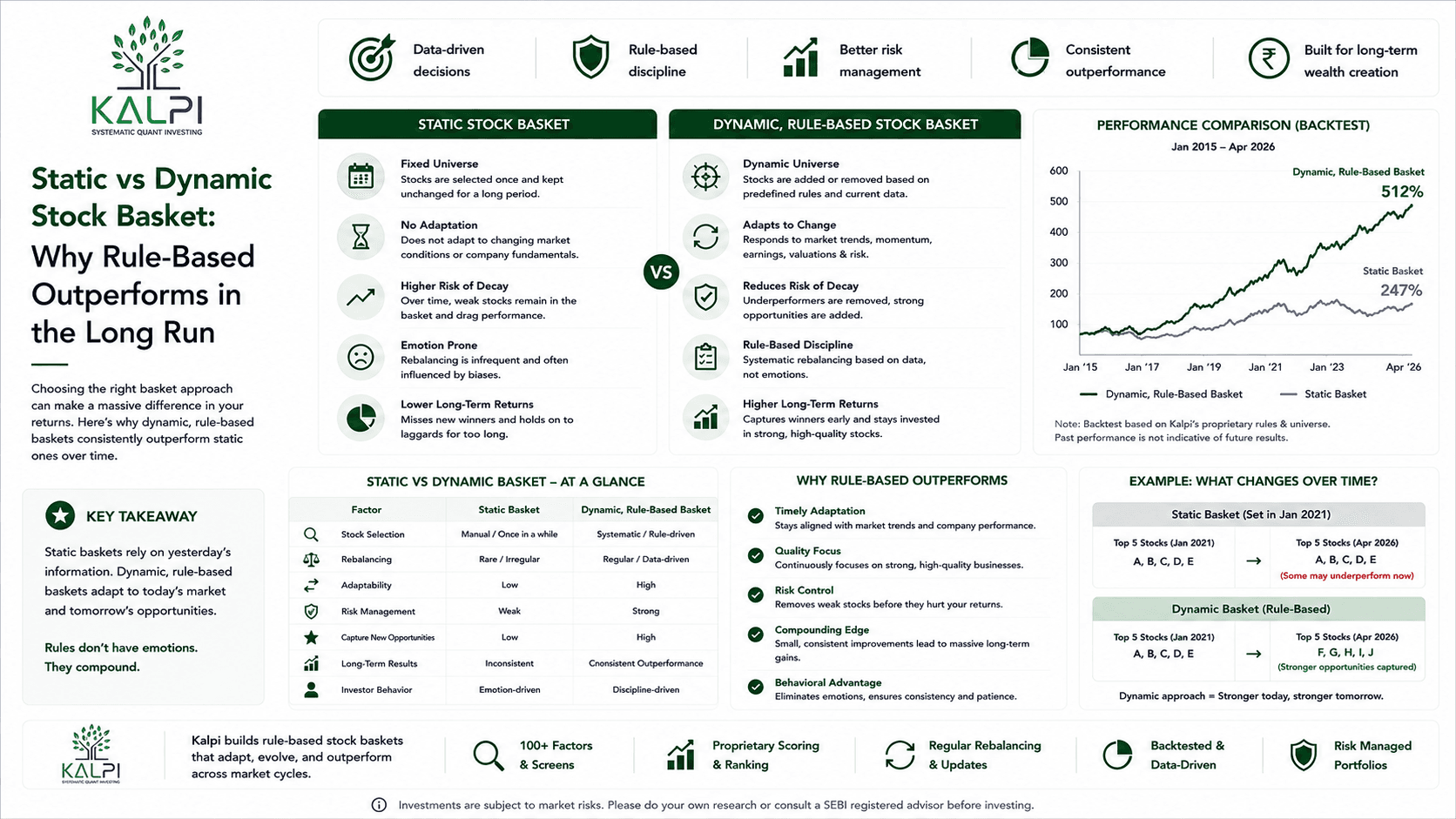
Instead of focusing purely on automated trade execution, it emphasises rule-based investing through professionally managed stock baskets. The idea is to help investors follow a disciplined investment process rather than making emotional buy and sell calls.
For long-term investors, this approach tends to feel more practical than constantly building and testing trading algorithms.

Kalpi may suit you if you:
- Prefer investing over active trading
- Want diversified stock baskets
- Like rule-based portfolio management
- Do not want to learn coding
- Want a simpler investing experience
That said, traders looking for highly customised intraday automation with dozens of technical conditions may find dedicated algo trading platforms more suitable for that purpose.

2. STRATZY
STRATZY has built a name for itself by giving retail investors access to ready-made trading strategies.
Instead of creating every strategy from scratch, users can browse existing ones and decide whether they match their own trading style and risk appetite. For beginners, this cuts down the learning curve significantly.
At the same time, it is worth remembering that no ready-made strategy guarantees profits. Every strategy behaves differently across different market conditions. Using one without understanding how it actually works can lead to expectations that do not match reality.
3. Streak
Streak is one of the better-known algo trading platforms for investors who want to automate trading without touching a single line of code.
Its visual strategy builder makes setting up trading rules fairly straightforward. You can also backtest strategies against historical data before taking them live.
For a lot of retail investors, Streak ends up being their first real introduction to automated trading, mainly because of how beginner-friendly the interface is. It works particularly well for traders who enjoy technical analysis but would rather skip the programming side of things.
4. Tradetron
Tradetron offers considerably more flexibility than most beginner-focused platforms.
It supports advanced automation, multi-leg strategies, and integrations across multiple brokers. That flexibility, however, comes with a steeper learning curve.
Someone completely new to algo trading might find the platform a bit overwhelming at first. Experienced traders, on the other hand, tend to appreciate the extra control and customisation it offers. As your trading requirements get more sophisticated, platforms like Tradetron can offer capabilities that simpler platforms simply cannot match.
5. Other Algo Trading Platforms
The Indian market keeps seeing new automation platforms enter the space. Some focus on quantitative investing. Others specialise in options trading, while a few are built around specific brokers.
Instead of chasing every new platform that launches, it makes more sense to first decide what you actually want to automate. A simple strategy followed consistently often does better than a complicated one that becomes hard to manage.
Comparing Popular Algo Trading Platforms
| Platform | Best For | Coding Required | Backtesting | Ready-made Strategies | Beginner Friendly |
|---|---|---|---|---|---|
| Kalpi | Rule-based investing and stock baskets | No | Basket-based approach | Yes | Yes |
| STRATZY | Strategy marketplace | No | Yes | Yes | Yes |
| Streak | Technical strategy building | No | Yes | Limited | Yes |
| Tradetron | Advanced automated trading | No | Yes | Yes | Moderate |
| Other platforms | Specialised strategies | Varies | Usually available | Varies | Depends on platform |
Price Shouldn’t Be Your First Filter
A lot of investors compare platforms purely by looking at subscription costs. That approach can be misleading.
Think about buying running shoes. A professional marathon runner and someone who takes a short evening walk do not need the same pair. Going for the cheapest option might save money today, but it may not give you what you actually need.
Algo trading platforms work the same way. Paying for advanced features you will never use adds unnecessary cost. Choosing an overly basic platform when your needs are growing can get frustrating down the line.
Instead of asking “Which platform is the cheapest?”, it helps to ask “Which platform matches the way I invest?” That question usually leads to a far better decision.
Questions to Ask Before Choosing Any Platform
Before signing up for any platform, run through a few simple questions:
- Am I investing or actively trading?
- Do I want ready-made strategies or prefer building my own?
- Will I actually use the advanced features?
- Does the platform support my broker?
- Can I test strategies before using real money?
- Is the pricing reasonable for how often I trade?
- Will this platform still meet my needs a year from now?
Answering these often makes the decision far clearer than scrolling through long feature lists.
The biggest mistake beginners make is assuming more features automatically mean a better platform. In reality, the best platform is the one that keeps your investing process simple, disciplined, and easy to follow.
Should You Actually Use Algo Trading?
After comparing different platforms, one question still remains: should you actually start using algo trading?
The answer depends less on the platform and more on how you invest. A lot of people assume automation is the natural next step for every investor. That is not always true.
Picture buying a fully automatic coffee machine when all you drink is one cup of tea every morning. The machine might look impressive with its dozens of features, but most of them would never get used.
Algo trading platforms can be similar. Some investors genuinely benefit from automation, while others end up paying for features they barely touch. The best platform is not the one with the longest feature list. It is the one that fits your investing style, experience, and financial goals.
When Algo Trading Makes Sense
Automation can genuinely make investing easier for certain people. It may suit you if:
- You follow a rule-based investment process
- You struggle to monitor markets through the day
- You want to cut down emotional decision-making
- You regularly use technical strategies
- You prefer consistency over making manual calls every single day
In these cases, automation becomes a tool that supports discipline rather than replacing it.
When You Probably Don’t Need It
Not every investor benefits from automated trading. You may not need an algo trading platform if you:
- Invest monthly through SIPs
- Mainly buy quality businesses for the long term
- Rarely trade
- Are still learning the basics of investing
- Enjoy analysing businesses more than charts
There is nothing wrong with sticking to a manual approach if it already works for you. Automation should solve a problem. It should never become the goal itself.
Common Myths About Algo Trading
Algorithmic trading has become popular, and along with that popularity have come a few misconceptions.
Myth: Algo trading guarantees profits.
Reality: Automation only follows the rules you give it. If the strategy is weak, the software will simply execute that weak strategy with more efficiency.
Myth: Only professional traders can use algo trading.
Reality: Many modern platforms are built specifically for retail investors and do not require any coding knowledge.
Myth: More automation always leads to better returns.
Reality: Good investing still depends on strategy, discipline, and risk management. Automation improves execution, not the quality of the investment decision itself.
Common Mistakes Beginners Make
One reason some investors get disappointed with algo trading is that they expect the software to do all the thinking for them. That rarely works out.
Choosing a platform before learning investing basics
Many beginners spend more time comparing platforms than actually understanding markets. No platform can make up for a lack of investment knowledge.
Running too many strategies
Testing every strategy available on a platform usually creates confusion rather than better performance. Starting with one simple strategy is almost always the smarter approach.
Ignoring risk management
Even the smartest algorithm cannot protect a portfolio if position sizing and risk management are ignored.
Expecting quick profits
Markets do not get easier simply because trading has been automated. Every strategy goes through periods of strong performance as well as periods of underperformance.
Features That Actually Matter
Many platforms advertise long lists of features, but most investors end up using only a small percentage of them.
Instead of asking how many features a platform offers, it helps to ask:
- Is the platform easy to understand?
- Can I test strategies before using real money?
- Does it support my broker?
- Is the pricing reasonable?
- Does it offer good customer support?
- Will I still be comfortable using it after six months?
These practical questions usually matter far more than an impressive marketing page.
Choosing the Right Platform
Different investors need different tools.
| Investor Type | Platform Style That May Suit Them |
|---|---|
| Beginner investor | Simple, beginner-friendly platform |
| Long-term investor | Rule-based investing platforms like Kalpi |
| Technical trader | Strategy-building platforms like Streak |
| Experienced trader | Advanced automation platforms like Tradetron |
| Investors exploring ready-made strategies | STRATZY or similar marketplaces |
This comparison should not be treated as a fixed recommendation. Your ideal platform depends on your investment goals, trading frequency, and level of experience.
Don’t Let Automation Replace Learning
One of the biggest advantages of manual investing is that it helps you understand how markets actually behave. Automation should build on that knowledge, not replace it.
Understanding why a strategy works is far more valuable than simply switching it on. Many successful investors combine both approaches. They learn how markets work first, and then use technology to execute their investment process more consistently.
That combination usually produces better long-term results than depending entirely on software.
Final Thoughts
Searching for the best algo trading apps India offers is a good place to start, but choosing a platform should never be the final goal.
The bigger question is whether automation actually improves the way you invest. Some investors benefit greatly from predefined rules and systematic execution. Others are perfectly comfortable managing a simple long-term portfolio without any automation at all. Neither approach is automatically better.
The objective is not to use the most advanced software available. The objective is to build an investment process that is disciplined, practical, and sustainable over the long term.
If you are comparing different algo trading platforms, focus less on flashy features and more on practical usability. Ask yourself:
- Does this platform match my investing style?
- Will I actually use its features?
- Does it make investing simpler?
- Will it help me stay disciplined during different market conditions?
Technology will keep evolving, and new platforms will keep entering the Indian market. The fundamentals of successful investing, however, stay exactly the same: patience, discipline, risk management, and continuous learning.
A good platform can make your investing process more organised and efficient, but it cannot replace good judgment. The best long-term results usually come from combining sound investment principles with technology that genuinely fits your needs.
Frequently Asked Questions
Which is the best algo trading app in India?
There is no single best platform for everyone. The right choice depends on your investing style, trading frequency, experience, and how much automation you actually want.
Do I need coding knowledge for algo trading?
No. Many modern algo trading platforms let investors build, test, and deploy strategies without writing any code.
Is algo trading legal in India?
Yes. Algorithmic trading is legal in India when it is conducted through authorised brokers and in line with applicable SEBI regulations.
Can beginners use automated trading platforms?
Yes, but beginners should first get comfortable with investing basics and risk management before leaning on automation.
Is algo trading better than manual trading?
Neither approach is universally better. Manual trading gives you more flexibility, while automation offers consistency. The better choice depends on your investment objectives and experience level.