

Last Updated: July 2026
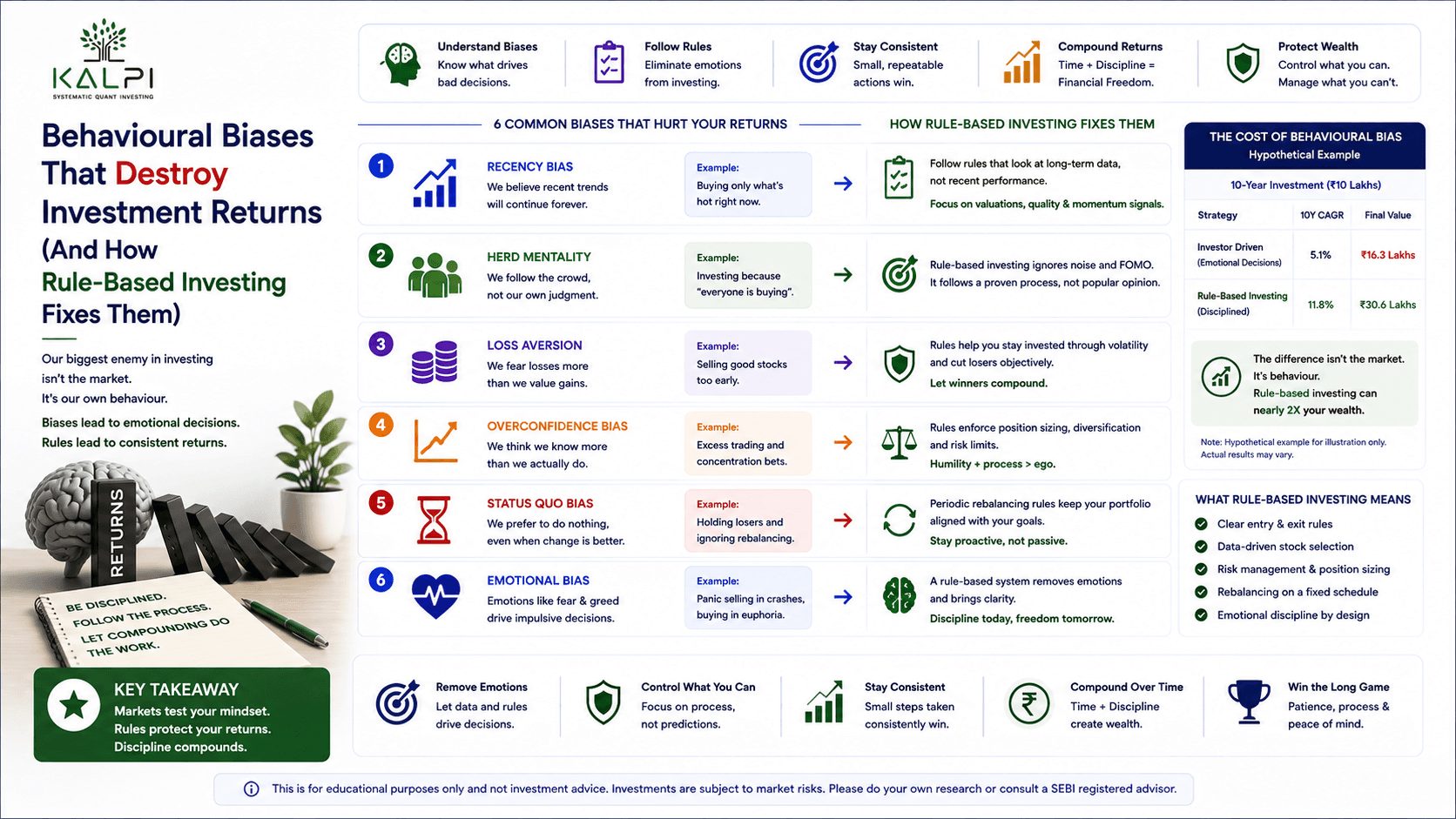
Behavioural biases in investing are common thinking errors that influence the way people buy, sell and hold investments. These biases often lead investors to make emotional decisions instead of rational ones. Understanding them, and following a rule-based approach, can help investors stay consistent and avoid costly mistakes over the long run.
Imagine you’re driving home after work during peak traffic. The lane next to you suddenly starts moving faster, so you switch. A few seconds later, your old lane begins moving while your new lane comes to a standstill. Frustrated, you switch again, only to watch the same thing happen.
Most of us have experienced this at least once. The funny part is that constantly changing lanes often doesn’t get you home any faster. It only makes the journey more stressful.
Investing works in a surprisingly similar way. Many investors keep chasing whatever looks better at the moment. They buy stocks after a rally because everyone else seems excited, then sell after a market fall because they fear prices will keep falling. Instead of following a clear plan, they keep changing direction based on emotions.
These reactions may feel natural, but they are often driven by behavioural biases that influence how we think about money and risk. Understanding these biases is one of the biggest differences between investing and gambling. Markets move every day, but the biggest challenge usually isn’t the market itself. It’s the way we react to those movements.
What Are Behavioural Biases in Investing?
Behavioural biases are predictable thinking errors that affect the way people make financial decisions. Human beings are not perfectly logical. We often rely on emotions, past experiences and mental shortcuts to make quick decisions. While these shortcuts can be useful in everyday life, they become expensive when money is involved.
Imagine touching a hot pan. Your brain immediately tells you to pull your hand away. That instinct protects you from getting hurt. The stock market, however, does not reward every emotional reaction.
Sometimes the best investment decision is to stay patient when prices fall. Sometimes it is to avoid buying simply because everyone else is buying. These choices often feel uncomfortable because our brains are wired to seek safety, avoid regret and follow the crowd. That is where behavioural biases begin to influence investing.
Why Our Brain Struggles With Investing
Thousands of years ago, quick decisions helped humans survive. If early humans heard a loud noise in the forest, stopping to analyse every possibility could have been dangerous. Acting immediately increased the chances of survival.
The stock market is completely different. Prices rise, fall and recover over time. A sudden market decline is rarely a life-threatening emergency, yet our brain often reacts as though it is.
That explains why investors panic during corrections, chase stocks after strong rallies, and hesitate to buy quality businesses when prices become attractive. This is what makes investing so challenging. Many of the decisions that improve long-term returns feel uncomfortable in the moment. Staying invested during a market fall, ignoring market noise or refusing to chase a popular stock rarely feels easy, but those decisions often lead to better outcomes over time.
This is one of the reasons experienced investors prefer following a disciplined process instead of relying on emotions. A clear set of rules helps remove impulsive decisions and brings consistency, especially during periods of uncertainty.
The Five Biases That Quietly Erode Your Returns
Anchoring Bias
One of the most common behavioural biases in investing is anchoring bias. Anchoring happens when investors become attached to a particular number and continue using it as a reference, even when circumstances have changed.
Suppose you bought a stock at ₹500. A few months later, it falls to ₹380. Instead of asking whether the company is still a good investment, your mind keeps returning to ₹500. You tell yourself:
“I’ll sell only after it comes back to my buying price.”
The market, however, has no idea what price you paid. A stock’s future depends on its business performance, earnings, valuation and overall market conditions, not on the number sitting in your portfolio.
Anchoring causes investors to make decisions based on past prices instead of present facts. Experienced investors try to focus on what the business looks like today rather than the price they happened to pay months or even years ago.
Recency Bias
Another common behavioural biases investing mistake is recency bias. Recency bias happens when investors give too much importance to recent events while overlooking the bigger picture.
Think about the weather during summer. After several days of intense heat, it can feel as though the weather will stay the same for months. Then the monsoon arrives, bringing a completely different situation. What seemed permanent turned out to be temporary.
The stock market behaves in a similar way. After months of rising prices, many investors begin to believe the market will keep moving higher. During a correction, the opposite happens: falling prices make it seem as though the decline will continue for a long time. Neither assumption tells the complete story.
Markets move in cycles. Strong rallies are followed by quieter phases, and corrections are often followed by recoveries. Investors who focus only on recent performance may end up buying after prices have already risen sharply, or selling after a temporary decline. Looking at long-term business performance instead of short-term market movements helps investors make more balanced decisions.
Loss Aversion
Among all behavioural biases, loss aversion is one of the strongest. People naturally find it harder to accept a loss than to enjoy an equivalent gain.
Imagine caring for a plant at home. One branch starts drying up while the rest of the plant remains healthy. Instead of accepting that the branch may not recover, many people continue focusing all their attention on it, hoping things will improve.
Investing often follows the same pattern. Some investors continue holding weak companies simply because selling would make the loss feel real. Instead of asking whether the business still deserves a place in the portfolio, they keep waiting for the price to return to where they bought it. At the same time, they may sell good investments too early because they worry about losing the profits they have already earned.
Over time, this can leave a portfolio filled with weaker businesses while stronger companies are removed too soon. Successful investing is not about avoiding every loss. It is about making decisions based on the company’s current fundamentals rather than the emotions attached to past gains or losses.
Herd Behaviour
People often feel more comfortable doing what everyone else is doing. Imagine walking through a busy market where two food stalls sell similar dishes. One has a long queue while the other has only a few customers. Without knowing anything about either stall, many people naturally join the longer line because they assume it must be the better choice.
The stock market often works the same way. When a particular stock or sector starts making headlines, investors rush in because they see others making money. Gradually, careful research takes a back seat while the fear of missing out starts driving decisions.
History has shown that many market bubbles grew because investors followed popularity instead of business fundamentals. Before investing, it helps to pause and ask one simple question:
“Would I still invest in this company if nobody else was talking about it?”
That single question can often separate independent thinking from crowd behaviour.
Confirmation Bias
Confirmation bias happens when investors look only for information that supports what they already believe. Suppose you are planning a holiday and have almost decided on a destination. Without realising it, you spend more time reading positive reviews than negative ones. By the time you finish your research, you feel even more confident because you have mainly seen information that agrees with your choice.
The same thing happens in investing. Once investors become convinced about a company, they often read only favourable news, follow optimistic opinions and pay less attention to information that raises concerns. As a result, they build confidence without seeing the complete picture.
Good investing requires the opposite approach. Instead of searching only for reasons to invest, it helps to actively look for reasons that could challenge the investment idea. Considering both positive and negative information usually leads to more balanced decisions.
Why These Biases Are Difficult to Eliminate
Many people believe that experience alone removes behavioural biases. In reality, even experienced investors feel fear during market declines and excitement during strong rallies. The difference is not that they stop feeling emotions. The difference is that they rely on a disciplined investment process instead of reacting to every market movement.
Many professional investors use investment frameworks, checklists and predefined rules because they know emotions become stronger when markets are volatile. The objective is not to eliminate emotions. It is to stop emotions from making investment decisions.
How Rule-Based Investing Helps
One practical way to reduce the impact of behavioural biases is to follow a rule-based investing approach. Instead of reacting to news headlines or market sentiment, investors follow a predefined investment process.
For example, the process may define:
- Which companies qualify for selection
- Which financial factors should be evaluated
- How much weight each investment should receive
- When the portfolio should be reviewed or rebalanced
- Under what conditions a stock should be replaced
Because these decisions are guided by clear rules instead of emotions, investors are less likely to make impulsive decisions during periods of market volatility.

A rule-based strategy defines the universe, filters, ranking criteria and weighting method upfront, removing emotion from stock selection.
A rule-based approach cannot remove investment risk, and it does not guarantee better returns. What it does provide is consistency. Instead of asking, “How do I feel about the market today?”, the process asks, “Do the investment rules still support this decision?” Over the long run, that shift in thinking can help investors make more disciplined and rational decisions.
Common Mistakes Investors Make
Behavioural biases often influence investment decisions without investors even noticing. The tricky part is that these decisions usually feel sensible at the time because emotions can be very persuasive.
Some investors buy a stock simply because it has been performing well recently. Others continue holding a weak investment because they don’t want to accept a loss. Many look only for opinions that support what they already believe, while ignoring information that challenges their view.
Another common mistake is reacting to short-term market movements instead of asking whether the company’s fundamentals have actually changed. On their own, these decisions may not seem significant. Repeated over many years, however, they can quietly reduce long-term investment returns.
How Investors Can Reduce Behavioural Biases
Behavioural biases are a part of human decision-making, so eliminating them completely isn’t realistic. What investors can do is build habits that make emotional decisions less likely. A few practical steps can help:
- Write down the reason for buying a stock before investing
- Review investments at planned intervals instead of reacting to every market movement
- Read opinions that disagree with your own, not just those that support it
- Revisit the original investment thesis whenever you’re considering buying or selling
- Follow a consistent investment process instead of reacting to headlines or market noise
These habits won’t prevent every mistake, but they can make decisions more thoughtful and consistent over time.
Why Rule-Based Investing Makes a Difference
Every investor eventually faces situations that test patience. A sharp market correction, a stock making new highs every week, or constant news about the economy can easily influence decision-making. During such periods, emotions often become louder than logic.
This is where a rule-based investing approach becomes valuable. Instead of making decisions based on fear or excitement, investors rely on predefined rules for selecting, reviewing and replacing investments. The focus stays on whether the investment still meets the criteria, not on how the market feels on a particular day.

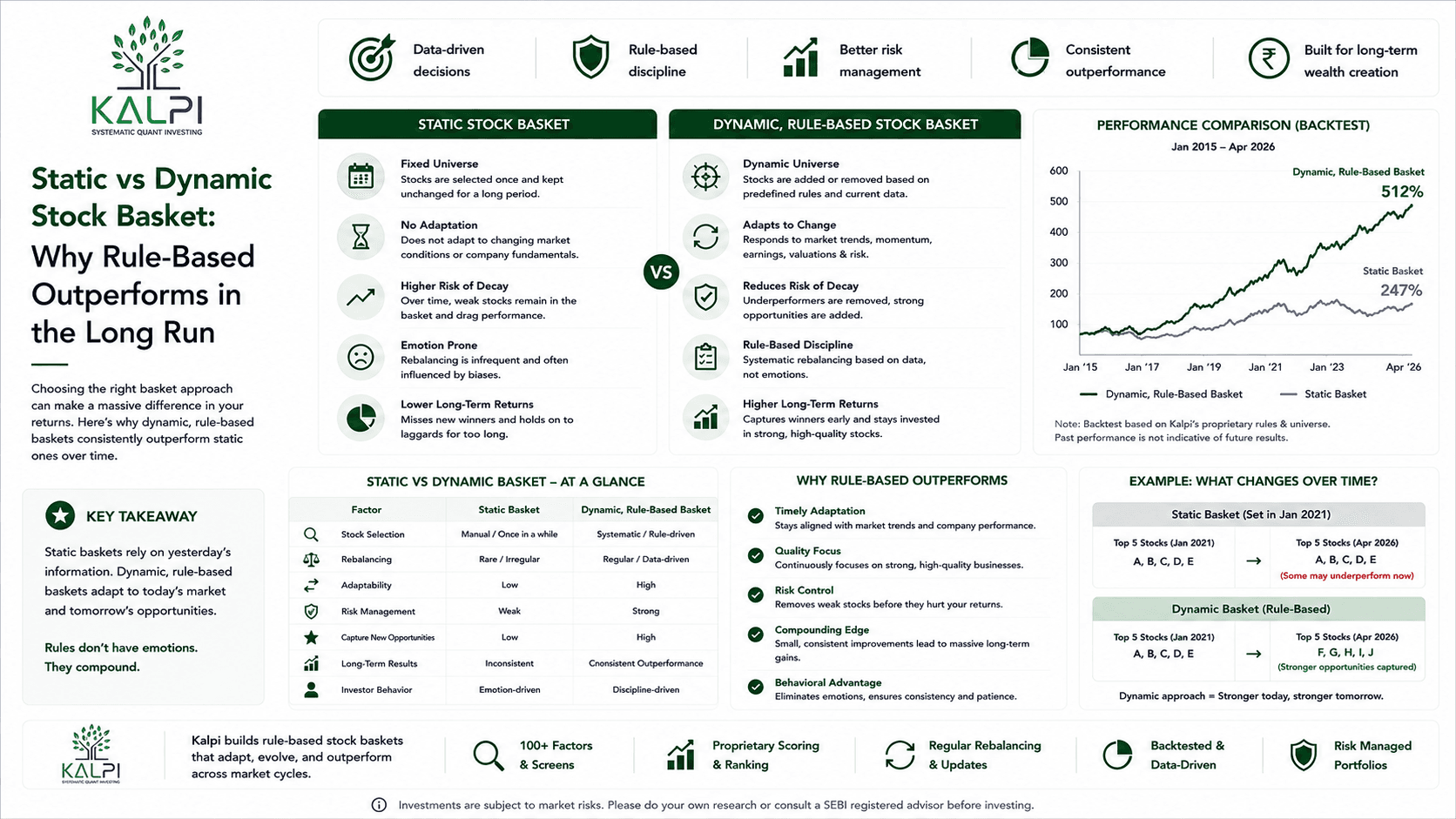
Staying disciplined through market cycles, rather than reacting to every swing, is what compounds into long-term outperformance.
A structured process cannot prevent market declines, nor can it guarantee better returns. What it can do is reduce impulsive decisions that often hurt long-term performance. Over time, consistency usually proves far more valuable than constantly reacting to short-term market movements.
Final Thoughts
Behavioural biases are part of human nature. Every investor experiences them, whether they are new to the market or have decades of experience. The difference is not who feels fear, excitement or uncertainty. The difference is how those emotions influence investment decisions.
Understanding behavioural biases investing helps investors recognise common thinking errors such as anchoring bias, recency bias and loss aversion before they affect a portfolio. While no investment strategy can remove emotions completely, a disciplined, rule-based approach can reduce their influence and encourage more consistent decision-making.
Investors cannot control what the market does next. They can, however, control how they respond to it. Over the long run, that difference often has a much greater impact than trying to predict the market’s next move.
Frequently Asked Questions
What are behavioural biases in investing?
Behavioural biases are mental shortcuts that influence investment decisions. They often lead investors to react emotionally instead of making decisions based on facts and analysis.
What is anchoring bias in investing?
Anchoring bias occurs when investors become attached to a particular price, usually the price at which they bought a stock, and continue using it as a reference even after the company’s fundamentals have changed.
What is recency bias in the stock market?
Recency bias is the tendency to give more importance to recent market events than to long-term trends. This can lead investors to make decisions based on short-term movements rather than a company’s overall performance.
How does loss aversion affect investment decisions?
Loss aversion makes investors feel the pain of losses more strongly than the satisfaction of gains. As a result, they may hold underperforming investments for too long or sell profitable ones earlier than they should.
How does rule-based investing help reduce behavioural biases?
Rule-based investing follows predefined investment criteria instead of emotions or market sentiment. While it cannot eliminate risk, it can reduce impulsive decisions and help investors remain consistent over the long term.